


Image Source: Unsplash
I spent most of my weekend analyzing charts, but one stopped me cold. Usually when I review 10-15 different setups, I highlight each one. This time I said: this is the only one that matters.
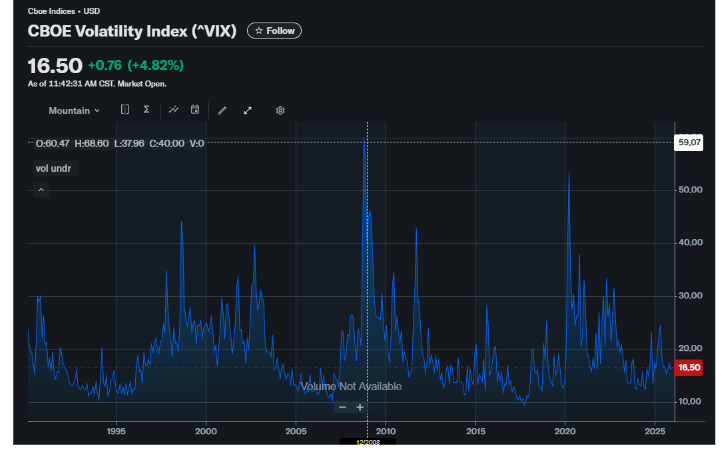
You're looking at the S&P 500 volatility index dating back to 1990. And what it reveals should terrify anyone trying to trade with traditional market logic.
From 1990 to 2011, the VIX had never pulled back by 40% over a 10-day window. Never.
Not during the dot-com crash. Not during 2008. Not after 9/11.
It's happened six times in the last 12 months.
Welcome to the Policy-Managed Market
Here's what's actually happening: we're not trading markets anymore. We're trading policy responses.
Every rapid VIX collapse you've witnessed represents the same thing - central bank intervention functioning as a volatility circuit breaker. Japan's carry trade guidance. The Fed's repo standing facilities. Treasury duration management. Bank reserve preservation.
Each action prevents natural market volatility from developing. The result? Violent whipsaw events where fear spikes then gets artificially suppressed within days.
This is the new normal. And something I talk a lot about during my livestreams.
Why Your Traditional Analysis Is Worthless
When policy makers actively prevent volatility from expressing naturally, every traditional signal breaks down. You can't read fear levels when fear gets circuit-breaked by policy. You can't gauge true market stress when stress gets liquidity-managed in real time.
The Fed is about to purchase $40 billion in Treasury bills through mid-next year, targeting $400-450 billion total. China's expected to add stimulus. One last big pump is coming, and the question isn't whether - it's where does all that money go?
The Liquidity Flow Map
Money is already rotating exactly where policy intervention creates the path of least resistance:
Banking stocks are ripping because when Western central banks pump money into the system, financialized economies see bank stocks rise. Every single time.
AI money is fleeing to financials not because of fundamentals, but because anticipated Fed regime change under Walsh or Hassett emphasizes different sectors.
Silver is climbing toward levels that will force cash settlement for banks that have been hedging - JP Morgan just moved their physical desks to Singapore overnight like the Baltimore Colts leaving in 1983.
This isn't natural market rotation. This is capital desperately seeking anywhere policy intervention creates stability.
The Real Circuit Breaker
Which brings me to my bathroom floor revelation about Bitcoin.
After a back spasm left me contemplating life on my bathroom tiles for two hours, I realized we might all be wrong about what Bitcoin actually is. Not whether it's money or a hedge or a bubble - but why the system allows this thing to exist and violently fluctuate without intervention.
Bitcoin converts monetary excess into volatility rather than social stress.
When government monetizes debt, that money has to flow somewhere. It can't go into food prices - people riot. Can't flow into energy - inflation spirals. Can't flood housing - social cohesion breaks. Can't surge into wages - policy tightening follows violently.
Every other asset affects daily life and voting behavior.
Bitcoin is economically quiet but financially loud. It absorbs liquidity size quickly, sits outside consumer price indexes, doesn't stress balance sheets, has supply that doesn't respond to demand, and works globally without permission.
It's the perfect drain pipe for policy-driven liquidity because there are no immediate real-world consequences to its movement.
The Policy Arbitrage
Understanding this regime change creates specific opportunities:
When you see rapid VIX spikes followed by policy announcements, position for the artificial suppression that follows. Don't fight the circuit breakers.
When massive liquidity injections are announced, allocate to assets that absorb size without political consequences - Bitcoin, gold, banking stocks in financialized economies.
When policy makers signal regime changes, follow the money flows they create rather than fighting fundamental logic that no longer applies.
The transportation stocks are signaling Dow movement toward all-time highs. Regional banks like SNV are breaking higher on liquidity expectations. Consumer staples in the XLP are positioned for anticipated rate cuts that relieve consumer pressure.
None of this is natural market behavior. All of it is policy arbitrage.
The Bottom Line
Markets don't express natural volatility anymore because policy makers won't let them. Understanding this isn't about predicting where markets "should" go - it's about following where policy forces them to go.
The VIX chart proves we're in uncharted territory where traditional fear gauges get managed by intervention rather than market forces. The smart money isn't fighting this new reality - they're arbitraging the predictable policy responses.
Every road points to more monetary expansion. Position accordingly.
More By This Author:
Things I'm Thinking About This WeekCME Blackout, And How The Game Actually Works
Charts And The Week Ahead



Comments
Log in or sign up to join the conversation.