

The good news is:
- Seasonality suggests a pretty rough month ahead; creating a buying opportunity near the end of this month.
The Negatives
The first chart covers the last 6 months showing the Nasdaq composite (OTC) in blue and a 10% trend (19 day EMA) of Nasdaq new highs (OTC NH) in green. Dashed vertical lines have been drawn on the 1st trading day of each month.
OTC NH continued moving downward..
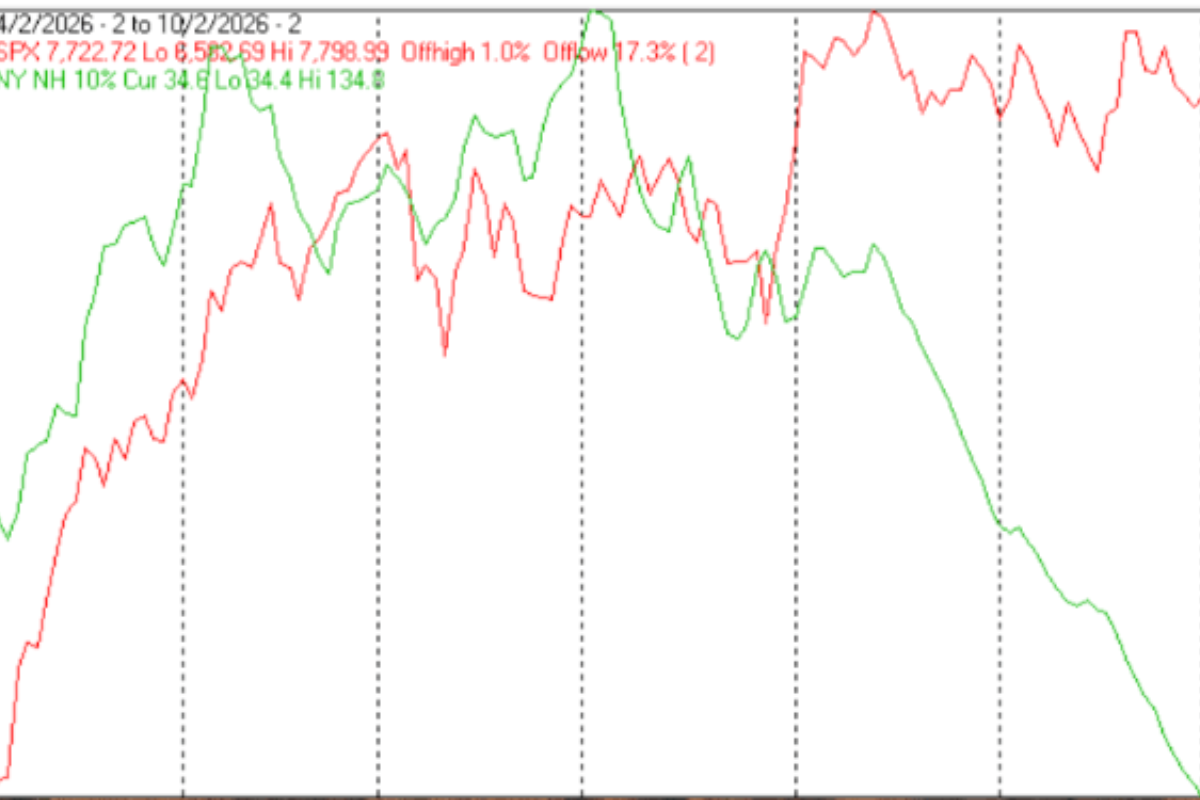
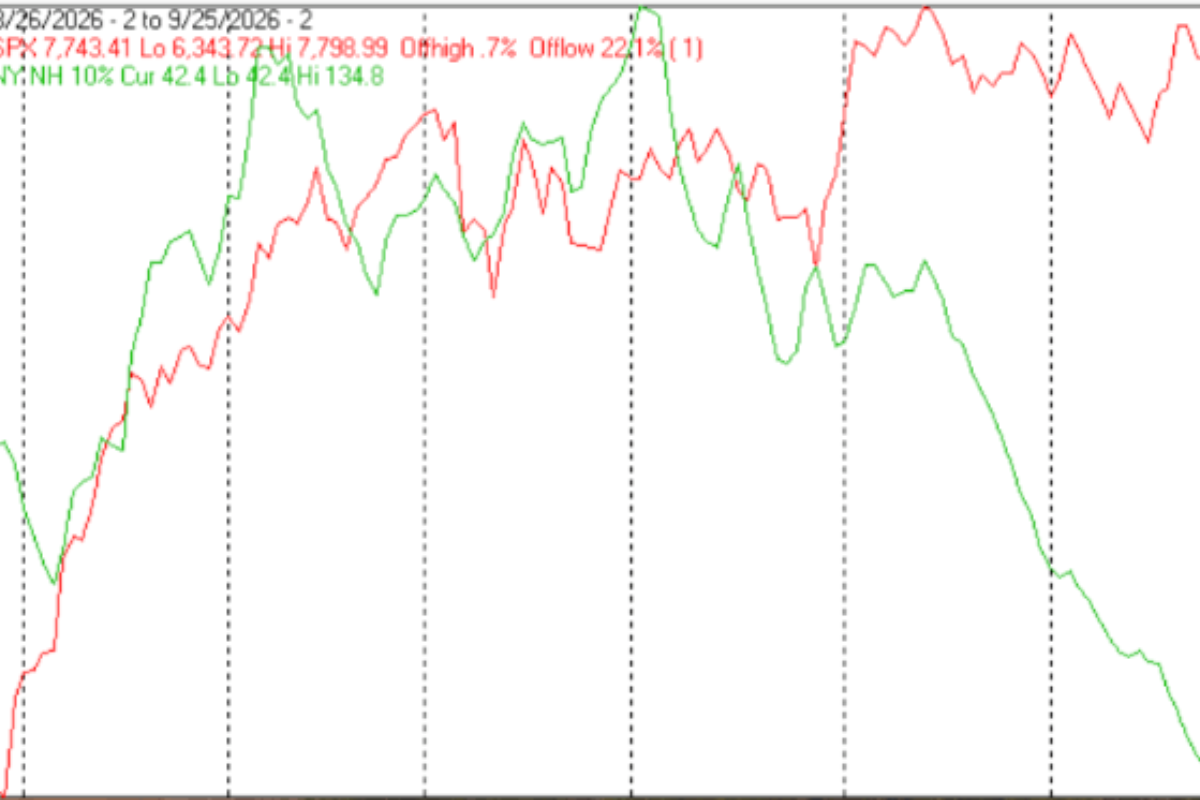
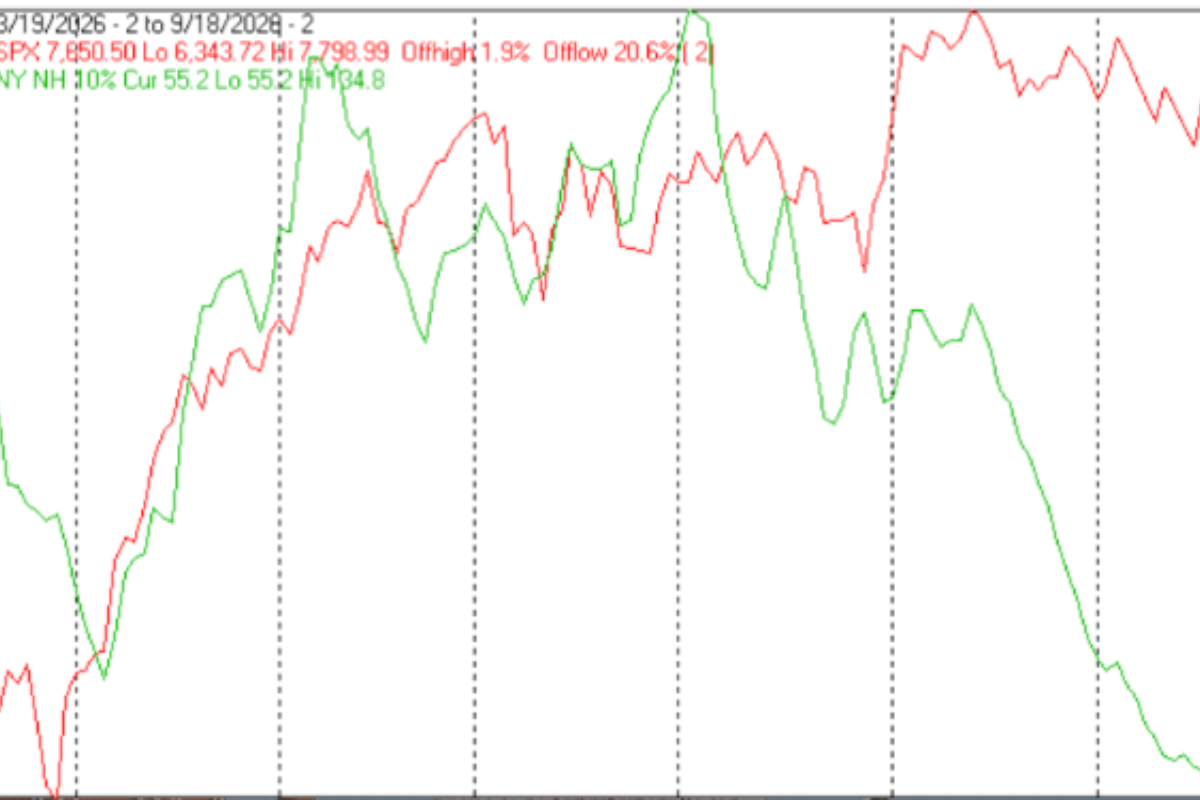
The next chart is similar to the one above except it shows the S&P 500 (SPX) in red and NY NH in green has been calculated with NYSE data.
NY NH has been falling fast.
The next chart covers the past 6 months showing the OTC in blue and a 40% trend (4 day EMA) of Nasdaq new highs divided by new highs + new lows (OTC HL Ratio), in red. Dashed horizontal lines have been drawn at 10% levels for the indicator; the line is solid at the 50%, neutral level (equal numbers of new highs and new lows).
OTC HL Ratio fell further into negative territory.
The next chart covers the past 6 months showing the OTC in blue and a 10% trend (19 day EMA) of Nasdaq new lows (OTC NL) in brown. OTC NL has been plotted on an inverted Y axis so decreasing numbers of new lows move the indicator upward (up is good).
OTC NL continued moving downward.
The Positives
The next chart is similar to the one above except it shows the SPX in red and NY NL, in blue, has been calculated with NYSE data.
NY NL continued moving slowly upward until Friday.
The next chart is similar to the third chart above except it shows the SPX in red and NY HL ratio, in blue, has been calculated with NYSE data.
NY HL Ratio moved downward, but finished the week in positive territory.
Seasonality
Next week includes the 5 trading days prior to the 2nd Friday of January during the 2nd year of the Presidential Cycle.
OTC data covers the period from 1963 to 2025 while SPX data runs from 1953 to 2025. There are summaries for both the 2nd year of the Presidential Cycle and all years combined. Prior to 1953 the market traded 6 days a week so that data has been ignored.
Seasonality for the coming week has been, on average, positive over all years, but negative during the 2nd year of the Presidential Cycle.
Report for the week prior to the 2nd Friday of January.
The number following the year is the position in the Presidential Cycle Daily returns from Monday to 2nd Friday.
OTC Presidential Year 2 (PY2)
Year Mon Tue Wed Thur Fri Totals
1966-2 -0.02% 0.17% 0.27% 0.05% -0.12% 0.36%
1970-2 1.01% 0.04% -0.54% 0.24% 0.34% 1.08%
1974-2 0.39% -0.44% -1.97% -0.85% 0.89% -1.98%
1978-2 -1.44% -0.62% -0.49% 0.45% 0.23% -1.86%
1982-2 -1.69% -0.78% -0.85% 0.09% 0.77% -2.47%
Avg -0.35% -0.33% -0.71% 0.00% 0.42% -0.97%
1986-2 0.08% 1.15% -0.25% -1.76% 0.32% -0.46%
1990-2 0.11% -0.42% -1.33% -0.41% -2.04% -4.09%
1994-2 0.48% -0.15% 0.17% 0.12% 0.57% 1.19%
1998-2 0.80% -0.88% -1.16% -0.40% -3.36% -5.01%
2002-2 -1.08% 0.92% -0.53% 0.11% -1.21% -1.79%
Avg 0.08% 0.12% -0.62% -0.47% -1.14% -2.03%
2006-2 0.57% 0.07% 0.48% -0.63% 0.02% 0.50%
2010-2 -0.21% -1.30% 1.12% 0.38% -1.24% -1.24%
2014-2 -0.44% 0.96% 0.30% -0.23% 0.44% 1.04%
2018-2 0.29% 0.09% -0.14% 0.81% 0.68% 1.73%
2022-2 0.05% 1.41% 0.23% -2.51% 0.59% -0.24%
Avg 0.05% 0.24% 0.40% -0.43% 0.10% 0.36%
OTC summary for PY2 1966 - 2022
Avg -0.07% 0.01% -0.31% -0.30% -0.21% -0.88%
Win% 60% 53% 40% 53% 67% 40%
OTC summary for all years 1963 - 2025
Avg 0.35% -0.03% 0.02% 0.45% 0.10% 0.88%
Win% 67% 57% 56% 73% 65% 63%
SPX PY2
Year Mon Tue Wed Thur Fri Totals
1954-2 -0.52% 0.52% 0.56% 0.48% 0.95% 2.00%
1958-2 -0.46% 0.79% -0.02% -0.59% -0.93% -1.22%
1962-2 -0.78% 0.04% -0.27% 0.59% 0.35% -0.07%
1966-2 0.20% 0.09% -0.24% 0.18% 0.15% 0.39%
1970-2 0.49% -0.68% -0.20% 0.05% -0.30% -0.64%
1974-2 -0.84% -1.99% -2.81% -1.10% 1.37% -5.36%
1978-2 -1.07% -0.52% -0.48% 0.09% -0.14% -2.12%
1982-2 -2.32% -0.41% -1.22% 0.57% -0.18% -3.56%
Avg -0.71% -0.70% -0.99% -0.04% 0.18% -2.26%
1986-2 -0.11% 1.50% -2.73% -0.89% -0.07% -2.31%
1990-2 0.45% -1.18% -0.66% 0.35% -2.47% -3.50%
1994-2 1.14% -0.24% 0.01% -0.36% 0.52% 1.07%
1998-2 0.21% -1.07% -0.27% -0.83% -2.97% -4.92%
2002-2 -0.65% -0.36% -0.48% 0.12% -0.95% -2.31%
Avg 0.21% -0.27% -0.83% -0.32% -1.19% -2.40%
2006-2 0.37% -0.04% 0.35% -0.63% 0.12% 0.17%
2010-2 0.17% -0.94% 0.83% 0.24% -1.08% -0.77%
2014-2 -0.25% 0.61% -0.02% 0.03% 0.23% 0.60%
2018-2 0.17% 0.13% -0.11% 0.70% 0.67% 1.56%
2022-2 -0.14% 0.92% 0.28% -1.42% 0.08% -0.29%
Avg 0.06% 0.14% 0.27% -0.21% 0.01% 0.26%
SPX summary for PY2 1954 - 2022
Avg -0.22% -0.16% -0.42% -0.13% -0.26% -1.18%
Win% 44% 44% 28% 61% 50% 33%
SPX summary for all years 1953 - 2025
Avg 0.10% -0.13% -0.17% 0.27% -0.02% 0.05%
Win% 56% 44% 49% 70% 52% 52%
“Sell in May and go away”
It is the 2nd year of the Presidential Cycle (PY2) that legitimizes the saying in quotes above.
PY2 is, on average, the weakest of the 4 years in the Presidential Cycle and most of that weakness has occurred between May and September.
Since 1963, over all years, the OTC has been up 74% of the time with an average yearly gain of 14.2%. During PY2 the OTC has been up 47% time with an average loss of -1.5%. The best PY2 ever for the OTC was 2009 (+43.9%), the worst 2008 (-40.5%).
The charts below show the average daily return over all years and for PY2. Dashed vertical lines have been drawn on the 1st trading day of each month.
In the chart below the blue line shows the average of the OTC over all years since 1963 while the black line shows the average during PY2 over the same period.
Since 1928, over all years, the SPX has been up 68% of the time with an average yearly gain of 8.2%. During PY2 the SPX has been up 54% of the time with an average yearly gain of 3.3%. The best PY2 ever for the SPX was 1933 (+46.6%), the worst 1931 (-47.1%).
The chart below is similar to the one above except it shows the average daily performance over all years for the SPX in red and the performance during PY2 in black.
Since 1979, over all years, the Russell 2000 (R2K) has been up 72% of the time with an average yearly gain of 10.8%. During PY2 the R2K has been up 45% time with an average loss of -1.2%. The best PY2 ever for the R2K was 2003 (+45.4%), the worst 2008 (-34.8%).
The chart below is similar to those above except it shows the daily performance over all years of the R2K in magenta and the performance during PY2 in black.
Since 1985, over all years, the Dow Jones Industrial Average (DJIA) has been up 66% of the time with an average yearly gain of 7.4%. During PY2 the DJIA has been up 54% time with an average yearly gain of 3.4%. The best PY2 ever for the DJIA was 1954 (+44.0%), the worst 1930 (-33.8%).
The chart below is similar to those above except it shows the daily performance over all years of the DJIA in grey and the performance during the PY2 in black.
Conclusion
Seasonality heads south next week and the breadth indicators are not much help.
The strongest sectors last week were Energy (up from the bottom last week) and Basic Materials (for the 2nd week) while the weakest were Internet and Precious Metals (down from the top for the past 2 weeks).
I expect the major averages to be lower on Friday January 9 than they were on Friday January 2.
Last week, contrary to seasonal expectations, all of the indices were down.
More By This Author:
Technical Market Report For December 27, 2025Technical Market Report For December 20, 2025
Technical Market Report For December 13, 2025
Comments
Log in or sign up to join the conversation.