

The good news is:
- The S&P 500 (SPX) and Dow Jones Industrial Average (DJIA) both closed at all time highs last Wednesday.
The Negatives
The first chart covers the last 6 months showing the Nasdaq composite (OTC) in blue and a 10% trend (19 day EMA) of Nasdaq new highs (OTC NH) in green. Dashed vertical lines have been drawn on the 1st trading day of each month.
OTC NH remained flat in spite of a sharp upward move by the index.
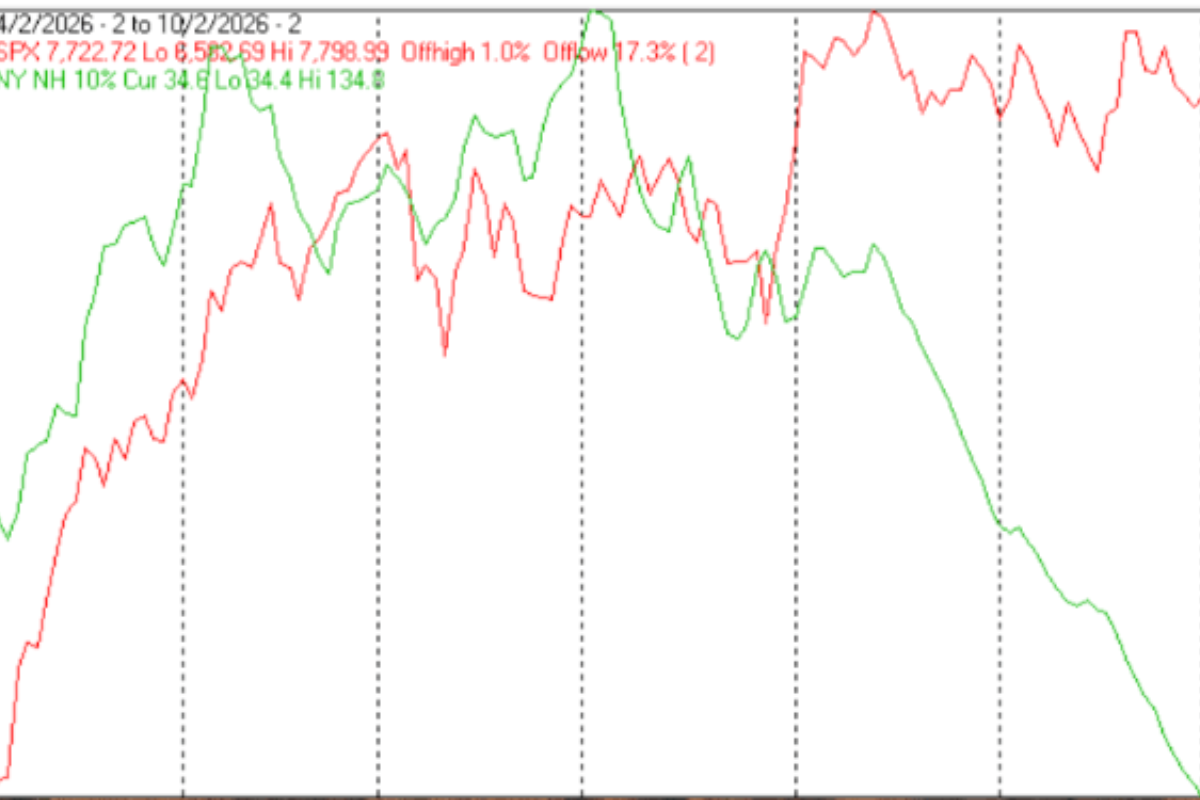
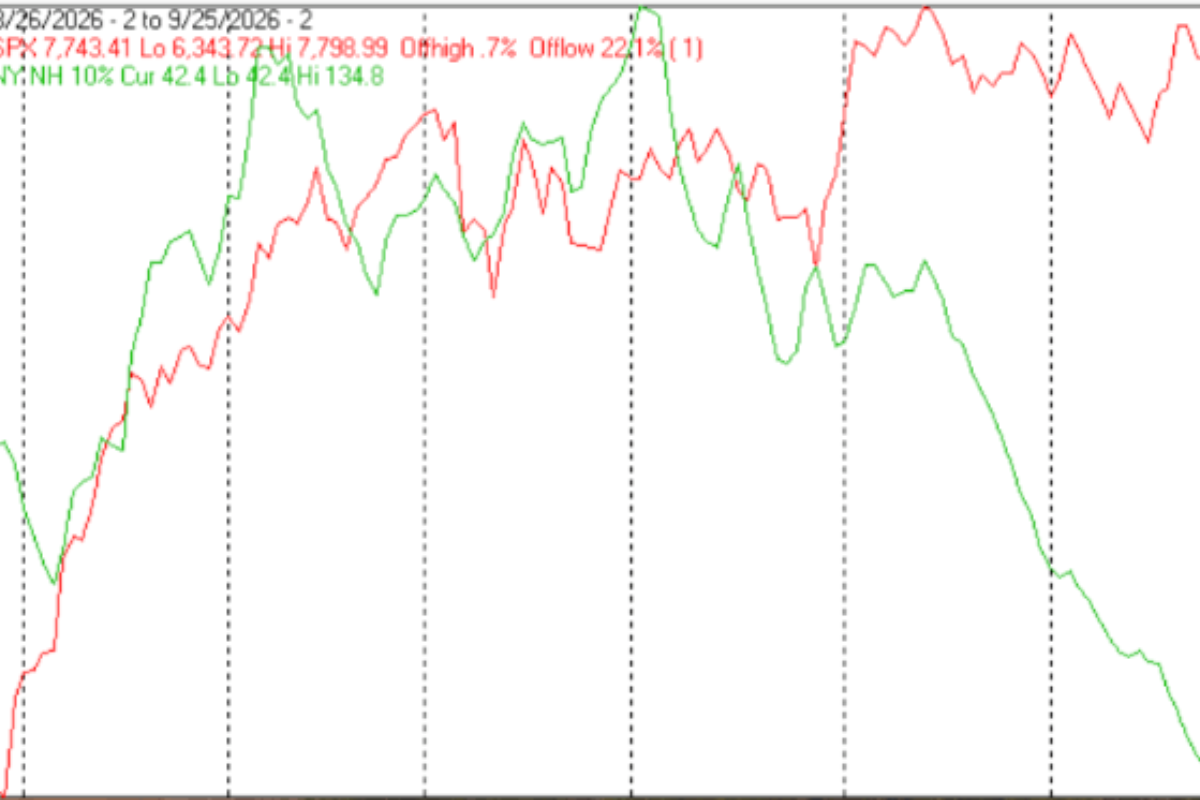
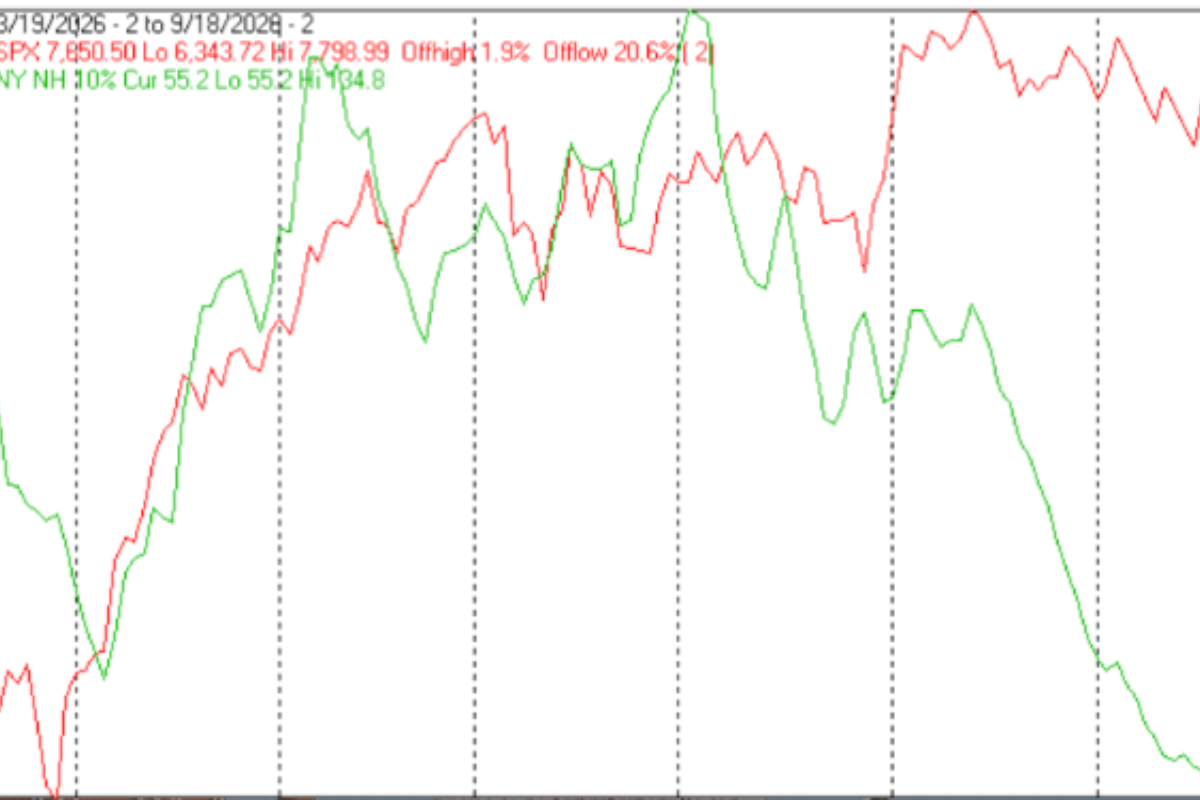
The next chart is similar to the one above except it shows the SPX in red and NY NH in green has been calculated with NYSE data.
NY NH failed to confirm the new SPX high.
The next chart covers the past 6 months showing the OTC in blue and a 40% trend (4 day EMA) of Nasdaq new highs divided by new highs + new lows (OTC HL Ratio), in red. Dashed horizontal lines have been drawn at 10% levels for the indicator; the line is solid at the 50%, neutral level (equal numbers of new highs and new lows).
OTC HL Ratio remained in modestly negative territory.
The next chart covers the past 6 months showing the OTC in blue and a 10% trend (19 day EMA) of Nasdaq new lows (OTC NL) in brown. OTC NL has been plotted on an inverted Y axis so decreasing numbers of new lows move the indicator upward (up is good).
OTC NL continued to move modestly downward in spite of the sharp rise of the index.
The Positives
The next chart is similar to the one above except it shows the SPX in red, and NY NL, in blue, has been calculated with NYSE data.
NY NL continued moving slowly upward.
The next chart is similar to the third chart above except it shows the SPX in red, and NY HL ratio, in blue, has been calculated with NYSE data.
NY HL Ratio moved modestly upward last week finishing the week at a comfortable 79%.
Seasonality
Next week includes the last 3 trading days of December during the 1st year of the Presidential Cycle and the 1st trading day of January during the 2nd year of the Presidential Cycle. The tables below show the daily performance on a percentage basis for both the OTC and SPX.
OTC data covers the period from 1963 to 2024 while SPX data runs from 1928 to 2024. There are summaries for both the 1st year of the Presidential Cycle and all years combined.
Seasonality for the coming week has been positive by all measures.
This report is from the perspective of the new year. It includes the last 3 days of previous December and first day of January.
The year is the year of January, December is from the previous year.
The number following the year represents its position in the Presidential Cycle. The number following the daily return represents the day of the week;
1 = Monday, 2 = Tuesday etc.
OTC Presidential Year 2 (PY2)
Day3 Day2 Day1 Day1 Totals
1966-2 -0.63% 3 0.35% 4 0.09% 5 0.70% 1 0.51%
1970-2 0.46% 1 -0.15% 2 0.38% 3 0.71% 5 1.40%
1974-2 1.18% 4 0.47% 5 0.56% 1 0.37% 3 2.57%
1978-2 0.08% 3 0.37% 4 0.60% 5 -1.00% 2 0.05%
1982-2 -0.63% 2 0.39% 3 0.61% 4 -0.16% 1 0.20%
Avg 0.09% 0.29% 0.45% 0.13% 0.95%
1986-2 0.77% 5 0.12% 1 0.39% 2 0.18% 4 1.46%
1990-2 0.80% 3 0.26% 4 1.08% 5 0.99% 2 3.13%
1994-2 0.36% 3 0.49% 4 0.74% 5 -0.78% 1 0.82%
1998-2 1.73% 1 1.79% 2 0.35% 3 0.71% 5 4.57%
2002-2 0.80% 4 0.55% 5 -1.85% 1 1.48% 3 0.97%
Avg 0.89% 0.64% 0.14% 0.52% 2.19%
2006-2 0.09% 3 -0.48% 4 -0.58% 5 1.74% 2 0.77%
2010-2 -0.12% 2 0.13% 3 -0.97% 4 1.73% 1 0.77%
2014-2 -0.25% 5 -0.06% 1 0.54% 2 -0.80% 4 -0.58%
2018-2 0.04% 3 0.16% 4 -0.67% 5 1.49% 2 1.02%
2022-2 -0.10% 3 -0.16% 4 -0.61% 5 1.20% 1 0.33%
Avg -0.07% -0.08% -0.46% 1.07% 0.47%
OTC summary for PY2 1966 - 2022
Averages 0.30% 0.28% 0.04% 0.57% 1.20%
% Winners 67% 73% 67% 73% 93%
MDD 12/31/2001 1.85% -- 12/30/2005 1.06% -- 1/3/1978 1.00%
OTC summary for all years 1963 - 2025
Averages 0.03% 0.21% 0.19% 0.20% 0.62%
% Winners 48% 58% 65% 57% 71%
MDD 1/2/2001 10.40% -- 1/2/2008 4.21% -- 1/4/2016 4.01%
SPX PY2
Day3 Day2 Day1 Day1 Totals
1930-2 -0.77% 6 1.11% 1 2.68% 2 -1.26% 4 1.77%
1934-2 2.88% 4 -0.20% 5 1.30% 6 0.10% 2 4.09%
1938-2 1.07% 3 1.34% 4 -0.09% 5 -0.28% 1 2.03%
1942-2 -0.95% 1 4.42% 2 -0.57% 3 2.30% 5 5.20%
1946-2 0.17% 5 0.29% 6 0.00% 1 -0.63% 3 -0.17%
1950-2 0.12% 4 0.66% 5 -0.18% 6 -0.60% 2 0.00%
1954-2 -0.65% 2 0.86% 3 0.20% 4 0.56% 1 0.97%
1958-2 -0.35% 5 -0.50% 1 1.04% 2 0.85% 4 1.03%
1962-2 0.89% 3 0.06% 4 -0.20% 5 -0.82% 2 -0.08%
Avg 0.04% 0.27% 0.17% -0.13% 0.35%
1966-2 0.31% 3 0.42% 4 0.25% 5 -0.27% 1 0.71%
1970-2 -0.70% 1 0.38% 2 0.50% 3 1.02% 5 1.21%
1974-2 2.09% 4 -0.20% 5 0.01% 1 0.13% 3 2.03%
1978-2 0.06% 3 0.20% 4 0.17% 5 -1.35% 2 -0.91%
1982-2 -0.49% 2 0.52% 3 0.20% 4 0.16% 1 0.39%
Avg 0.25% 0.26% 0.23% -0.06% 0.68%
1986-2 0.94% 5 0.51% 1 0.28% 2 -0.80% 4 0.94%
1990-2 0.58% 3 0.53% 4 0.78% 5 1.78% 2 3.67%
1994-2 -0.08% 3 -0.41% 4 -0.47% 5 -0.22% 1 -1.17%
1998-2 1.80% 1 1.83% 2 -0.04% 3 0.47% 5 4.07%
2002-2 0.68% 4 0.34% 5 -1.11% 1 0.57% 3 0.47%
Avg 0.78% 0.56% -0.11% 0.36% 1.59%
2006-2 0.13% 3 -0.30% 4 -0.49% 5 1.64% 2 0.99%
2010-2 -0.14% 2 0.02% 3 -1.00% 4 1.60% 1 0.48%
2014-2 -0.03% 5 -0.02% 1 0.40% 2 -0.89% 4 -0.54%
2018-2 0.08% 3 0.18% 4 -0.52% 5 0.83% 2 0.57%
2022-2 0.14% 3 -0.30% 4 -0.26% 5 0.64% 1 0.22%
Avg 0.04% -0.08% -0.38% 0.77% 0.34%
SPX summary for PY2 1930 - 2022
Averages 0.32% 0.49% 0.12% 0.23% 1.16%
% Winners 63% 71% 50% 58% 79%
MDD 1/3/1978 1.35% -- 1/2/1930 1.26% -- 1/3/1994 1.17%
SPX summary for all years 1929 - 2024
Averages 0.23% 0.39% 0.15% 0.08% 0.84%
% Winners 59% 68% 60% 47% 63%
MDD 1/2/2001 3.82% -- 1/2/1932 3.69% -- 1/2/2008 3.37%
January
Since 1963, over all years, the OTC in January has been up 66% of the time with an average gain of 2.6%. During the 2nd year of the Presidential Cycle January has been up 47% time with an average loss of -0.5% The best January ever for the OTC was 1975 (+16.6%), the worst 2008 (-9.9%).
The average month has 21 trading days. The chart below has been calculated by averaging the daily percentage change of the OTC for each of the 1st 11 trading days and each of the last 10. In months when there were more than 21 trading days some of the days in the middle were not counted. In months when there were less than 21 trading days some of the days in the middle of the month were counted twice. Dashed vertical lines have been drawn after the 1st trading day and at 5 trading day intervals after that. The line is solid on the 11th trading day, the dividing point.
In the chart below the blue line shows the average of the OTC in January over all years since 1963 while the grey line shows the average during the 2nd year of the Presidential Cycle over the same period.
Since 1928 the SPX has been up 63% of the time in January with an average gain of 1.2%. During the 2nd year of the Presidential Cycle the SPX has been up 58% of the time with an average gain of 0.4%. The best January ever for the SPX was 1987 (+13.2%), the worst 2009 (-8.6%).
The chart below is similar to the one above except it shows the average daily performance over all years for the SPX in January in red and the performance during the 2nd year of the Presidential Cycle in grey.
Since 1979 the Russell 2000 (R2K) has been up 55% of the time in January with an average gain of 1.4%. During the 2nd year of the Presidential Cycle the R2K has been up 36% of the time in January with an average loss of -1.4%. The best January ever for the R2K was 1985 (+13.1%), the worst 2009 (-11.2%).
The chart below is similar to those above except it shows the daily performance over all years of the R2K in January in magenta and the performance during the 2nd year of the Presidential Cycle in grey.
Since 1885 the DJIA has been up 63% of the time in January with an average gain of 0.9%. During the 2nd year of the Presidential Cycle the DJIA has been up 63% of the time in January with an average gain of 0.6%. The best January ever for the DJIA was 1976 (+14.4%), the worst 2009 (-8.8%).
The chart below is similar to those above except it shows the daily performance over all years of the DJIA in January in dark grey and the performance during the 2nd year of the Presidential Cycle in light grey.
Conclusion
Seasonality remains the dominant consideration through next week.
The strongest sectors last week were Precious Metals (for the 2nd week) and Basic Materials while the weakest were Electronics and Energy (for the 3rd week in a row).
I expect the major averages to be higher on Friday January 2 than they were on Friday December 26.
More By This Author:
Technical Market Report For December 20, 2025Technical Market Report For December 13, 2025
Technical Market Report For December 6, 2025
Comments
Log in or sign up to join the conversation.