

When you look at a brand as ubiquitous as Starbucks (SBUX), it is easy to assume the stock must be a perennial winner. We see packed cafes and long drive-thru lines, and as traders, our instinct is to want a piece of that action. It feels safe and familiar. But as we know all too well, a popular brand does not always make for a great stock trade.
I have been watching SBUX closely for quite some time. It is one of those names that pops up on scanners occasionally, teasing a potential move. You see a flicker of life and a price level that looks like it might finally act as a launchpad. But time and again, Starbucks has proven to be a master of the failed breakout.
So is SBUX a buy here? Can the recent price action be trusted, or is this just another trap waiting to snag overzealous bulls eager to buy the dip? After analyzing the charts and the broader market context, my answer is one of extreme caution. While the temptation to buy the dip is strong, especially from a long-term perspective, the technical evidence suggests this stock belongs on a watchlist, not in a portfolio.
The Reality of Recent Breakout Attempts
Breakouts are the bread and butter of swing trading. We look for consolidation, energy building, and then a push through resistance on strong volume. That move is the green light that buyers are in control and the path of least resistance is higher.
Over the past year, Starbucks has delivered a masterclass in failed breakouts. There have been two clear breakout attempts in the last twelve months. On paper, they looked promising. In reality, neither attempt held long enough to sustain momentum.
(Click on image to enlarge)
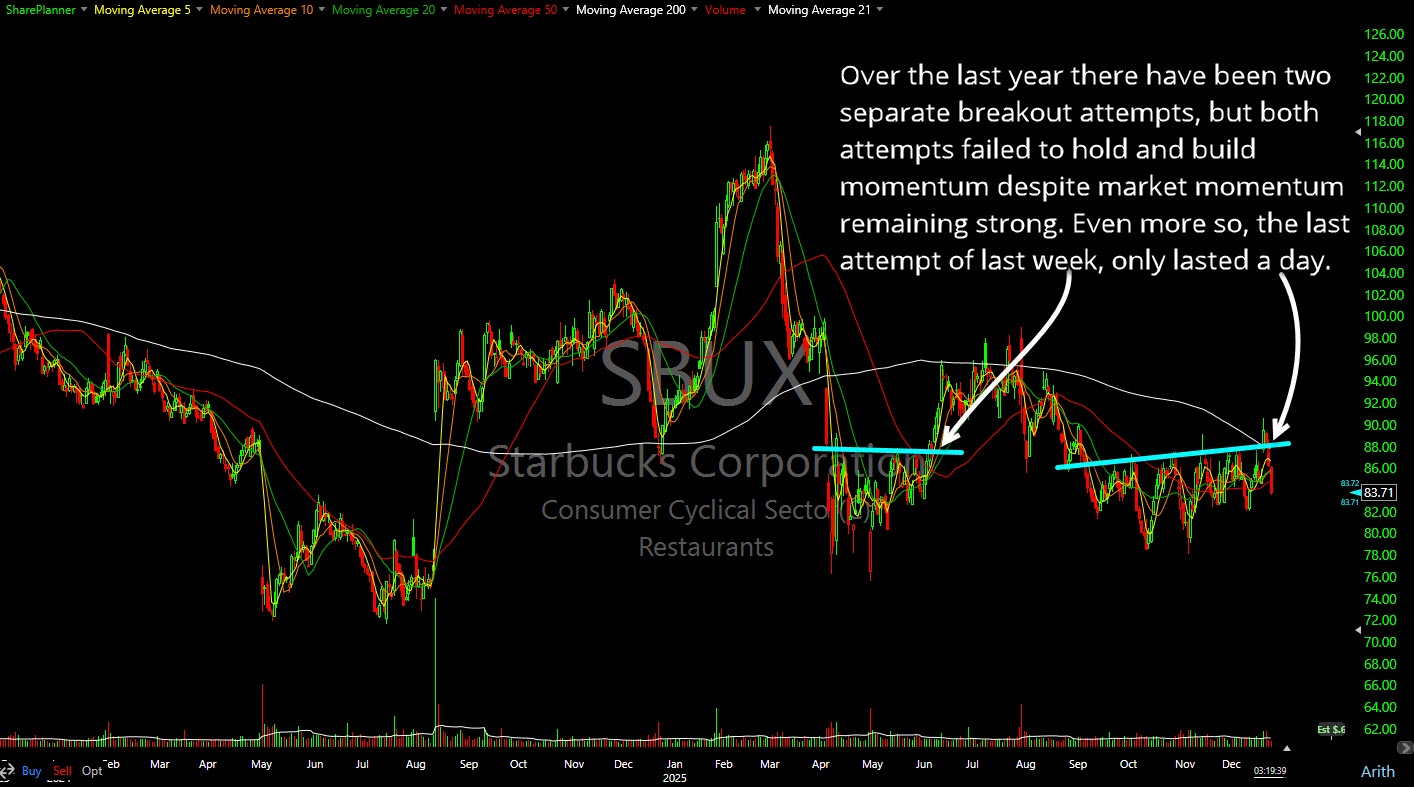
The most recent attempt was particularly discouraging for bulls. What appeared to be a reversal lasted exactly one day. The stock popped, buyers rushed in, and then price immediately rolled over. When a stock cannot hold a breakout for more than a single session, it tells you sellers remain aggressive and firmly in control.
Ignoring the Raging Bull Market
This weakness is even more concerning given the broader market environment. We are not in a bear market or a choppy range. The S&P 500 and Nasdaq have been relentlessly pushing to new highs, lifting most stocks along the way.
In strong bull markets, a rising tide lifts most boats. When a stock like Starbucks fails to participate, it signals clear relative weakness. While other large-cap stocks are breaking out and holding gains, SBUX is struggling to stay afloat.
Many traders convince themselves a lagging stock is “due” for a catch-up move. That is a dangerous mindset. Stocks lag for a reason. If SBUX cannot rally when conditions are ideal, imagine how it will behave when the broader market finally pulls back.
Long-Term Support Is Not a Buy Signal
Traders often point to long-term support as justification for buying. They look at multi-year charts and assume a bounce is inevitable. To be fair, Starbucks is sitting near an area that has historically attracted buyers.
(Click on image to enlarge)
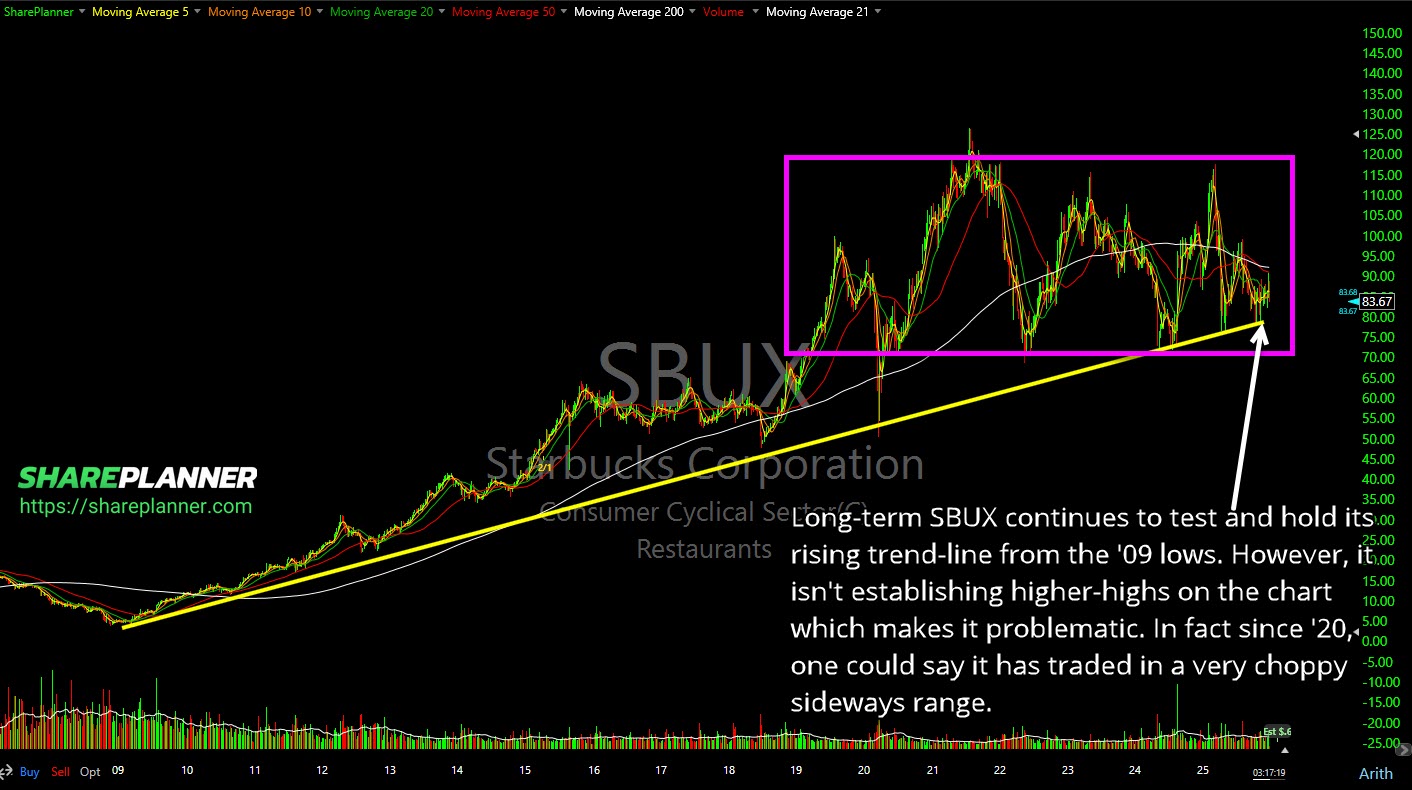
But support alone is not a buy signal. Support is simply a level where price may react, and it may only be suitable for short-term trades. Floors can break. More importantly, a stock can sit on support for months, tying up capital while better opportunities pass by. This is the opportunity cost of trading.
Right now, there is little evidence of meaningful accumulation. Institutional buyers appear to be defending support, but they are not aggressively stepping in. Until that changes, buying SBUX is more about hope than probability.
What Needs to Change Before We Buy
This does not mean Starbucks is uninvestable forever. Charts change, and when they do, opinions should change with them.
For SBUX to become a viable swing-trade candidate, we need a clear structural shift. Specifically, I want to see a classic Dow Theory reversal.
That means a sustained pattern of higher highs and higher lows on the daily chart.
- Higher Highs: Price must break above a prior resistance level and hold, proving buyers are willing to pay higher prices.
- Higher Lows: Pullbacks must find support above previous lows, showing sellers are exhausting themselves sooner.
Until SBUX demonstrates this behavior, it is not worth considering. We need confirmation, not anticipation.
The Danger of Trying to Pick a Bottom
Buying Starbucks right now is essentially an attempt to pick a bottom. It is the trading equivalent of catching a falling knife. You might get lucky, but the odds are stacked against you.
Trading is a game of probabilities. Buying a stock that has failed multiple breakouts during a strong market does not stack the odds in your favor. It puts you in a position of weakness.
Too many traders blow up accounts trying to be heroes who call exact bottoms in well-known brands. They let familiarity cloud judgment and confuse the company with the ticker symbol. Your job is to grow capital, not to be a loyal customer in the stock market.
More By This Author:
Gold Pullback
Swing Trading Using Volume Analysis
SLV Parabolic Rally & What Traders Should Watch Next



Comments
Log in or sign up to join the conversation.