

Image Source: Pixabay
Market Recap
Despite additional tariffs on India, a lack of a final trade deal with Switzerland, and hints of stagflation from Tuesday’s ISM Services report, markets ended the day higher. Mag 7 and Technology names were additive as evidenced by the correlation of exposure and broad equity index results with the Dow gaining 0.18%, the S&P 500 adding 0.79% and the Nasdaq Composite closing 1.21%. Small caps missed out as the Russell 2000 fell 0.20%. Sectors were mixed, with leadership coming from Consumer Discretionary as Amazon (AMZN) and Tesla (TSLA) combined to contribute to just over 66% of the sector’s 2.08% result. Healthcare (-1.50%) and Materials (-1.08%) lagged most, and the remaining sectors saw returns ranging from -0.92% (Energy) to 1.43% (Consumer Staples).
The advance/decline line for holdings of the SPDR S&P 500 Trust ETF (SPY) was close to evenly split at 238/265. The top 10 contributors to return accounted for just over 100% of the fund’s 0.77% result. That list included five Mag 7 names. Dragging against the top 10 contributors’ positive effects somewhat was the single largest detractor from performance, Microsoft (MSFT), which only fell 0.53% but given its roughly 7.30% weight, has more impact than the 18.29% decline of Super Micro Computer (SMCI).
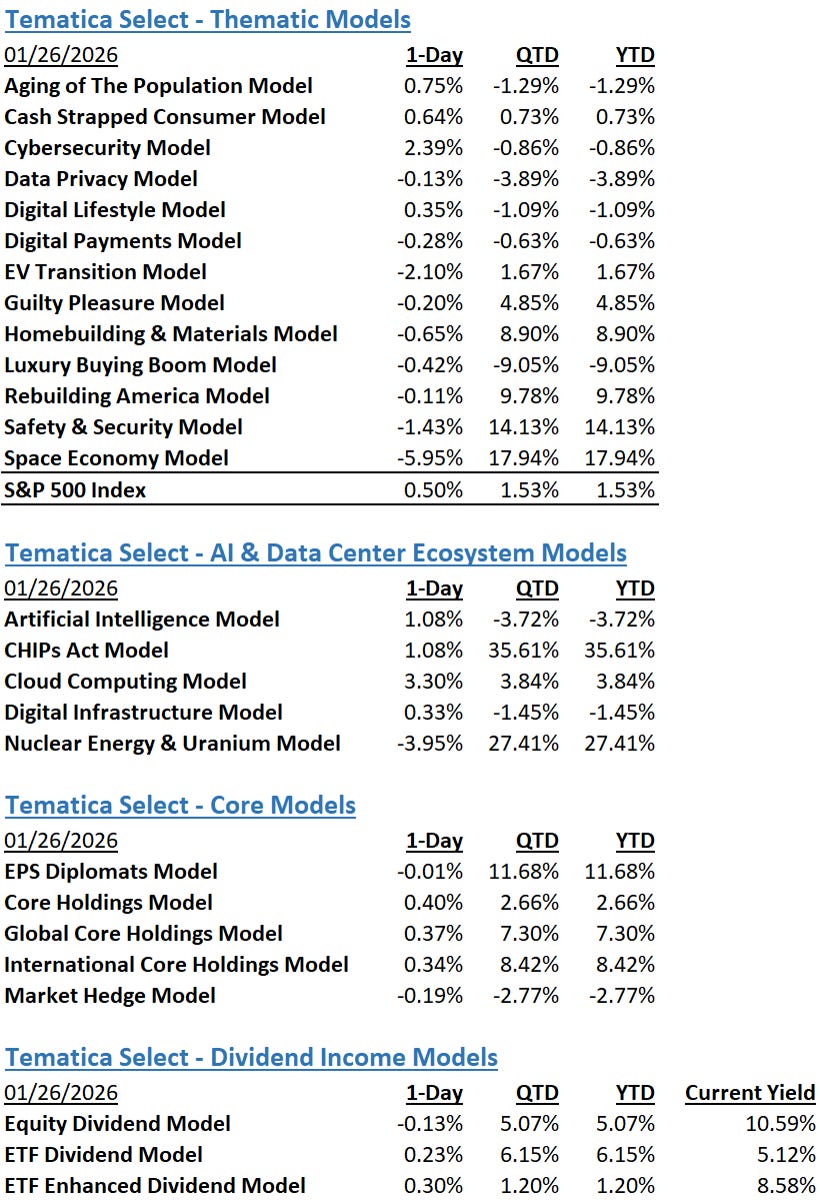
The Tematica Select Model Suite saw mixed results with leadership coming from Luxury Buying Boom (LUXE), Cloud Computing (CLOUD), and Cybersecurity (CYBR). Laggards included Homebuilding & Materials (HOMES), and Rebuilding America (REBUILD).
Exemption Relief Over Trump Chip Tariffs Continues the Market Climb
Futures point to an extension of the market rally when U.S.-listed stocks begin trading later this morning. That move comes as shares of Apple (AAPL), Nvidia (NVDA), Taiwan Semiconductor (TSM), and others are up in pre-market trading following word from President Trump that there will be 100% tariffs on imported chips, but not for companies that are “building in the United States.” As we’ve seen in recent weeks with similar proclamations, details like how much US manufacturing a company needs to do in order to qualify for the exemption were not clear.
Signs of pushback to Trump’s tariffs are being had, however, the European Union (EU) is already indicating that EU companies that export chips to the US will only face a 15% tariff, in line with the 15% tariff for the majority of EU exports. Swiss politicians are aiming to cancel an order of three dozen F-35A fighter jets, a ~$9.1 billion order, with Lockheed Martin (LMT). Prime Minister Narendra Modi indicated India won't compromise on the interests of its farmers, fishermen, and livestock rearers, a day after President Trump said he was doubling tariffs on Indian goods to 50%.
TBD as to how all of this plays out and what its role will be as trade conversations with Mexico, Canada, and China, better known as the US’s three largest trading partners, continue, and other aspects of trade deals are codified. The question we keep asking is to what degree corporate pledges to sidestep Trump tariffs will turn into actual US manufacturing and production capabilities? Building a semiconductor fab typically takes two to three years, while a steel mill can take anywhere from two to 10 years, depending on its size and complexity.
In the near term, we’ll continue to monitor the flow through of tariffs on inflation pressures and the impact on corporate margins, consumer spending, and the aggregate impact on EPS expectations. If we were to examine Costco’s (COST) July revenue report released last night, the one that showed its adjusted US comp sales accelerated to 6.5% from 5.5% in June, it would likely be a positive signal for our Cash-Strapped Consumer model.
June quarter results and updated guidance from AMN Healthcare (AMN), Alarm.com (ALRM), Block (XYZ), Con Edison (ED), indie Semiconductor (INDI), Motorola Solutions (MSI), Synaptics (SYNA) and others after today’s market close should bring fresh signals for our Aging of the Population (AGING), Homebuilding & Building Materials (HOMES), Digital Infrastructure (DIGI), Digital Lifestyle (DLIFE), and Safety & Security (SAFE)models.
The next major piece of US economic data will be the July Consumer Price Index report published on Tuesday, August 12. That report and the July Producer Price Index published the following day, will be mined not only for what they say about inflation pressures, but how they may shape Fed comments between now and the 2025 Jackson Hole Economic Policy Symposium. That event, put on by the Kansas City Federal Reserve Bank, runs from August 21-23.
More By This Author:
AI And Data Center Spending Confirms The AI Trade Is Very Much Alive And WellEarnings Continue, Flash July PMI Ahead, Trump To Visit Powell
TSM 2Q 2025 Revenue Stuns, Costco Delivers, Delta Raises The Bar
Comments
Log in or sign up to join the conversation.