

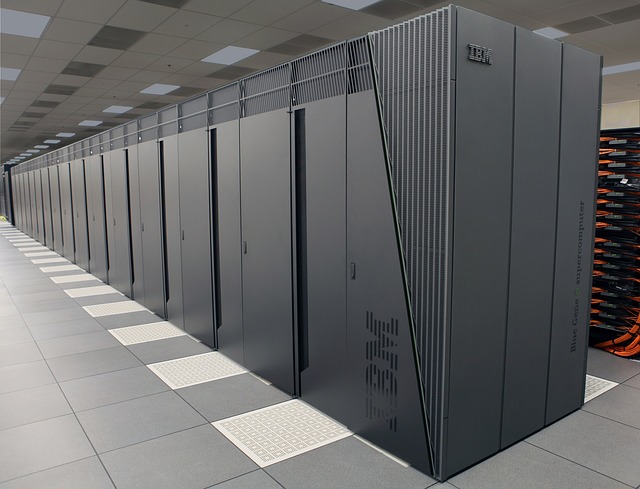
Photo Credit: Mikita Yo on Unsplash
IBM (NYSE: IBM) recently announced the $11 billion acquisition of Confluent as it positions itself to cater to the evolving AI driven IT landscape.
IBM’s Financials
Yesterday, IBM also announced its fourth quarter results. For the quarter, IBM’s revenues grew 12% to $19.69 billion, ahead of the market’s expectations of $19.2 billion. Earnings came in at $4.52 per share and were also ahead of the expected $4.33 per share.
By segment, software revenue rose 14% to $9.03 billion, ahead of the consensus of $8.77 billion. Its consulting unit grew 3% to $5.35 billion, falling short of the $5.38 billion estimate. Its infrastructure division revenues grew 21% to $5.1 billion. IBM’s gen AI book of business stood at more than $12.5 billion, growing $3 billion over the last quarter.
IBM ended the year with revenues of $67.54 billion and earnings of $11.17 per share.
For 2026, IBM expects its revenue to grow 5% over the year.
IBM’s Confluent Acquisition
Last month, IBM announced plans to acquire Confluent for $11 billion. Mountain View-based Confluent was founded in 2014 by Apache Kafka’s founders – Jay Kreps, Jun Rao, and Neha Narkhede. The three of them had built Kafka while working at LinkedIn in 2008. They left LinkedIn to create Kafka’s platform and then build a company to support it.
Confluent is known for its proprietary open-source enterprise data streaming platform that connects, processes, and governs reusable and reliable data and events in real time. Confluent’s cloud neutral solution runs identically on AWS, Azure, Google Cloud, and on-premises data centers. Its universal, cross-cloud data transport layer allows organizations to build real-time applications and AI workflows on a single, consistent platform, regardless of where their data resides or which cloud hosts their compute.
As organizations continue to expect more from AI, AI models will need access to connected and trusted data in real time. Confluent provides the mechanism to transport data from multiple sources directly into an AI’s reasoning process.
By acquiring Confluent, IBM is getting access to the vital part of the data supply chain that makes its AI portfolio more valuable. The acquisition strengthens IBM’s position as the essential management and automation fabric. IBM’s belief is that the future in AI infrastructure is not as much in storing data, but more on being able to stream it. IBM is convinced that the acquisition will drive significant synergies across IBM’s portfolio including AI products and services, Automation, Data and Consulting and accelerate revenue growth by leveraging IBM’s go-to-market reach.
Prior to the acquisition, Confluent was being traded on the Nasdaq at a valuation of $8 billion. It last announced results in October 2025. Its revenues grew 19% to $298.5 million and adjusted net operating income was $0.13 per share. Overall, the company had still not been profitable. Confluent was looking to close fiscal 2025 with revenues of $1.113-$1.114 billion.
IBM is not new to open-source acquisitions. Red Hat, its biggest acquisition ever at $34 billion, was another open-source player that it had acquired and initially struggled to integrate successfully in the business. Confluent may go through a similar process. Confluent is also not the only provider in the market. AWS has Kinesis, Google has Cloud Pub/Sub, and Microsoft Azure has Event Hubs that provide similar functionality. AWS and Azure services are based on Kafka. IBM is still awaiting regulatory approval to the deal.
IBM’s stock is trading at $293.86 with a market capitalization of $275 billion. It touched a 52-week high of $324.90 in November last year. The stock has recovered from the 52-week low of $214.50 that it was trading at in last April.
More By This Author:
Cloud Stocks: AMD Chips Away At Nvidia
Cloud Stocks: For Adobe, Is The Semrush Acquisition Enough?
Cloud Stocks: Atlassian Grows Through Acquisitions



Comments
Log in or sign up to join the conversation.