

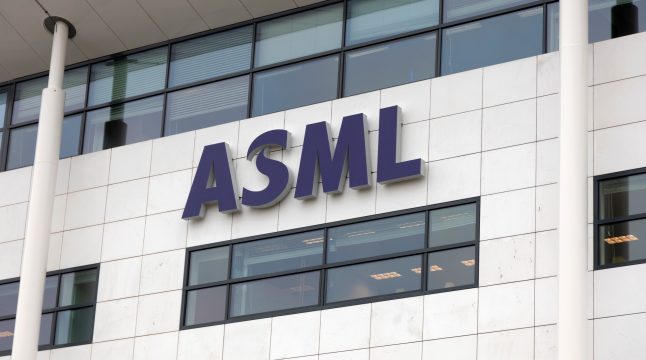
Image courtesy of 123rf.com
When we last covered ASML stock in late November, it was priced at $1,028 per share. At the current press time price of $1,422.92, shareholders could tap into impressive 41% gains for such a short time span.
Although we tagged Dutch ASML as the “foundational bottleneck layer” for the entire chip industry, we noted that investors often pick cheaper stocks for AI and semiconductor exposure.
After the latest Q4 earnings on Wednesday, let’s examine if ASML exposure at this high entry point is still a good bet.
ASML’s Unique Position Explained
There are monopolies and then there is ASML. Without the company’s Extreme Ultraviolet (EUV) lithography, by which chip patterns are printed onto silicon at an atomic scale, it is difficult to imagine any chip roadmaps – 5nm, 3nm, 2nm – for companies like Intel, Samsung and TSMC.
While designer chip companies like Nvidia and AMD are reliant on TSMC, as the world’s largest chip manufacturer, TSMC runs on ASML. By the end of 2024, Taiwan’s chipmaking giant had over half of global EUV installations, as the most complex machines humans ever built.
ASML gained this unique market position by betting on immersion lithography as the technological fork in the road against dry lithography that Japanese giants like Nikon and Canon pursued. Due to the risky and intensive research that eventually led to today’s EUV systems, ASML nearly ran out of money by 2012.
However, ASML convinced TSMC, Samsung and Intel to participate in its Customer Co-Investment Program to pull through, with a combined weight of €3.85 billion, or €5.23 billion with equity investment and R&D included. In fact, to avoid diluting shares, ASML executed a synthetic share buyback in early December 2012.
Although no such company like ASML exists, it has been speculated in late 2025 that China has its own “Manhattan Project” to build an EUV prototype based on ASML’s designs through reverse engineering by former ASML employees. However, due to the complex nature of these machines, it is unlikely that China will be able to scale up any time soon.
In the meantime, although not directly controlled by USG, ASML remains under tight grip of American Foreign-Direct Product (FDP) rules to restrict exports. The USG has such power because some of ASML’s technology originated from the federally funded Lawrence Livermore National Laboratory (LLNL) under the U.S. Department of Energy (DoE).
Charting Compute Scarcity
With ASML’s origin out of the way, it is clear that the company’s prospects rely on future compute demand. Using electricity consumption as a proxy for global compute demand, the International Energy Agency (IEA) estimated in April 2025 report that the world’s data center power drain will more than double in a base case scenario by 2030.
This is where the “AI bubble” element comes in. Notwithstanding the overleverage of individual entities like OpenAI, we’ve maintained from the beginning that AI is not about churning “AI slop”. Instead, the core purpose of AI is to erect automated governance layers, which is why we have seen unprecedented public-private partnerships (PPPs).
Of course, to be truly useful, all AI models will have to be multi-modal. This entails drastically higher compute demand beyond text interpretation into visual data interpretation and generation. Moreover, even if chip efficacy in these workloads is reduced, such as with Nvidia’s latest Vera Rubin platform, this would only translate to greater aggregate demand.
In other words, when a new technology arrives, total usage explodes because new feasibility thresholds are crossed. Historically, this phenomenon is referred to as the Jevons Paradox.
The fact that consumer electronics, such as memory modules from Micron, are now largely diverted to an AI buildup, clearly points to an age of compute scarcity coupled with energy scarcity.
Case in point, the average electricity price in U.S. cities has gone up 39% over the last five years. Accordingly, ASML will serve as a toll collector on that scarcity for the foreseeable future.
ASML’s Financials Examined
For the full year 2025, ASML achieved net income of €9.6 billion, 27% more than in 2024. Year-over-year, the company’s backlog increased 8% to €38.8 billion, representing accumulated sales orders of systems that are yet to appear as net sales.
During Q4, ASML improved its gross margin to 52.2%, from 51.6% in the previous quarter. On a yearly basis, the gross margin improved to 52.8% compared to 51.3% in 2024. Overall, with a total revenue of €32.6 billion for 2025, the company increased its earnings-per-share (EPS) by 28.4% YoY to €24.73 EPS.
ASML CEO Christophe Fouquet expects 2026 to be “another growth year”, with total net sales to reach up to €39 billion, with a minimum of €34 billion. Although this represents growth, it suggests a more measured expansion owing to near-term demand variability and capex discipline from hyperscalers.
After all, the electric grid is not ready for massive AI data center expansion, facing a hard obstacle such as copper shortage. Nonetheless, this would be only an interim period. ASML is ready to excite investors long-term with a newly announced €12 billion stock buyback program to be executed by the end of 2028.
In the meantime, the average ASML price target of $1,423.30 is now slightly above its current price of $1,422 per share, according to the Wall Street Journal consensus. The bottom outlook for ASML stock is $950, while the ceiling price target is $1,672 per share.
In conclusion, although ASML stock is one of the safest bets due to its unique market position, it bears waiting for a market upset to take the plunge. For instance, given that President Trump is in total alignment with Israeli interests, Iran is still on the table as a major market catalyst.
More By This Author:
Why Is Southwest Airlines Stock Rising? Q4 Results And Major Business ShiftCaterpillar Beats Q4 2025 Earnings Forecasts As Sales Hit All-Time High
The New Crypto Stack: Coinbase, Bitcoin, Stablecoins


Comments
Log in or sign up to join the conversation.