


Image Source: Unsplash
You probably assume Big Trade = Big Move.
So, what happens when a massive options trade hits the tape?
Honestly, not much. Because that’s not how things work.
Big options positions CAN move price. But it doesn’t happen immediately, and for good reason.
It all comes down to what’s known as the “Gamma Squeeze”.
How It Starts
Someone buys thousands of call contracts at a specific strike. The stock trades just below it.
These calls have a 35 delta. That means market makers who sold those calls need to hedge by buying shares—about 35% of their exposure.
This creates some buying pressure. You might see a small pop. Then the stock fades. Days pass. Nothing.
Most traders see this and think the trade failed. They walk away.
But this is exactly where the setup gets interesting.
The "To and Through" Principle
Here's the key insight: Ghost Prints don't guarantee immediate price movement.
The real action happens when price moves to and through the strike.
Why? It comes down to delta.
An out-of-the-money option with 35 delta this week might only have 20 delta next week if the stock doesn't move. Time decay chips away at it. The squeeze potential fades.
But when price reaches the strike, everything changes.
Delta jumps to 50. Market makers have to increase their hedging. A call that required hedging 35 shares per contract now requires 50.
That's not the squeeze yet. That's the setup.
Where the Acceleration Happens
The squeeze kicks in when price pushes through the strike.
That 50 delta starts climbing toward 100. Every dollar higher forces market makers to hedge more aggressively.
They bought shares to cover 50 delta. Now they need to cover 70. Then 85. Then 95.
Each step forces more buying. That buying pushes price higher. Which increases delta further.
This is gamma—the rate of change in delta. It peaks at-the-money, especially near expiration.
And that's when things get explosive.
A Quick Example
Hertz HTZ traded at $6. Someone bought massive call volume at the $6 strike for March expiration.
The position was at-the-money from day one. That's 50 delta right out of the gate.
As expiration approached, any move above $6 accelerated fast. Delta climbed from 50 to 80, then 90. Market makers kept buying to maintain their hedge.
The buying fed on itself.
Meanwhile, the $9 calls sat with only 8 delta. Seemed irrelevant. But if price reached $9? That delta would jump to 50 and the gamma potential would explode.
That's "to and through" in action.
Why Time Matters
Time works against out-of-the-money options. But it works for at-the-money gamma.
Here's the trap. You buy a call 25% out of the money with 60 days to expiration. Plenty of time, right?
But 40 days pass and price hasn't moved. Now you've got 20 days left and your delta has cratered.
The squeeze potential shrinks every day price stays flat.
Professionals know this. They don't just buy far out-of-the-money calls and hope. They pick strikes where price can realistically arrive in time.
Two Scenarios
Scenario one: You buy $9 calls when the stock trades at $6. You've got 63 days and 23 delta. Stock sits flat for 40 days. Your delta drops to 15. Time killed your trade.
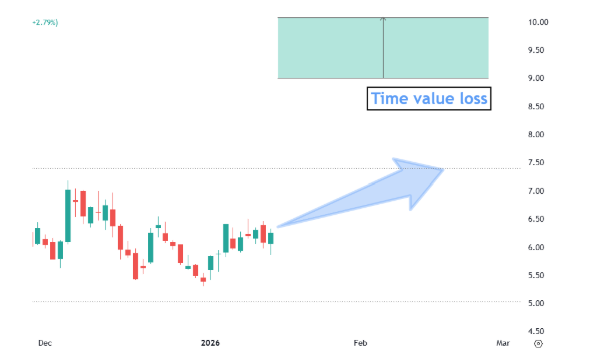
Scenario two: You buy $6 calls when the stock trades at $6. You start with 50 delta. Stock moves to $6.50 in two weeks. Your delta jumps to 65.
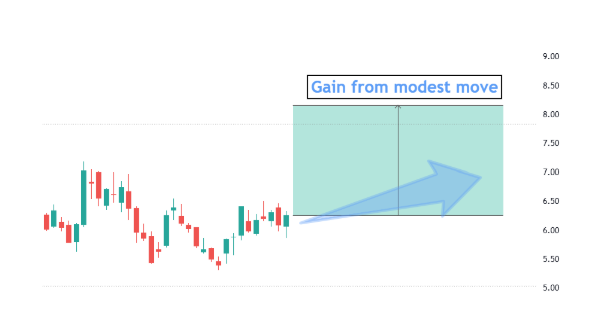
You captured gamma acceleration without needing a massive move.
The second approach lets you take profits earlier. You don't need 50%. You need 10% at the right strike with the right timing.
The Cascade Effect
Market makers don't make directional bets. They hedge everything.
When they sell calls, they buy stock proportional to delta. Delta goes up, they buy more. Delta goes down, they sell.
This creates a cascade.
Price moves toward the strike. Delta increases. They buy. Price moves higher. Delta increases more. They buy more.
The cycle feeds itself until price moves away or expiration arrives.
The Ghost Prints Console catches the initial positioning before this cascade begins. You see the contracts hit the tape. You know market makers will need to hedge as price approaches.
Most traders see the initial pop and think that's the move. They chase after it's already happened.
The professionals? They positioned before the pop. They're watching delta climb. They're taking profits in stages.
Real Example: SOXS
Let me show you this in action.
Ghost Prints members positioned in SOXS—the 3x inverse semiconductor ETF—using out-of-the-money calls.
Semiconductors were showing weakness. Put buying accumulated across Intel, Oracle, Broadcom, Taiwan Semi. The prints pointed to institutional downside positioning.
When semiconductors drop, SOXS rises. The 3x leverage amplifies everything. A 2% drop in semis creates a 6% gain in SOXS.
The trade started with SOXS around $3.50. We bought the $4 calls. As SOXS rallied toward $4, we rolled to the $5 strike for a 40-cent credit. Locked in partial profits while keeping upside exposure.
Then semiconductors stabilized. SOXS pulled back. The $5 calls moved further out of the money.
Here's where "to and through" comes in.
We layered back in at the $4 strike for February expiration. Total risk: 41 cents. Breakeven: $4.41.
The structure gives us 59 days for SOXS to reach $4. Once it does, gamma acceleration kicks in. Delta restores to 50. Any move through $4 toward $5 ramps up quickly.
Over the last five trading days, semiconductors had zero up days and two major drops. This is exactly the environment where SOXS calls shine.
We're not betting on a 50% move. We're positioning for SOXS to move to and through $4. Gamma handles the rest.
The Setup You Want
A proper gamma squeeze trade needs three things:
Large call positioning at a specific strike. A realistic path for price to reach that strike in time. And ideally, a catalyst—like high short interest or sector weakness—to fuel the initial move.
Ghost Prints shows you the positioning. Your job is figuring out whether price can get there before time decay kills the setup.
Out-of-the-money calls are low probability. You can lose 100% of the premium. But the upside is unlimited with defined risk.
The key? Enter with enough time and a clear catalyst. Manage the position as delta increases.
Take partial profits along the way. If you bought at 20 delta and you're now at 40, you've doubled your gamma potential. Consider taking half off.
If price reaches the strike, let the rest run. Now you're playing with house money. Now gamma works for you.
What's Next
Semiconductor weakness isn't over. Multiple Ghost Prints across the sector point to continued downside positioning. Intel, Oracle, Broadcom, NVIDIA—all flashed similar signals before breaking down.
SOXS captures that move with 3x leverage. The call structure keeps risk defined. The "to and through" approach lets you position before gamma acceleration instead of chasing after.
This is how you trade gamma squeezes correctly.
Not by chasing vertical moves after they start. By positioning before price reaches the strike. By understanding how delta restoration creates the cascade. By taking profits in stages as gamma builds.
The difference between profiting and watching comes down to timing.
Charts show you what already happened. Ghost Prints shows you where institutional positioning is building before the move starts.
More By This Author:
The Gamma Trap Is Set
Nasdaq's Warning Just Got Louder
China's Deal Changes Everything


Comments
Log in or sign up to join the conversation.