


Image Source: Pexels
Tesla stock recently hit $440. Retail traders see potential consolidation, while institutions see potential trouble. Someone recently dropped $238,000 on far out-of-the-money puts. Specifically, the $250 strike that expires Jan. 31.
This trade was filled with zero hesitation, at the asking price, and with no haggling whatsoever. Most traders seemingly missed it entirely. Our Ghost Prints method didn't.
This is a pattern we've seen before. And it preceded major selloffs in other mega-cap names. Here’s how you can turn it into a possible trade idea.
We've Seen This Movie Before
First, far out-of-the-money puts appeared on Taiwan Semiconductor Manufacturing Company (TSM), and I mean way out. Strikes that seemed absurd. The market ignored them. Then, closer strikes started trading. The $300s. The $280s. The $260s. Downside pressure followed. The stock sold off hard.
Tesla's showing an identical setup, with the $250 puts recently printed. These aren't immediately impactful, with zero delta at the time of the trade, but they signal where institutional capital seems to expect trouble.
If this follows the pattern seen with Taiwan Semiconductor Manufacturing, we'll see closer strikes accumulate next. Then, the real selling begins.
The Valuation Nobody's Talking About
Why would institutions bet against a roughly $440 stock? The numbers will tell you.
Tesla trades at around 90% above fair value. That's not a typo; it's 90% overvalued based on fundamental metrics. The stock also sits at 18 times book value versus a median of 13.66.
It has a price to sales ratio of 16.14 versus a median of 7.31. These aren't tech company margins. Tesla manufactures cars. Its net margins are 5%, and gross margins are at 17%. Compare that to General Motors' (GM) 9% gross margin and 1.63% net margin. Tesla's better, but not 30 times General Motors' market cap better.
Earnings are Moving Backwards
Here's where the story seems to break down completely.
Tesla made $2.42 per share in 2024. Analysts expect $1.64 this year. That's backwards. For 2025, projections show $2.17. That's still below 2024 levels. The growth story isn't just slowing, it's reversing. And earnings drop Jan. 28. That's roughly 12 trading days away.
Remember that $238,000 put position? It expires Jan. 31, three days after earnings. That's not coincidence. Someone's betting on post-earnings weakness, not the immediate reaction.
Technical Setup Confirms the Risk
The following chart agrees with the options flow.
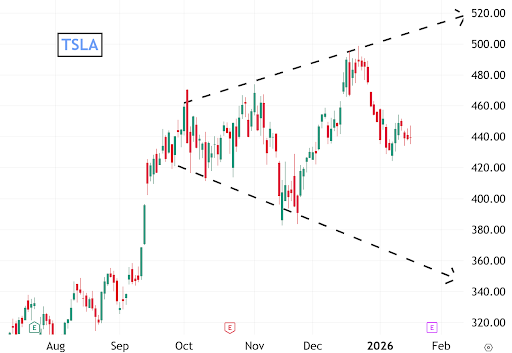
Tesla's been consolidating in a broadening formation. The stock sits dead center of its November to December range, at around $440. Such broadening formations aren't stable. They often resolve with violent moves.
Downside action could break the target at $380. That's a measured move matching the prior leg down. Meanwhile, upside action may face resistance at the $470 level, then the prior highs near $490.
But here's what matters most. The volatility skew shows more crash risk being priced in than upside potential. Even with call buying activity, puts command higher implied volatility across the board. More participants expect downside than upside. And they're willing to pay for protection.
Earnings Create Binary Risk
Jan. 28 sets the stage. Earnings reports are coin flips. You can be right on direction and still lose if you're holding through the announcement. The options market is seemingly pricing in a massive move. Straddles suggest a $50+ swing in either direction. That's over 11% in a single session.
Smart traders will take profits before that event. You may want exposure to the drift lower into earnings, not through them.
Everything Points the Same Direction
Institutions don't throw $238,000 at lottery tickets. They position ahead of moves they expect to materialize.

The valuation extreme is unsustainable, earnings are moving backwards, the technical structure shows a potential consolidation before a breakout, and the options market has priced in more downside risk than upside opportunity.
Most retail traders will likely keep chasing momentum. They'll see $440 as support and buy the dips. They'll ignore the warning signs until it's too late.
The Taiwan Semiconductor Manufacturing pattern played out exactly as the options market predicted. Tesla's following the same script. Our method caught this signal before the crowd noticed.
What you don't know about Tesla can certainly hurt you, but now you know.
More By This Author:
Own Small Caps Or Get Left Behind In 2026AI Trade Lost Its Mojo
Low-Beta Dividend Plays For 2026


Comments
Log in or sign up to join the conversation.