
Women, AI & The Workplace
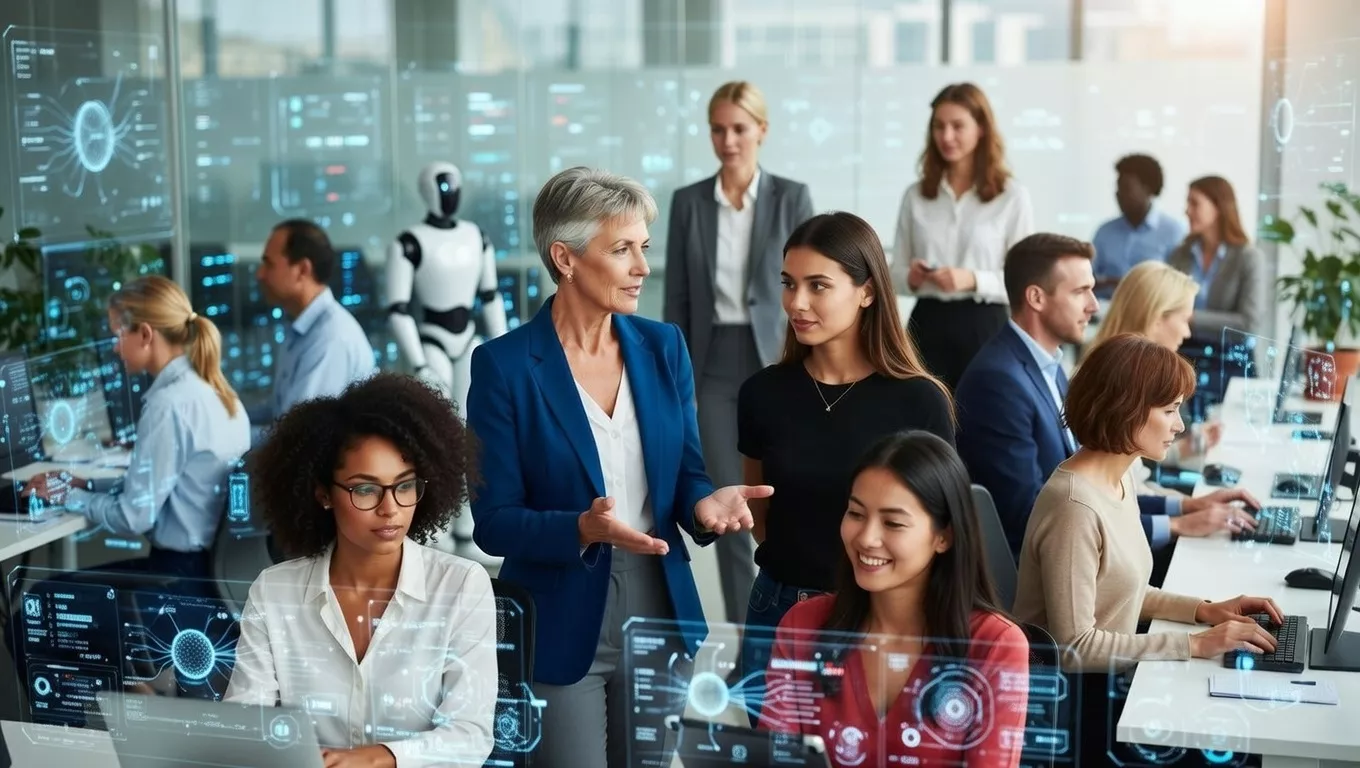
Image Source: Grok
Over the past year, something remarkable has happened in the workplace. The world has turned its focus from humans to artificial intelligence. No longer are workers at the center of business efforts, as artificial intelligence (AI) and its promise of productivity, efficiency, and speed have taken the spotlight in business production. What does that mean for your average employee or worker and their economic future? That is the question we, the American public, must grapple with today.
Despite AI existing for several decades, ChatGPT has exploded into our online reality, especially at its intersection with our everyday life and work. Most articles on AI usage seem to suggest that you should either take AI by the reins and use it for your advantage, or you will be left behind, possibly losing your competitive edge, or in worst cases, your job. Most people I talk to fall somewhere along the spectrum of not knowing what AI is, why they need to use it, or whether it can be trusted. And due to the nature of my work, most people I talk to are women.
For many women, there is good reason to be deeply skeptical of AI. Deepfake images and videos, or technology-facilitated abuse, have created harm for women in ways that society has not fully grasped, and regulations are just starting to address. This abuse has the potential to cause economic harm, as employers often search for candidates online, and finding these videos can turn employers away from viable candidates, judging the content as consensual and willing to be shared online. Yet despite these cruel harms now deemed criminal acts in 2025 through the Take it Down Act, it has created a limiting barrier for women to embrace the goodness of AI, especially in the ways that it has changed how we work, communicate, and make decisions.
One critical article published in the Harvard Business School Review examined AI usage patterns between men and women globally. Through 18 studies, researchers[1] found that women lag 20% behind men in AI usage and suggested that access was insufficient to increase women's use of AI. This gap could have real implications for how AI continues to learn and evolve, as AI platforms use algorithms trained on data from sites predominantly used by men and from AI users, who are also predominantly men. This reality is how, when Chanel, the female-founded, women-led luxury brand, asked ChatGPT what its board looked like, it produced an image of an all-male board.
How can we support women in approaching AI differently? With curiosity, reflection, and grounded possibility. That is what the Center for Economic Futures at Futures Without Violence (FUTURES) sought to uplift at its Women, AI and the Workplace event on Nov. 13th, 2025. We hoped to make the case that women should engage with AI not simply because of hype. Women should engage AI for their own benefit, to upskill, to increase their productivity, to affect their opportunities and economic standing directly. Women from every industry and economic class should learn to use AI to show up with confidence and pursue opportunity, advancement, and financial power.
Video Length: 00:55:31
Weighing the pros and cons of AI, FUTURES brought together a stellar panel of women in the AI ecosystem to unpack the opportunities and challenges AI presents for women. Professor Renée Cummings, Professor of Practice in Data Science at the University of Virginia, Shubhi Rao, the Founder and CEO of Uplevyl, and Konstanze Frischen, co-lead of Aspen Digital, shared their perspectives as to the value of AI for women, where could we think about integrating AI in the workplace, and most importantly, how can we engage with AI safely and ethically.
Some key takeaways include the following:
- AI should be engineered with values and guardrails from the start that account for women, serve those at risk of harm, and protect people in the workplace.
- Data collection should capture how and where women work, bringing value to research on how women are engaging with AI across the world of work.
- Research indicates that women are more thoughtful in the use of AI and in the ethics of its use, so we need more women engaging with AI to strengthen its viability, but also how it is held accountable for the harm it could cause.
With these insights, I feel compelled to see what is on the other side of the AI rainbow. The questions raised at our event provide some guideposts for a path forward.
How to Increase AI Usage Among Women
As with most new skills or knowledge, training is key. Modeling how it can be used to upskill and reskill, and how to implement across industries, will help ensure employees and company leadership have a basic education and understanding of what generative AI is and what it can accomplish.
According to an article in the Harvard Business Review, “Every organization adopting or increasing its use of AI will need to provide its workforce with proper training on AI-enhanced tools and make employees comfortable with the approach it’s taking with the technology.”[2] Training should focus on the safety and ethics of using AI, the governance of AI, and how to continue to improve AI usage across the organization.
Policy development for the workplace serves as the guardrail to help ensure safer use and implementation. This includes understanding the applied ethics techniques in AI design that fundamentally affect the output of any system created.
Finally, normalizing AI as a way of doing business or as part of organizational culture is a key factor in ensuring its steady integration into the workplace. This starts with getting buy-in from leadership to ensure its longevity.
Where should Companies be Encouraging Usage to Improve Productivity
According to AI, AI can improve productivity across many work areas, including automating repetitive tasks like data entry and scheduling, and optimizing workflows in fields such as IT, customer service, supply chain management, and finance. It also helps with data analysis, content creation, project management, and decision-making. More advanced uses of AI include parsing massive datasets to simplify processing, performing predictive data analytics, and improving work processes to increase efficiency.
Yet the effective adoption of AI should start with a strategic planning process that looks at the problem an organization needs to solve, not just the capabilities of the technology. “For organizations having trouble driving adoption of technology, [adopting AI] could be another one of those examples,” Kelly says. “What we want to do is start with a problem and leverage generative AI to solve that problem.”[3]
As AI systems are fueled by data, data preparation and management will also be critical. Evaluating the performance and efficacy of AI technologies is actually helping the evolution of the standard metrics and key performance indicators businesses typically use. This includes carefully analyzing bias and continuing to improve accuracy.
AI's role in Addressing Domestic and Sexual in the Workplace
FUTURES’ National Resource Center Workplaces Respond works to ensure safer workplaces by examining risk and protective factors related to sexual harm. The primary mechanism for doing so is the creation of policies and programs so that all workers know what to expect. This includes policies that address technology-facilitated abuse and human-centered practices that serve the greater interests of workers.
We need international and national policies and regulatory frameworks to ensure that these emerging technologies benefit workers. Regulations should vary and be tailored to the relative risk levels of AI systems across functions, from affecting behavior to abridging people’s rights to ensuring user safety.
All policies should be overseen by a governing authority that involves stakeholders and business functions to help scale AI safely across the organization. This body should ensure that reporting harm is clear, regardless of who is perpetuating the harm—including managers, coworkers, clients, contractors, or leadership.
Leading by Modeling AI Analysis & Integration
Our team at the Center for Economic Futures plans to delve into the complexity of AI tools to determine how to facilitate women’s learning, increase their use and championing of AI in the workplace, and support the development of AI tools that address the needs of women. We have started working on our first generative AI tool to support the employment rights of those who have been impacted by intimate partner or sexual violence. We are also creating guidelines for integrating AI into the workplace while ensuring the safety and well-being of all workers. We hope to support a new generation of women who are safeguarding the use of AI in the workplace while still bringing innovation to the causes, products, and services they represent.
[1] Otis, Nicholas G. & Cranney, Katelyn & Delecourt, Solene & Koning, Rembrand, 2024. "Global Evidence on Gender Gaps and Generative AI," OSF Preprints h6a7c, Center for Open Science.
[2] Hashim, Sashi, Harvard Business Review Briefing Paper. “Artificial Intelligence at Work: Enhancing Employee Engagement and Business Success .” https://explore.zoom.us/media/ai_at_work_zoom.pdf
[3] Kelly, Patrick, Ep. 16, Harvard Business Review, “AI at Work: Got a Minute?” YouTube, 24 January 2024, https://www.youtube.com/watch?v=qDsfToE19ls



Comments


