


Image Source: Pixabay
- Euro drops as US–EU deal triggers broad Dollar strength, mirroring the Japan-style 15% tariff framework.
- ECB remains divided; Eurozone data dump ahead includes growth, jobs, and inflation figures.
- Markets focus on Fed decision, Powell’s guidance, and Core PCE inflation gauge this week.
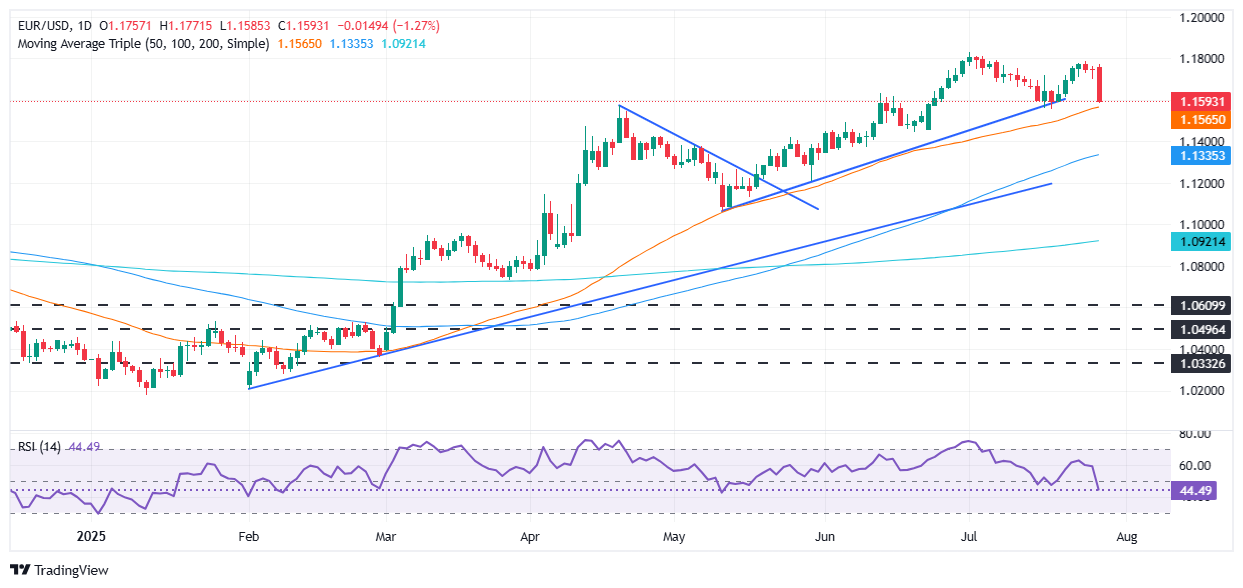
The EUR/USD dropped more than 1% on Monday as investors bought the Dollar on news that the United States (US) and the European Union (EU) had reached a trade agreement, similar to the one inked by Japan. The pair trades at 1.1590 after reaching a high of 1.1771.
Wall Street ended Monday’s session with gains as investors seemed confident that the US would reach additional deals throughout the week. Nevertheless, the August 1 deadline approaches, and Washington remains unable to reach agreements so far with two of its three largest partners: Canada and Mexico.
Aside from this, the US economic docket would be packed in the current week. The Federal Open Market Committee (FOMC) is expected to keep interest rates unchanged at its meeting on July 29–30. Eyes will be on the Fed Chair Jerome Powell as market participants look for cues on when the central bank will resume its easing cycle.
Besides this, further US economic data is awaited. The release of the Fed’s preferred inflation gauge, the Core PCE Price Index for June, along with jobs and growth data, and the ISM Manufacturing PMI, is expected to provide insight into the current state of the economy.
Across the pond, the European Central Bank (ECB) held rates and adopted a meeting-by-meeting approach amid a split division between doves and hawks in the Governing Council.
The EU economic docket will feature Retail Sales data for Germany, growth figures for Spain, Italy, Germany and the EU. Furthermore, traders await the release of HCOB Manufacturing PMIs for Spain, Italy, Germany, and the bloc, jobs data, and inflation figures in Germany, and the EU.
Daily digest market movers: EUR/USD dives ahead of Fed’s decision, busy schedule
- Over the weekend, US President Donald Trump announced that the US and the EU have struck an agreement that will impose 0% tariffs on certain US products imported to the EU. Meanwhile, EU goods would pay a 15% duty, which is lower than the 30% set by Washington two weeks ago. Beyond levies, the agreement would include the commitment of $750 billion worth of US energy.
- Last week’s US economic data—especially on the labor front—supported the Federal Reserve’s decision to keep the federal funds rate unchanged. Policymakers remain cautious, as inflation indicators have yet to resume a clear path toward the central bank’s 2% target.
- Besides the Fed’s decision, traders will be watching the release of the Job Openings and Labor Turnover Survey (JOLTS), which is expected to show that openings decreased from 7.769 million to 7.55 million. Besides this, the Gross Domestic Product (GDP) for Q2 is projected to improve from -0.5% to 2.4% on a QoQ basis. The Fed’s Core Personal Consumption Expenditures (PCE) Price Index is forecast to remain unchanged at 2.7% YoY.
- In the EU, the schedule will feature GDP for Spain, expected at 0.6% QoQ, unchanged from Q1 2025. Retail Sales in Germany are projected to improve from a -1.6% plunge to 0.5% growth.
- US President Trump said the US is going to impose a tariff on the rest of the world, and that's what they will have to pay, while he would love to see China open up its country. Furthermore, Trump said the world tariff would be somewhere between 15% and 20%.
Technical outlook: EUR/USD resumes downtrend, drops below 1.1700 and 1.1600
EUR/USD plummeted below the 20-day Simple Moving Average (SMA) at 1.1693 and also below the 1.1600 figure, following the EU-US trade news. The Relative Strength Index (RSI) turned bearish, indicating that traders are booking profits on the pair and/or shifting slightly bullish on the Dollar.
If EUR/USD tumbles below the 50-day SMA of 1.1569, traders would expect a test of 1.1500. Once surpassed, the next stop would be the 1.1400 mark. On the other hand, if the pair climbs above 1.1600, the 20-day SMA would be up for grabs at 1.1693.
More By This Author:
GBP/USD Slips To 1.3401 As U.S.–EU Trade Deal Lifts Dollar Ahead Of Fed MeetingEUR/USD Ends Week Nearly 1% Higher As Trade Optimism Offsets Weak U.S. Data
Gold Set For Weekly Loss As Strong U.S. Data, Trade Optimism Hits Safe-Haven Demand



Comments
Log in or sign up to join the conversation.