

Image Source: Pexels
Chinese equities are rallying through December and January.
Beijing's efforts in a Tariff-driven world seem to be working.
The yuan strengthened against the dollar and Chinese ETFs are pushing higher.
Over 220,000 put contracts flooded into FXI and ASHR across two trading sessions (popular Chinese ETFS).
Every single print hit at the ask price.
This was aggressive institutional positioning for downside that hadn't arrived yet.
The Signal: 220,000 Contracts Point One Direction
January 20th brought the first wave.
FXI saw 21,000 put contracts bought near the ask. March expiration. The $33 strike.
Someone spent serious capital betting Chinese stocks would fall before spring.

January 21st amplified the bet. Another 136,000 contracts bought.
ASHR told the same story. 46,000 put contracts across two massive prints. 35,000 contracts in the first block. 11,000 more minutes later. Pure directional bearish bets.
These weren't protective puts spread across multiple strikes. This was concentrated firepower aimed at specific price targets.
When institutions build positions this size at identical strikes, they're not guessing. They're positioning ahead of a known catalyst.
The question: What do they see coming?
The Hidden Catalyst: Currency Creates the Trap
Chinese stocks don't trade on fundamentals alone. They trade on currency mechanics most investors never consider.
Since November, the Chinese yuan has appreciated significantly against the dollar. That currency strength acts as a tailwind for Chinese equity ETFs. It takes more dollars to buy yuan. That makes Chinese stocks relatively attractive to U.S. investors. FXI and ASHR benefit mechanically from yuan appreciation.
But here's what history shows. Every time the yuan reverses against the dollar, Chinese stocks lose support fast.
- October 2024: FXI dropped from $42 to $38 when yuan weakened.
- April 2024: Significant selloff followed yuan reversal.
- August 2024: Another decline as currency gave back gains.
The pattern repeats. Yuan appreciation supports Chinese equities. Yuan reversal crushes them.
Right now, the yuan sits extended after months of strength. The trade is crowded.
Beijing likely supported their markets by selling dollars and buying yuan. They may have sold treasuries.
They may have bought gold. They almost certainly bought domestic stocks.
That government support creates artificial stability. When the currency trade unwinds—even slightly—you see big movements in Chinese companies.
The mechanical support disappears. The flows reverse. The stocks that rallied on yuan strength now face selling pressure as that strength fades.
The 220,000 put contracts aren't betting on Chinese economic collapse. They're betting the currency trade is about to reverse.
And when it does, FXI, KWEB, and ASHR will lose the mechanical bid that's been propping them up.
Why This Trade Works Now
Trade tensions sit at elevated levels. Tariff discussions continue. Currency manipulation remains a political flashpoint.
These aren't hypothetical catalysts. They're active forces that could trigger yuan weakness at any moment.
Beijing has shown willingness to intervene in currency markets. But intervention can't last forever.
Eventually, market forces reassert themselves. The yuan gives back gains. The dollar strengthens. And Chinese equity ETFs face mechanical selling pressure.
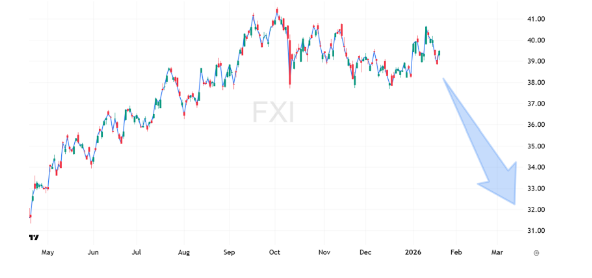
FXI currently trades well above recent support levels. A move back to $37 represents only a one-third retracement from recent highs. A 50% retracement sits at $35.50. These aren't catastrophic targets. These are normal mean reversion levels after an extended rally.
The put buyers positioned for exactly this scenario. They didn't buy deep out-of-the-money lottery tickets. They bought strikes with real probability. Strikes where gamma pressure will build as price approaches. Strikes where the mechanical selling from yuan weakness will feed on itself.
The FXI Trade Structure
Based on the institutional positioning we're seeing, here's one way to capture this setup with defined risk.
Trade: FXI 38/36 Put Vertical Spread
Expiration: March 21, 2026
Target: FXI reaches $36.50-$37
This spread captures the exact same thesis as the massive put blocks that hit the tape. You're positioning for FXI to retrace toward $37 over the next eight weeks. That's less than a 10% move from current levels.
Why this structure works: The options market is pricing heavy downside skew at these strikes.
That means implied volatility is higher on the puts you're buying than normal. But the trade still offers edge because you're aligning with massive institutional flow rather than fighting it.
FXI doesn't need to collapse. It just needs to give back recent gains as the yuan trade unwinds. The put spread captures that move while limiting your risk to a defined amount.
What Happens Next
Currency moves create mechanical flows in equity markets. When the dollar strengthens against the yuan, it doesn't matter what Chinese companies report for earnings.
It doesn't matter what Beijing announces for stimulus. The mechanical support disappears.
That's why 220,000 put contracts materialized across two days at identical strikes. Institutions aren't predicting the future. They're positioning for a currency reversal that history says comes eventually.
When it arrives, Chinese equity ETFs will face selling pressure that feeds on itself.
The FXI put spread gives you defined-risk exposure to this thesis. Your maximum loss is known from the start. Your profit potential is clear. And you're positioned alongside the same institutional capital that spent millions building this exact setup.
The yuan rally since November created the opportunity. The massive put buying revealed where smart money expects the next move. The trade structure captures it efficiently.
More By This Author:
Big Money Is Hedging China
The Market Sold Hard: Don’t Buy, Yet
Tech's 4-Month Warning Sign



Comments
Log in or sign up to join the conversation.