


Image Source: Unsplash
The Australian Dollar inches higher against the US Dollar (USD) on Friday, remaining in the positive territory for the second consecutive day. The AUD/USD pair holds ground following the preliminary reading of Australia's S&P Global Manufacturing Purchasing Managers Index (PMI), which came in at 52.4 in January versus 51.6 prior. Services PMI climbed to 56.0 in January from the previous reading of 51.1, while the Composite PMI climbed to 55.5 in January versus 51.0 prior.
Thursday’s seasonally adjusted employment data from Australia strengthened expectations of tighter monetary policy from the Reserve Bank of Australia (RBA). Employment Change, which arrived at 65.2K in December, swung from 28.7K job losses (revised from 21.3K job losses in November, compared with the consensus forecast of 30K. Meanwhile, the Unemployment Rate declined to 4.1% from 4.3% prior, against the market consensus of 4.4%.
Sean Crick, head of labour statistics at the ABS, said that this month saw more people aged 15–24 move into employment, contributing to the increase in overall employment and the decline in the unemployment rate.
US Dollar weakens ahead of PMI data
- The US Dollar Index (DXY), which measures the value of the US Dollar against six major currencies, is losing ground and trading around 98.30 at the time of writing. The attention will shift to the preliminary reading of the US S&P Global Purchasing Managers Index (PMI), which will be released later on Friday.
- The US economy grew in Q3 by 4.4%, slightly more than initially reported, bolstered by stronger exports and a smaller drag from inventories. Additionally, the Initial jobless claims came in at 200K last week, below the market consensus of 212K. Personal Spending rose at a solid pace in November, underscoring consumer resilience.
- US President Donald Trump said he would step back from imposing tariffs on goods from European nations opposing his effort to take possession of Greenland. He said earlier there is “no going back” on his ambitions regarding Greenland, alongside earlier threats to impose new 10% tariffs on eight European Union (EU) countries.
- President Trump also said that the United States and the North Atlantic Treaty Organization (NATO) had “formed the framework of a future deal regarding Greenland.” However, he did not outline the parameters of the so-called framework, and it remained unclear what the agreement would entail.
- US labor market data has pushed back expectations for further Federal Reserve (Fed) rate cuts until June. Fed officials have signaled little urgency to ease policy further until there is clearer evidence that inflation is sustainably moving toward the 2% target. Morgan Stanley analysts revised their 2026 outlook, now forecasting one rate cut in June followed by another in September, compared with their previous expectation of cuts in January and April.
- The People’s Bank of China (PBOC), China's central bank, announced on Tuesday that it would leave its Loan Prime Rates (LPRs) unchanged. The one-year and five-year LPRs were at 3.00% and 3.50%, respectively. It is essential to note that any changes in the Chinese economy could impact the Australian Dollar, as both countries are close trading partners.
- The International Monetary Fund (IMF) has urged the RBA to remain cautious, highlighting that inflation has stayed above the Bank’s 2%–3% target band for a prolonged period, even though headline CPI eased more quickly than anticipated in November.
- Australia’s TD-MI Inflation Gauge, released on Monday, rose to 3.5% year-over-year (YoY) in December, up from 3.2% previously. On a monthly basis, inflation surged 1.0% month-over-month (MoM) in December 2025, the fastest pace since December 2023 and a sharp acceleration from 0.3% in the prior two months.
- RBA policymakers acknowledged that inflation has eased significantly from its 2022 peak, though recent data suggests renewed upward momentum. Headline CPI slowed to 3.4% YoY in November, the lowest reading since August, but remains above the RBA’s 2–3% target band. Meanwhile, trimmed mean CPI edged down to 3.2% from October’s eight-month high of 3.3%.
Australian Dollar rises to near 0.6850 barrier above upper ascending channel boundary
The AUD/USD pair is trading around 0.6850 on Friday. Daily chart analysis indicates that the pair is rising above the ascending channel pattern, indicating a persistent bullish bias. Moreover, the nine-day Exponential Moving Average (EMA) rises above the 50-day EMA, with the spot price holding above both and reinforcing a bullish tone. This alignment keeps upside pressure in place. The 14-day Relative Strength Index (RSI) at 74.96 is overbought, signaling stretched momentum.
The daily close above the channel would lead the AUD/USD pair to approach 0.6942, the highest level since February 2023. On the downside, the primary support lies at the nine-day EMA at 0.6762. A break below the short-term average would weaken the price momentum and target the lower ascending channel boundary at 0.6680, followed by the 50-day EMA of 0.6664.
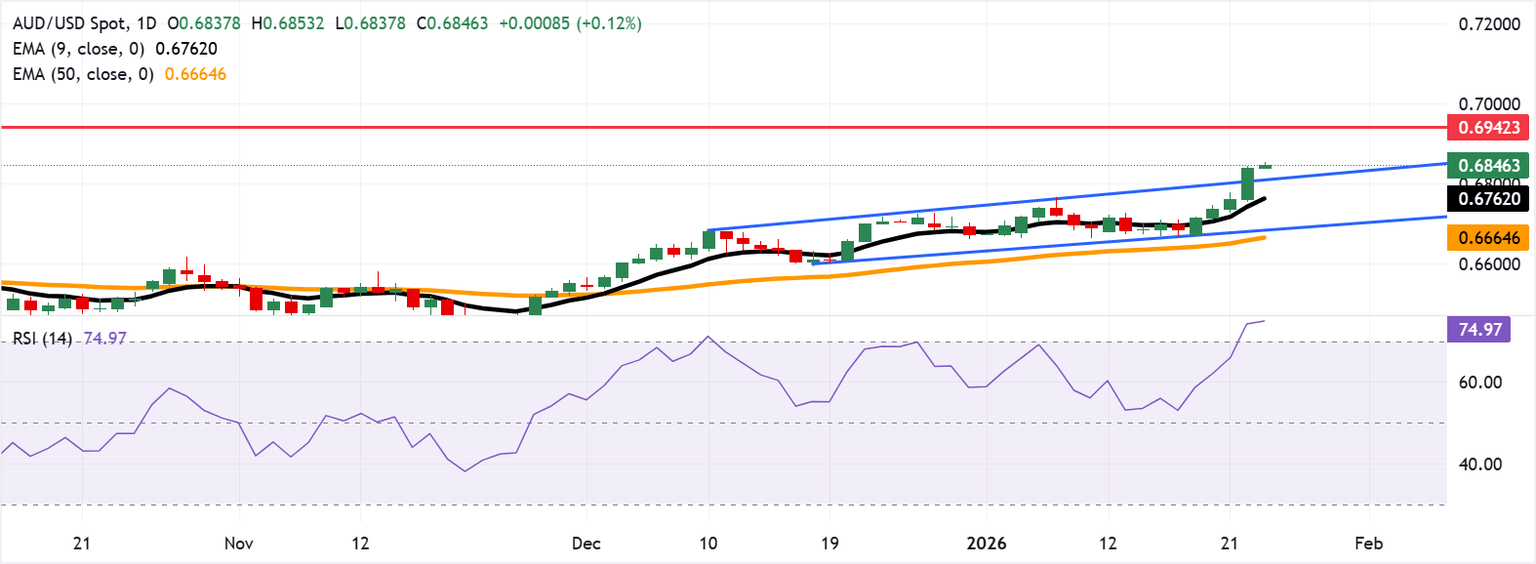
AUD/USD: Daily Chart
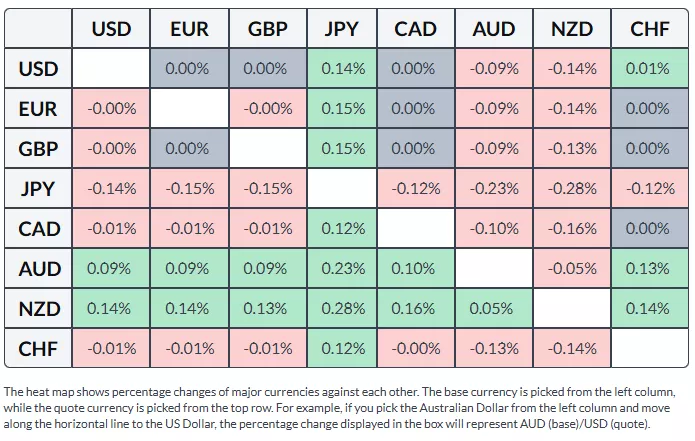
Australian Dollar Price Today
The table below shows the percentage change of Australian Dollar (AUD) against listed major currencies today. Australian Dollar was the strongest against the Japanese Yen.
More By This Author:
Silver Price Forecast: XAG/USD Rebounds Toward $95.00 Near Record HighsAustralian Dollar Rises As Employment Data Boosts RBA Outlook
Australian Dollar Gains As Westpac Leading Economic Index Rises In December


Comments
Log in or sign up to join the conversation.