

(Click on image to enlarge)
Key Takeaways
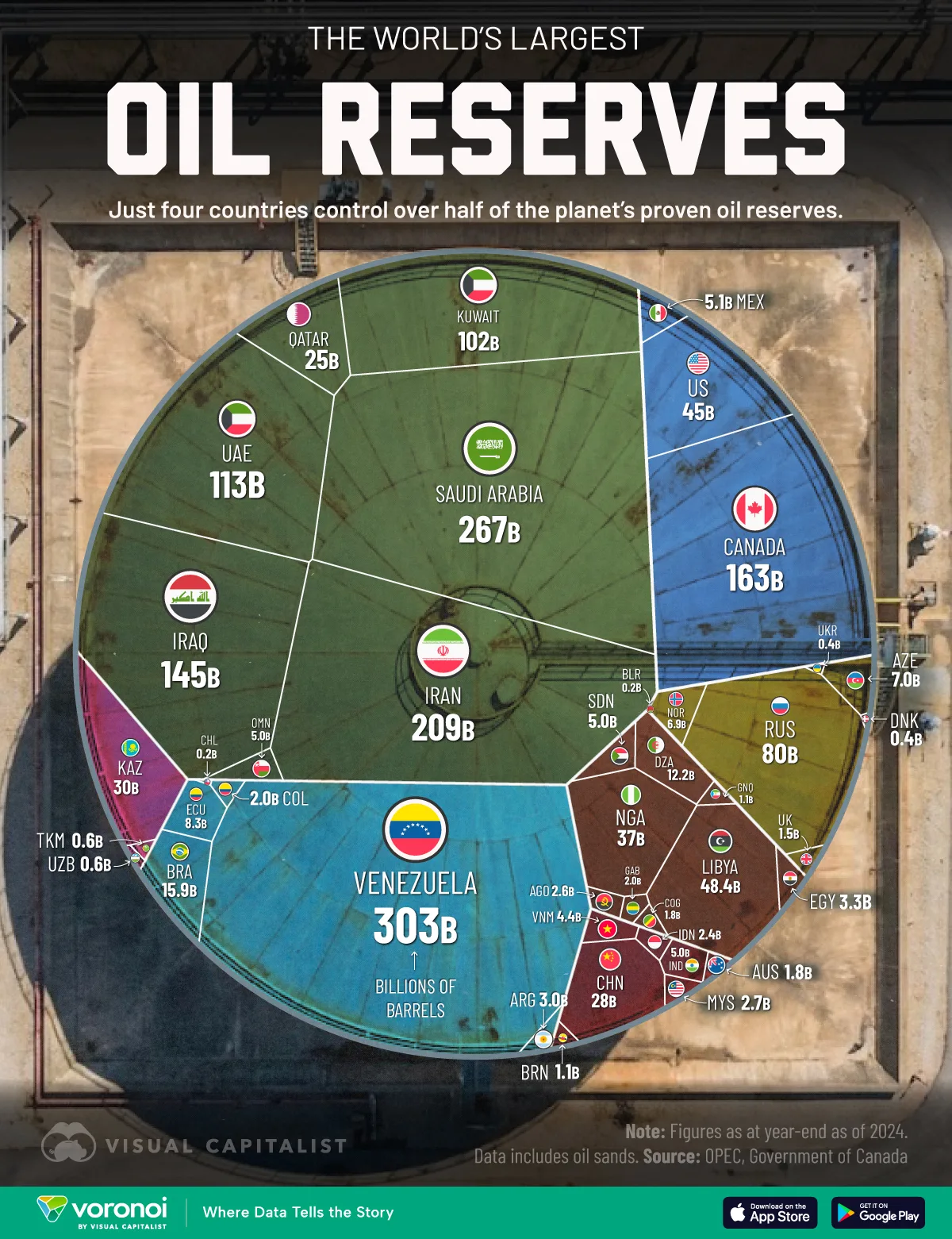
- Just four countries control more than half of the world’s proven oil reserves.
- Despite the energy transition, fossil fuels still account for nearly 70% of global energy demand.
Oil remains one of the most strategically important resources in the global economy. It powers transportation systems, underpins industrial activity, and continues to shape geopolitics and trade flows. While renewable energy is growing, oil still plays a dominant role in meeting global energy needs.
This visualization ranks countries by the size of their proven oil reserves at the end of 2024. The data for this graphic comes from OPEC’s Annual Statistical Bulletin 2025. Figures represent proven oil reserves as of year-end 2024 and are measured in billions of barrels. The data includes conventional crude oil as well as oil sands.
Four Countries Dominate Global Oil Reserves
Global oil reserves are highly concentrated.
Venezuela has the world’s largest proven oil reserves (about 303 billion barrels), but U.S. sanctions have limited its ability to export crude and fully monetize this resource.
President Trump has said the U.S. would take control of Venezuela’s oil reserves and invite American companies to invest in rebuilding the country’s weakened oil industry following a military operation that captured President Nicolás Maduro.
Saudi Arabia follows the South American country with 267 billion barrels. Iran, Canada, and Iraq round out the top five.
|
Rank |
Country |
2024 (Billion Barrels) |
|---|---|---|
| 1 | Venezuela | 303,221 |
| 2 | Saudi Arabia | 267,200 |
| 3 | Iran | 208,600 |
| 4 | Canada | 163,000 |
| 5 | Iraq | 145,019 |
| 6 | United Arab Emirates | 113,000 |
| 7 | Kuwait | 101,500 |
| 8 | Russia | 80,000 |
| 9 | Libya | 48,363 |
| 10 | United States | 45,014 |
| 11 | Nigeria | 37,280 |
| 12 | Kazakhstan | 30,000 |
| 13 | China | 28,182 |
| 14 | Qatar | 25,244 |
The Role of OPEC and the Middle East
Many of the world’s largest oil reserves are held by OPEC members, particularly in the Middle East. Saudi Arabia, Iran, Iraq, Kuwait, and the United Arab Emirates anchor the region’s dominance.
These countries benefit from low extraction costs and large, easily accessible reserves. As a result, Middle Eastern producers are expected to remain critical suppliers even as global demand growth slows.
Oil Sands and Non-OPEC Producers
Canada stands out among non-OPEC countries, ranking fourth globally with 163 billion barrels of reserves. The majority of Canada’s reserves come from oil sands, which are more expensive and carbon-intensive to extract. Russia and the United States also rank among the top 10.
Taken together, the data highlights how unevenly oil resources are distributed and why oil-rich nations continue to have significant economic and geopolitical power.
More By This Author:
Ranked: Magnificent Seven Stock Returns In 2025
Charted: The Growing Gap Between U.S. Home Size And Price
Yuletide Irony? Countries That Export The Most Christmas Decorations
Comments
Log in or sign up to join the conversation.