


Image Source: Pexels
Much of the discussion over the last few years has centered around the Magnificent 7 group of stocks and artificial intelligence (AI). With this amount of attention, investors in the Magnificent 7 have been rewarded with strong performance. This performance has pushed the valuation for some of the stocks to elevated levels.
Broadcom (AVGO) trades at 75 times trailing earnings. However, with the strong projected earnings growth, the forward P/E is 36x. Knowing valuation alone is not a good market timing variable; subsequent to Broadcom's strong earnings report on Friday, the stock closed down over -11%. The trigger for this decline was the company discussing lower margins going forward due to increased demand for its ASIC business. Nonetheless, the market used the weaker margin narrative to sell the stock.
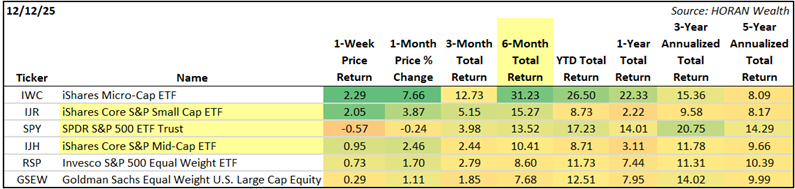
A broadening market outside of the artificial intelligence industry has been underway for six months or so. As the below table shows, the best-performing market segment presented is the micro-cap ETF (IWC), followed by the small-cap ETF (IJR). The return for both small-cap and micro-cap stocks are double or more the return of the S&P 500 Index (SPY). The top two sector weightings in the iShares Micro-Cap ETF are Health Care (28.4%) and Financials (20.6%).
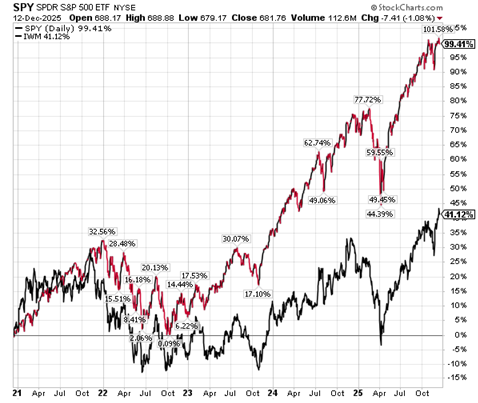
From a reversion to the mean perspective, the small-cap space has been out of favor for some time. The below chart shows that the cumulative return of the iShares Russell 2000 Small Cap ETF (IWM) is up 41.1% versus the S&P 500 Index return of 99.4%. With the interest rate trend looking like lower rates into 2026, this market environment does benefit smaller companies as they tend to be more likely to access debt to finance the growth of their business.
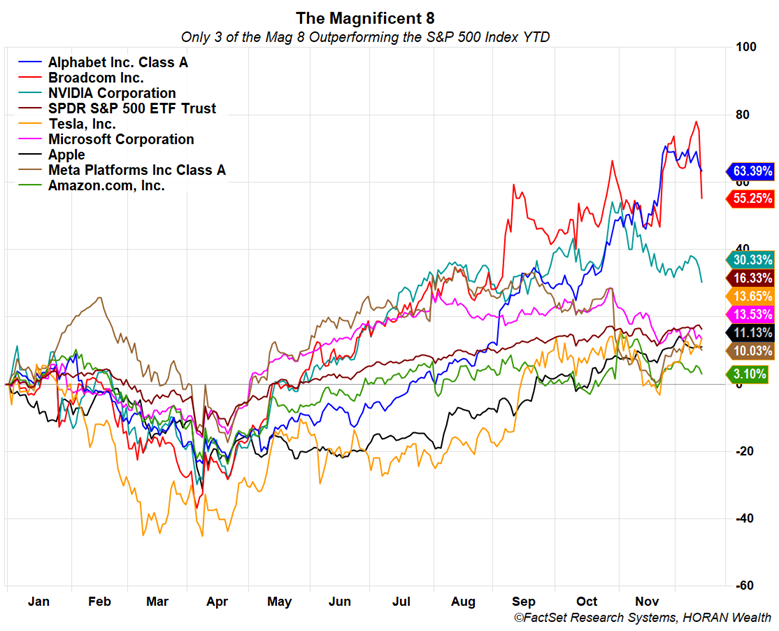
Some further evidence of a broadening market is the fact only 3 of the Magnificent 8 (when including Broadcom) are outperforming the S&P 500 Index on a year-to-date basis.
Lastly, from an earnings perspective, small-cap stocks are experiencing significantly stronger earnings growth versus larger S&P 500 companies, as shown in the below table. With over 90% of companies having reported third quarter earnings, the Russell 2000 has recorded earnings growth of approximately 62.5% versus the S&P 500 Index's increase of 15%.
If monetary policy continues its less hawkish approach, and the economy continues to grow at an increasingly faster pace, recent favorable small-cap returns might be the beginning of a multi-year outperformance cycle.

More By This Author:
Lucky 7's In A Broadening Equity MarketDogs Of The Dow Continue Outperforming Broader Market
A Stock Buyback Strategy Can Provide Balance



Comments
Log in or sign up to join the conversation.