

Image Source: Pixabay
Every so often, a single word surfaces and cuts through the noise. If you’re like me, you know the noise all too well. It’s the stream of emails that pile up overnight. The editorial pieces that demand your attention, each one competing for the same limited resource: your time. Even the newsletters that hit your inbox. (Hey, wait a second!)
Jokes aside, I hope that Global Macro Update has been a source of economic and geopolitical analysis that helps you get ahead of the big market trends shaping our world today.
I think most of us can agree that the global order is shifting.
Alliances are now outwardly frayed. Old rules are bent, and new ones were never written down. It’s like everyone senses that something had ended, but no one can agree on what will replace it.
This sentiment is very much in the mainstream now. Look no further than Prime Minister Mark Carney of Canada’s buzzworthy speech at the World Economic Forum earlier this week in Davos, which prompted global political and corporate leaders in the audience to rise from their seats for a standing ovation like they were at the Cannes Film Festival.
Then there was this:

Source: Reuters
Ice water.
Carney described the end of an era underpinned by US hegemony, calling the current phase a “rupture.” Sure, he never mentioned President Trump by name, but his reference was clear.
The speech came after Trump doubled down on his threats to seize Greenland from Denmark, saying he would slap fresh tariffs on European powers as punishment for their support of Greenland’s sovereignty. He’s since backed off, and it sounds like he’s achieved his goal. Details are scarce at this point, but it is clear: big changes are underway.
“The old order is not coming back. We should not mourn it,” Carney said. “Nostalgia is not a strategy.”
I mentioned at the top that a specific word can cut through the noise. Certain words have the power to clarify, even if the destination remains unclear. It’s not “rupture,” which feels too sudden and immediate and stark. And it’s not “nostalgia” because the old order is, indeed, gone.
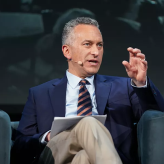
Enter this week’s guest, my friend George Friedman, who just published his annual forecast at Geopolitical Futures. There’s a twist this year in his forecast that stands out: The world is “re-anchoring.”
That’s the word I have stuck in my head. Once you understand what he means, suddenly everything happening right now—from the US-China relationship to NATO’s identity crisis to the President’s focus on Greenland—starts to make a lot more sense.
The Search for a New Anchor
We should start with the Cold War…
For decades, the world was anchored. Brutally so. Every country had three distinct options: side with the US, side with the Soviets, or remain neutral. The system was violent, tense, and dangerous—but it was organized. Everyone knew where the fissures were. Everyone knew what crossed the line.
Then that anchor disappeared.
What followed wasn’t peace so much as drift. The post-Cold War era promised a hubristic globalization without friction, economics without geopolitics, and trade without consequences. For a while, it almost worked. But drift has a way of turning into instability, and instability eventually demands structure.
That’s where we are now.
What Friedman argues (and what I find so compelling) is that the world isn’t simply “de-globalizing” or “rupturing.” It’s searching for a new anchor. And that process is finally manifesting.
Russia, long assumed to be one pole of the global system, increasingly looks like a relic of the old order. Its power was always militaristic, never economic. Strip away the mystique—after Russia tried to take Kyiv and couldn’t—and you’re left with a country that struggles to project force beyond its borders and has little leverage in a world where economics is power.
China, on the other hand, is something entirely different—and that difference matters. We’re deeply entangled. China needs our massive consumer market—we’re a quarter of the world’s economy—and we need its manufacturing, from the phones in our pockets to the medications in our cabinets.

Source: Visual Capitalist
Trade, supply chains, capital flows, technology—this isn’t just a geopolitical standoff. It’s an intimate relationship between two economies that depend on one another, even as they eye each other warily across oceans.
That intimacy is precisely what makes the current moment so unstable… and so important. We’re trying to do something historically unnatural: maintain a potentially hostile military relationship alongside a deeply intertwined economic one. History suggests that kind of arrangement doesn’t last forever. Eventually, something gives. Either the hostility recedes or the economic ties do.
The re-anchoring, as Friedman sees it, is the attempt—on both sides—to figure out what a sustainable balance looks like. This isn’t about sudden decoupling or dramatic confrontation. It’s about recognition that the old assumptions no longer work, and that dependence cuts both ways. A world anchored around US-China dynamics will look very different from the one anchored around the US-Soviet rivalry.
And it’s not just Washington and Beijing feeling the shift. Europe, in many ways, is the most exposed. For years, it lived comfortably under the old anchor—US security guarantees, Russian energy, Chinese trade. That triangle is gone. The question Europe now faces isn’t how it relates to the rest of the world but how it relates to itself. Is it a coherent actor? Or a collection of countries with shared institutions and very different instincts?
That uncertainty feeds into everything—from debates about NATO’s relevance to awkward conversations about defense, energy, and autonomy. When anchors move, everyone must adjust their footing.
Even Geography Is Back in Play
Places that once felt peripheral—icebound islands, polar routes, forgotten chokepoints—suddenly matter again. Not because of ideology but because control of space, trade routes, and communications has reemerged as a first-order concern. Re-anchoring isn’t abstract. It’s physical. It’s maritime. It’s strategic in ways that feel almost old-fashioned.
What struck me most in talking with George is that none of this is presented as neat or comforting. Re-anchoring is not a smooth process. It’s messy, political, and contradictory. Rational interests collide with domestic pressures. Long-term strategy clashes with short-term tactics. Even superpowers grope their way forward.
That’s precisely why the concept is useful.
It gives us a framework to understand why so many things feel unsettled at once—trade, alliances, military posture, even domestic politics. These aren’t isolated issues. They’re symptoms of a system searching for its next point of balance.
“It’s going to be a very unpleasant period,” George says. “And it was predictable.”
The question isn’t whether re-anchoring is happening—it’s what the world looks like on the other side.
I encourage you to watch my full conversation with George.
Video Length: 00:34:24
More By This Author:
Rethink The Mag 7You’re Worried About the Wrong AI Problem
Why The Fed Has No Choice But To Monetize The Debt


Comments
Log in or sign up to join the conversation.