

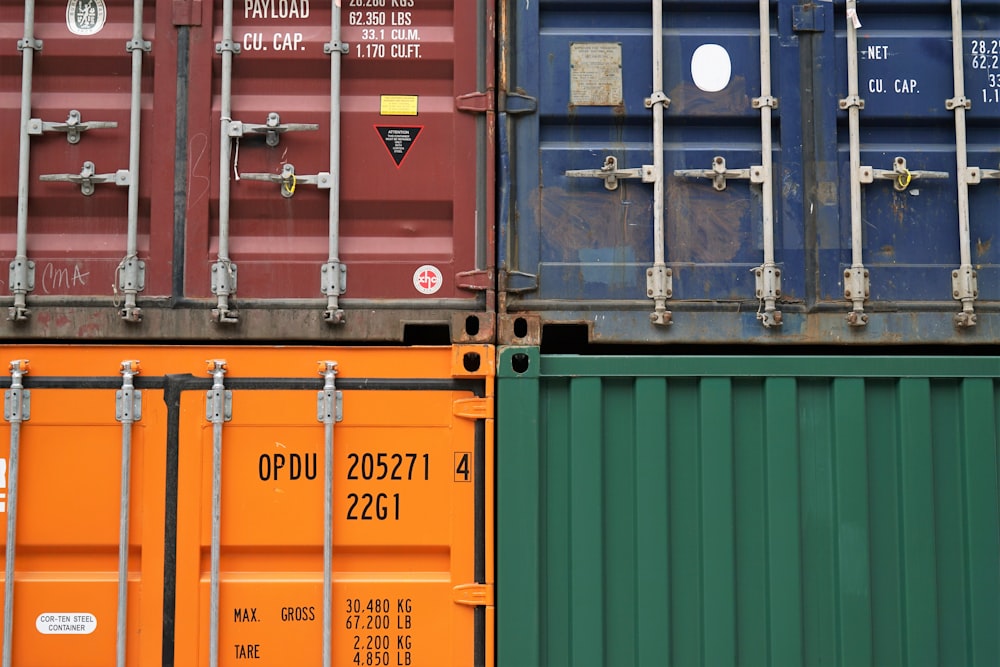
Image Source: Unsplash
The world economy has been in the midst of a second age of globalization for the last few decades–although, at present, it is not altogether clear whether the globalization trendline is up, flat, or down. However, Marc-William Palen takes a look back at the end of the first age of globalization that ran from the closing decades of the 19th century up through World War I in “When Free Trade First Faltered” (Finance & Development, September 2025). This short article covers some of the themes in Palen’s recent book about the same time period in Pax Economica: Left-Wing Visions of a Free-Trade World. Here are a couple of themes that jumped out at me:
The first era of globalization happened at a time of tariff wars and geopolitical conflict. Palen writes:
The “first age” of globalization was beset by contradictions. In the 60 years or so before World War I, global trade grew rapidly despite the ever-higher tariff walls built by the rising protectionist empires of the United States, Germany, Russia, France, and Japan. Geopolitical conflicts and trade wars grew more common even as markets became more integrated. These contradictions were at the heart of heated debates over free trade and economic nationalism that dominated the industrializing world at the time.
So how is it possible that global trade was rising dramatically at a time when trade barriers were also very high? President Trump is seeking to move US tariff levels back to where they were in the 1920s, or even the 1890s–but the 1890s were actually a heyday of globalization. The answer, worth remembering today, is that international trade is affected by govenment policies but perhaps even more affected by economic underpinnings. And the late 19th century saw technological shifts that dramatically increased the potential for international trade. Palen writes:
Transoceanic steamship lines drastically lowered transportation costs and travel times. The transatlantic cable, successfully laid in 1866, meant that messages between Wall Street and the City of London took mere minutes. The opening of the Suez Canal in Egypt and the completion of the US transcontinental railway in 1869 shrank the world even further. …
But globalization’s unprecedented interdependence soon landed the industrializing world in an unpredictable boom-bust economic cycle. Low transportation costs, mass industrialization, and trade liberalization cut costs for consumers, but the steep fall in prices also meant tighter profit margins, or even losses, for many of the world’s exporters. … The first age of globalization was facing the first Great Depression (1873–96), and protectionism and colonialism were the policies of choice of the industrializing world. Globalization’s protesters grew louder. As is common during economic crisis, cries for national self-sufficiency drowned out calls for cosmopolitan comity. Free trade fell out of fashion among Britain’s imperial rivals …
In our own time, technologies of transportation and communication have of course also developed rapidly around the world: container shipping, giant tankers, air freight, extended rail lines and ports, along with the ability to manage and oversee production and shipping of international trade in real time over the internet. Moreover, the ratio of value-to-weight has been rising for many technology goods, so the costs of shipping them become relatively lower. The share of services trade that can be done in one place and shipped online to another country keeps rising.
In short, one lesson from the first wave of globalization is that when the economic forces are expanding the potential for gains from trade, pushback from political forces is likely–but the pushback may have to be quite extreme if it is to reshape the economic trend toward additional flows of goods, services, and information across national borders.
Another main theme of Palen is that the forces of globalization are often regarded as synonymous with the forces of market capitalism. But back in the late 19th century, the political support for free trade came mainly from the political left. Palen emphasizes the pro-protectionism writings of Friedrich List, whose philosophy was that countries should close their borders to imports, build up their own industries, and then sell to the expanding but captive markets of their own colonies. As Palen writes:
Imperial-minded economic nationalists across the globe began to revere List’s national system as economic divination. Free trade was seen as part of a vast British conspiracy to thwart the industrialization projects of rivals—a self-serving trick to undermine emerging industries elsewhere. List-inspired economic nationalists saw geopolitics as a zero-sum game in which only the fittest would survive.
The technological tools of globalization that not so long ago promised to tie the world together in benign universalism now seemed better suited for binding colonies to imperial metropoles. Tariff walls grew ever higher, turning infant industries into monopolies, cartels, and trusts. Monopoly-induced market inefficiencies at home soon sparked an interimperial search for new markets to export surplus capital and acquire raw materials. Trade wars, military interventions, and the scramble for colonies in Africa and Asia picked up pace.
By 1880, economic nationalists had the upper hand. Their imperial protectionist politics moved ever more to the right. In the US, the Republican Party rebranded itself as the party of protectionism and big business, reversing the freer trade trend of the preceding decades. The 1890 McKinley Tariff, which imposed an unprecedented average rate of about 50 percent, plunged the country into trade wars with European trading partners.
An intriguing parallel with modern times is that, once again, the forces of high tariffs and trade protectionism are often discussed (as in the late 19th century) as if they were the embodiment of hard-headed national toughness. Palen argues that back in the late 19th century, it was the liberal radicals, socialists, internationalists, feminists, and Christians who advocated for free trade as part of their overall critique of imperialism and militarism. In modern US politics, it’s hard to identify a mainstream popular movement that openly contests President Trump’s vision that national prosperity can and should be built behind tariff walls. But it does seem as if people are noticing that the tariffs (as predicted) are helping to keep prices higher, while not triggering the promised renaissance in US manufacturing jobs or solving the US trade deficit.
More By This Author:
Some Snapshots Of Global UrbanizationGovernment Data: Report Of The American Statistical Association
Antitrust Enforcement Around The World


Comments
Log in or sign up to join the conversation.