


Photo by Ibrahim Boran on Unsplash
The euro and other major currencies staged a recovery this morning as the U.S. dollar extended its decline. EUR/USD led the move higher, supported by broad-based dollar weakness and upbeat European services PMI data. Market sentiment also improved after Russia described ongoing negotiations as “constructive” and clarified that President Putin had not dismissed the entire U.S. peace proposal for Ukraine, acknowledging that some elements were acceptable.
Dollar to stay offered
Despite trying to bounce here and there, the US dollar index has come under pressure in recent days, and it looks like it is potentially resuming the general decline seen earlier this year. It did recover a little ground in the last couple of days, likely helped by safe-haven flows moving away from high-beta currencies – which kind of reversed this morning. Still, a bit more stability in broader risk sentiment is probably needed before the dollar can weaken more substantially against the more risk sensitive currencies. But against the yen, any further volatility in stock or bond markets could see the USD weaken and weigh on the USD/JPY pair. The euro has also been showing signs of strength, and it does tend to hold its own relatively well even when risk sentiment turns sour, suggesting investors are seeing it as a more haven currencies in recent years than perhaps a decade or so ago.
Indeed, US data continues to lean bearish, highlighted by Monday’s weaker ISM manufacturing print. Even if that release had surprised to the upside, it’s unlikely the market would have meaningfully altered expectations for a December rate cut. Importantly, the key US indicators — such as the jobs report — won’t be released until after next week’s December rate decision. That timing significantly limits this week’s potential to influence rate-cut expectations. As such, I expect the upcoming data released today (ADP private payrolls and ISM services PMI) and tomorrow (Jobless Claims and Challenger Job Cuts) to broadly reinforce the market’s dovish view.
Euro holds steady
Underscoring the relative calm in the eurozone, today saw the German-Italy bond yield spread fall to 70 basis points for the first time since 2010. This helped to keep the EUR/USD currency pair supported, especially as markets continue to price out the prospects of another rate cut by the ECB.
The Russia-Ukraine peace talks remain the key driver for the euro this week. With Kremlin denying that President Putin rejected all of US peace plan for Ukraine, saying parts were 'acceptable', markets are still hopeful that a peace deal could be reached and should get a clearer sense of whether we’re edging any closer to a genuine breakthrough soon. However, the fact that Putin is showing no signs of compromise over territorial concessions for Ukraine, it looks like the war is going to drag on for now, which is unfortunate. Still, we are now a lot closer to hopefully see peace and an end to the war than ever before.
On the data front, eurozone services PMIs were revised slightly higher across the board, lifting the bloc’s final PMI reading to 53.6 from 53.1. Yesterday, Eurozone CPI nudged up from 2.1% to 2.2% in November, while core inflation held steady at 2.4%. At this stage, disinflationary forces and lingering price pressures are effectively cancelling each other out — and importantly, they’re doing so at levels that don’t justify further rate cuts.
Markets hadn’t been expecting an imminent cut anyway, and nothing in this week’s numbers really shifts that view. I do think inflation could slip below target in the coming months, but the medium-term picture still carries enough upward pressure to stop the ECB from leaning too far in a dovish direction.
EUR/USD key levels to watch
The EUR/USD has been moving higher for a second straight week, extending the mild upward drift we saw throughout November. The recent price action has been consistently bullish, and the break above several important resistance levels reinforces that positive momentum.
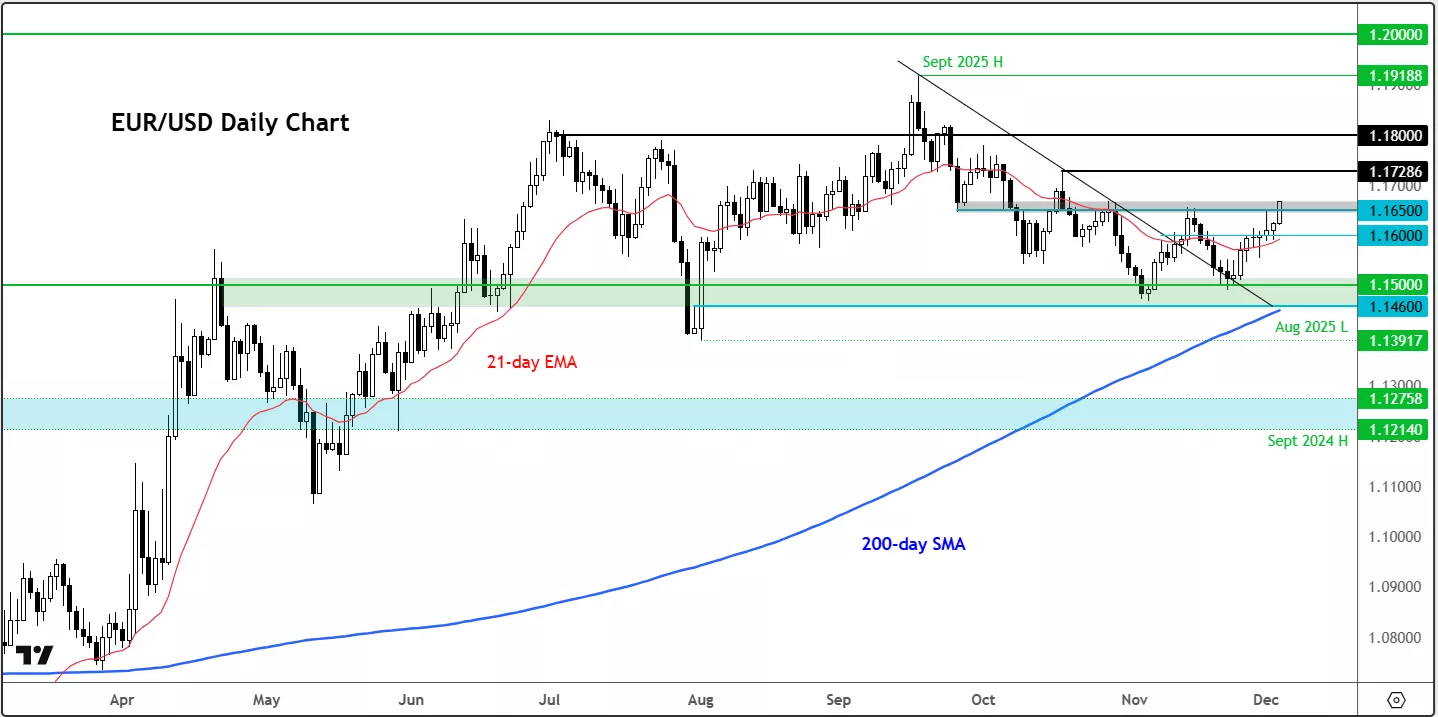
EUR/USD has now pushed through 1.1600 and 1.1650, both of which had acted as firm resistance in the past. The big question from here is whether the pair can maintain support above these levels and continue driving higher toward 1.1700 and potentially further.
Just above 1.1700, the next upside target sits around 1.1728, which corresponds to the latest swing high. A break above that would expose 1.1800 as the next notable resistance zone. We’ll have a clearer picture of the broader trend if the market manages to reach those levels.
To the downside, 1.1600 is now the first area of support. Beneath that, the 1.1550 region provides an additional cushion. Still, the most important support range remains the established zone between 1.1460 and 1.1500, which has held firm on several occasions in recent months.
More By This Author:
Gold Starts December On A Positive Note, But Things Could UnravelNasdaq 100: Will The Recovery Hold?
Gold Awaits Direction From Stock Markets



Comments
Log in or sign up to join the conversation.