


Image Source: Unsplash
West Texas Intermediate (WTI) Crude Oil prices are holding firm above $67.00 on Friday as traders digest a shift in the fundamental landscape.
A combination of revised US production forecasts, robust domestic fuel demand, and persistent geopolitical threats is providing support despite ongoing concerns around trade tariffs introduced by the Trump administration.
At the time of writing, WTI is trading around $67.27, stabilizing after a volatile week driven by headlines ranging from fresh tariff announcements to updated drilling projections.
One of the more significant developments this week occurred on Tuesday, when the Energy Information Administration (EIA) revised its forecast for US crude production for the year.
The agency now expects 13.37 million barrels per day, down from the prior estimate of 13.42 million. This marks the second consecutive month of downward revision and reflects the slowdown in rig activity seen across shale basins since late Q2.
Lower production expectations are being interpreted as a sign that supply may remain tight heading into the winter months, particularly if demand remains elevated and global disruptions emerge.
While inventory data from earlier in the week showed a surprise build in Crude stockpiles, with the EIA reporting a 7.07 million barrel increase on Wednesday, markets quickly shifted their focus to gasoline demand.
Ahead of the Independence Day holiday, gasoline consumption in the US jumped to multi-month highs, reinforcing the narrative that fuel demand remains resilient despite elevated pump prices and lingering inflation.
This seasonal strength has played a key role in limiting downside moves in WTI, particularly as refinery margins remain healthy and utilization rates stay high.
President Donald Trump’s announcement of a 35% tariff on Canadian oil imports, followed by broader threats of 15–20% tariffs on other trading partners, initially raised concerns about retaliatory measures or supply disruption.
However, the muted market response suggests traders are largely viewing the announcements as politically motivated, rather than indicative of real logistical risk in the short term.
While tariffs could distort flows later in the year, the current view is that physical supply chains, particularly pipelines between the US and Canada, will remain operational.
(Click on image to enlarge)
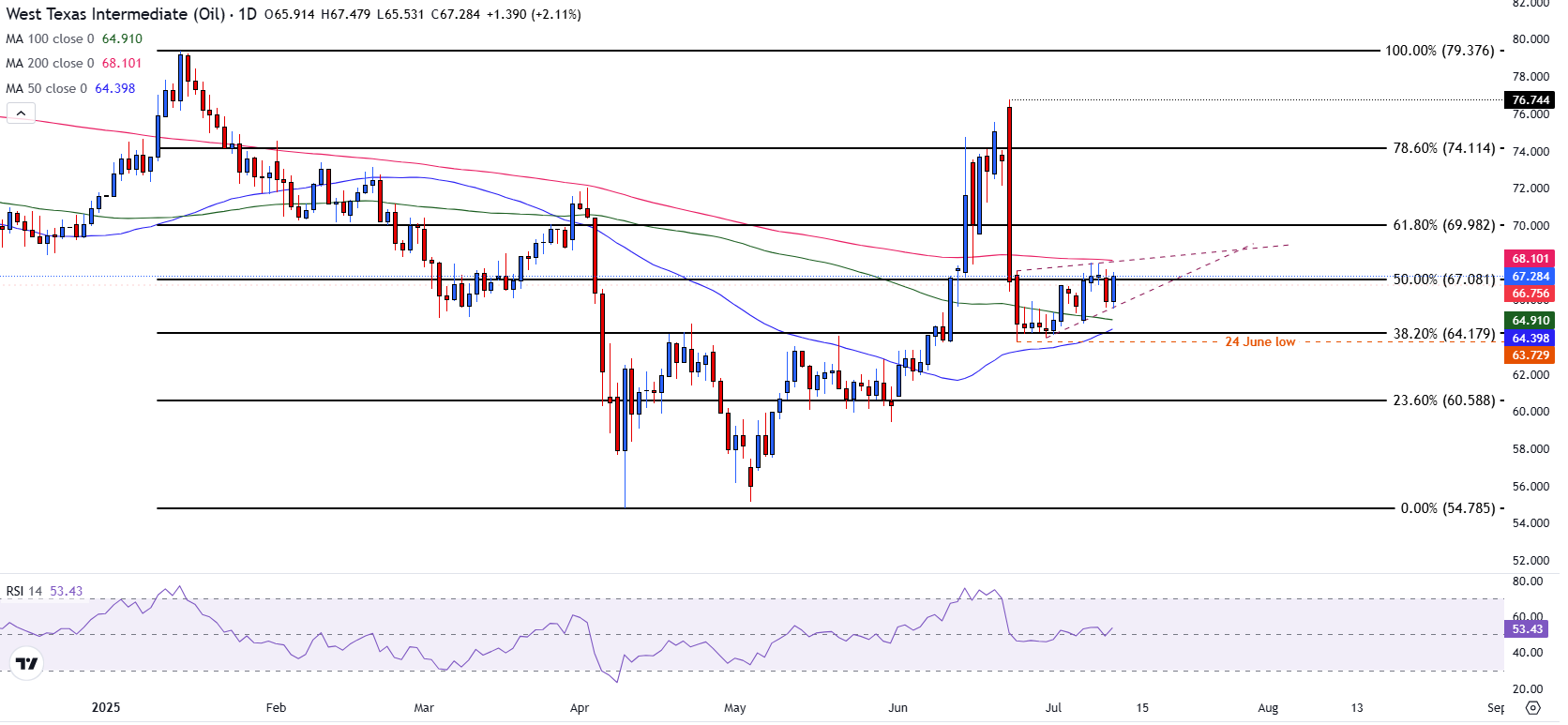
West Texas Intermediate (WTI) is currently trading near $67.27, stabilizing within a tightening range as price action consolidates just above the 50.0% Fibonacci retracement of the January–April decline at $67.08.
This level now acts as immediate support, while additional downside levels include the 100-day Simple Moving Average (SMA) at $64.91, the 50-day SMA at $64.40, and the June 24 low at $63.72.
On the upside, the 200-day SMA at $68.10 remains the primary resistance to watch.
A confirmed breakout above this level could expose the 61.8% Fibonacci retracement at $69.98. Structurally, WTI is forming a short-term ascending triangle, characterized by higher lows since late June, which suggests underlying bullish pressure.
The Relative Strength Index (RSI) is currently near 53, indicating a modest bullish bias.
More By This Author:
Gold Spikes As Safe-Haven Demand Surges On Trump's Tariff ThreatsGold Rises For Second Consecutive Day As Trade Tensions Intensify
Gold Flirts With $3,300 As FOMC Minutes And Tariff News Loom


Comments
Log in or sign up to join the conversation.