
On New Year’s Eve, my biggest challenge is trying to stay awake until midnight.
But from an infrastructure perspective, New Year’s Eve is a massive challenge. In fact, it’s one of the biggest stress tests our power grid faces all year.
That’s because on New Year’s Eve, millions of people do the same thing all at once.
They flip switches.
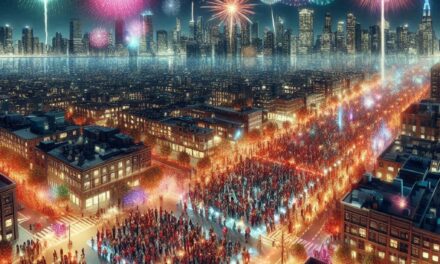
Around the country, televisions and sound systems get turned on. Lights glow in living rooms, bars, stadiums and city squares. In many cities, entire skylines light up all at once.
That kind of synchronized demand isn’t typical.
And for our aging electric grid, it’s anything but trivial.
THE MIDNIGHT SURGEEMPTY HEADING
Electricity is different from most things we rely on.
It still can’t be stockpiled at any meaningful scale, which means it has to be generated, transmitted and consumed almost instantly.
In the United States, our power grid is designed to operate at 60 cycles per second — 60 hertz — and it must stay within very tight margins of that frequency to avoid equipment damage or outages.
This requirement forces grid operators to match supply and demand in real time.
When demand rises, the system slows. When demand falls, it speeds up. And if the frequency drifts outside its narrow tolerance range, the grid’s protective systems can disconnect generators or loads to stabilize the network.
Even small imbalances can trigger automatic balancing and protective systems. And this can sometimes cause wide outages.
On an ordinary night, demand forecasts keep our grid stable. Typically, people come home from work, cook dinner and watch TV. Then demand tapers off as they go to bed.
But New Year’s Eve doesn’t follow that script. Instead, demand builds throughout the evening. Then, right at midnight, it jumps as the ball drops.

Image: Wikimedia Commons
When that happens, there’s no margin for error.
For decades, grid operators handled nights like New Year’s Eve by overbuilding capacity. They kept backup generators ready and relied on experienced human operators to make quick decisions.
That approach mostly worked in the past. But it doesn’t work well with a grid that has tighter tolerances and far less room for human delay.
Because today’s power grid is more complex than it’s ever been.
Coal and nuclear plants that ran at a steady output for decades are being replaced by solar and wind. Those renewable sources are cleaner, but they fluctuate with weather and daylight.
The electrification of vehicles and industries adds new, unpredictable demand. And the increasing demand of data centers is taxing the grid like never before.
Collectively, U.S. data centers consumed around 4.4% of the country’s electricity in 2023. That share could expand to somewhere between 6.7% and 12% by the end of the decade as AI workloads and cloud computing grow.

Source: LBNL
And these large data centers are massive loads. Some hyperscale facilities draw tens to hundreds of megawatts continuously. That’s roughly equivalent to the power demand of a small town.
New Year’s Eve exposes the limits of a grid that was designed for a slower, more predictable world before massive data centers existed.
And that’s why AI has started to step in.
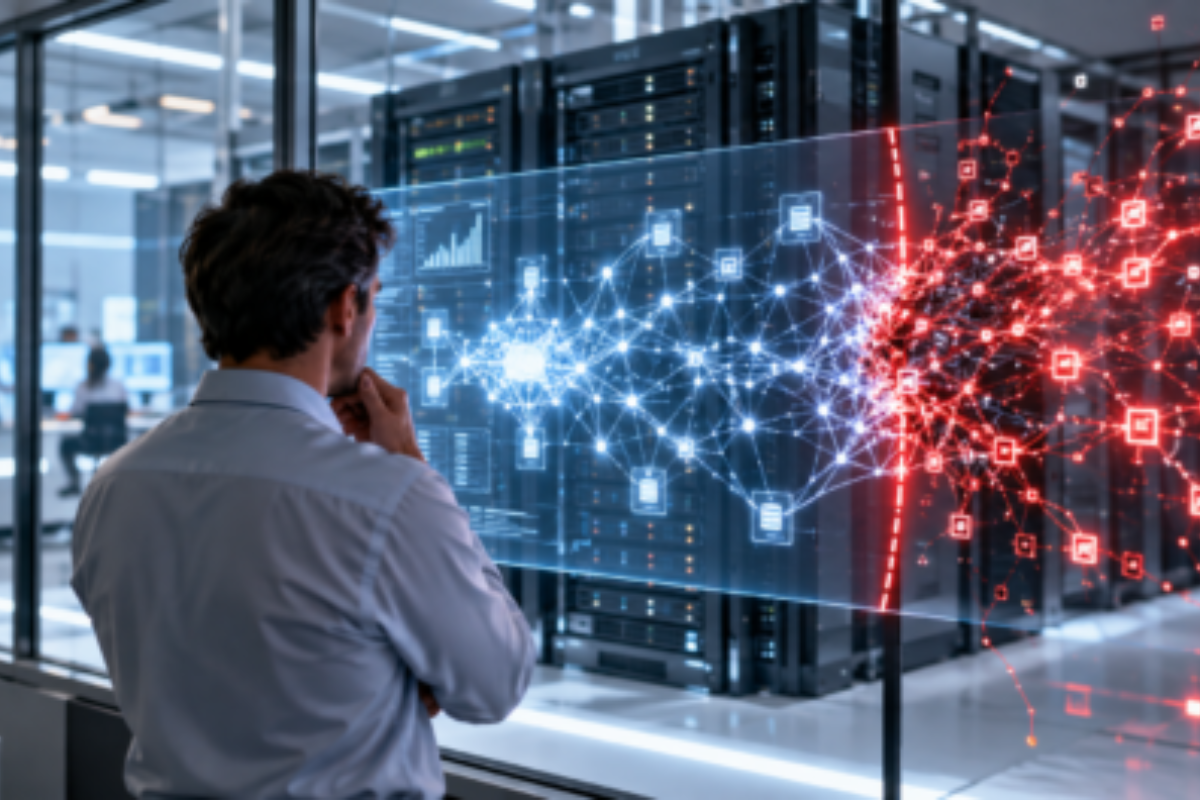
Modern power grids are increasingly being managed by software that can see problems forming before they happen. And these AI systems forecast demand using far more than historical averages. They ingest weather data, event schedules, traffic patterns and real-time sensor readings from across the grid.
In other words, these systems know what’s coming on New Year’s Eve. They anticipate the midnight surge and bring additional generation online ahead of time.
They also coordinate grid-scale battery storage systems, helping absorb and supply energy within seconds when needed.
These batteries can respond in milliseconds — much faster than traditional generators — and provide critical flexibility when demand spikes unexpectedly.
AI also helps the grid by temporarily lowering power use from large consumers, which can smooth peaks without customers noticing.
And when a surge does hit, AI adjusts continuously.
If a neighborhood spikes faster than expected, power flows are rerouted. If a generator stumbles, backup resources are dispatched automatically. And if renewable output dips, stored energy fills the gap.
All of this happens in mere seconds.
Of course, people are still there to supervise. But they aren’t flipping switches manually anymore. Instead, they’re overseeing systems that react faster than any humans ever could.
Not that you’re supposed to notice.
As long as the lights stay on and the countdown hits zero without a hitch, most people never think twice about what’s happening on the power grid.
And that’s the point. If AI is doing its job, everything just works.
HERE’S MY TAKE
New Year’s Eve has increasingly tested my ability to stay up late enough to ring in the new year.
But it has always tested our electrical grid in ways that it rarely experiences during the rest of the year. So when the ball drops and the lights stay on, it’s worth remembering what’s happening behind the scenes.
AI is making the grid more flexible, more resilient and more capable of supporting the next wave of technological growth.
If it can handle a synchronized midnight surge across millions of homes, surely it can handle much more than that.
Not just on New Year’s Eve, but on every night of the year.
More By This Author:
Is Quantum Entering Its Infrastructure Phase?
JPMorgan Just Confirmed My Tokenization Thesis
The Year Santa’s Supply Chain Went Digital


Comments
Log in or sign up to join the conversation.