

.webp)
Photo by Zlaťáky.cz on Unsplash
The volatile week in the gold and silver markets has continued on Thursday, with the gold price moving around quite a bit, but roughly flat on the day, while silver is another $2 lower at the moment.
Here’s the one-day chart for the gold futures, which are currently down $6 to $4,457.
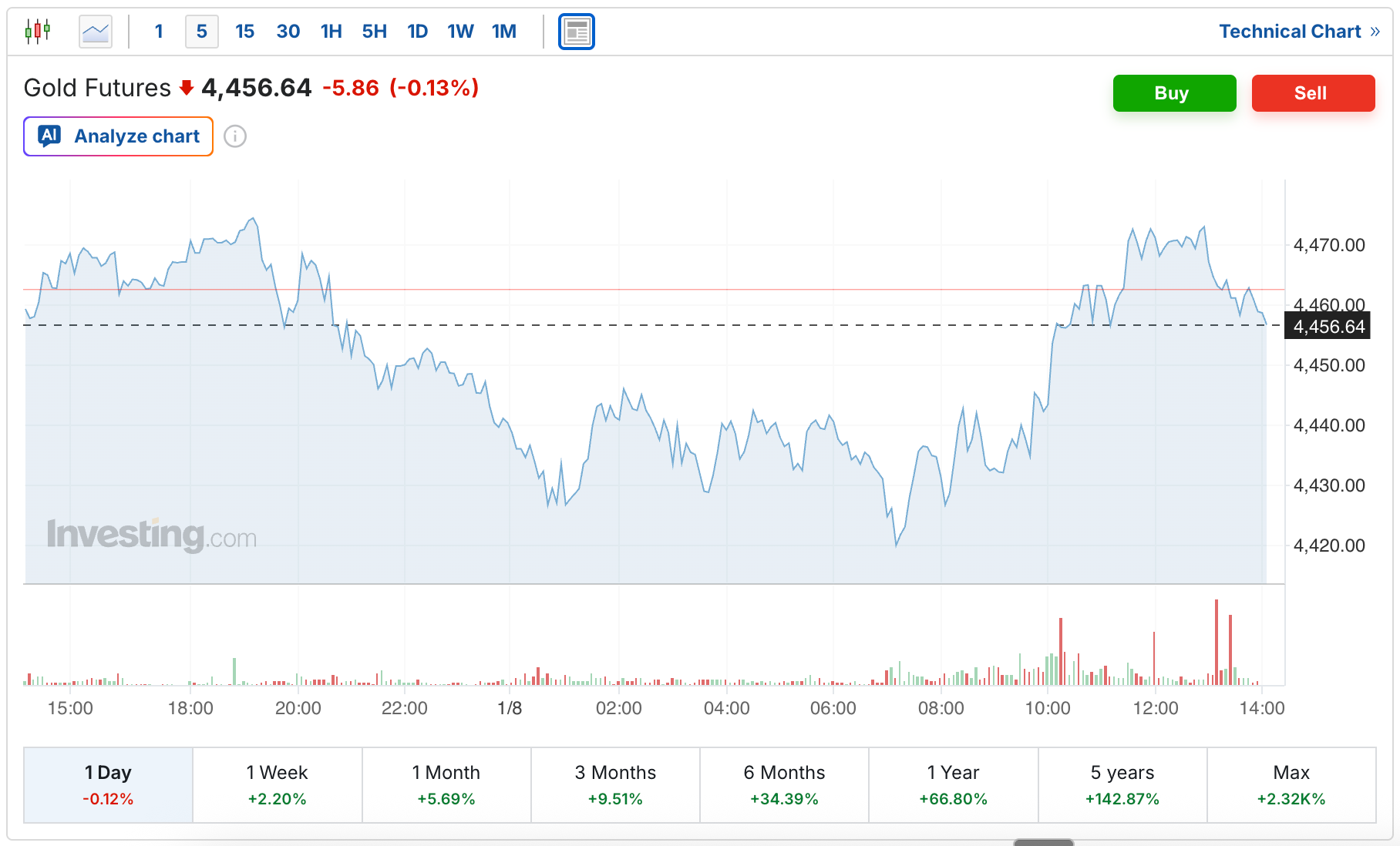
Today’s range in gold from peak to trough is $60.

It’s a slightly different picture with the silver futures, where the price is down more substantially, although almost $2 off of the lows of the day.
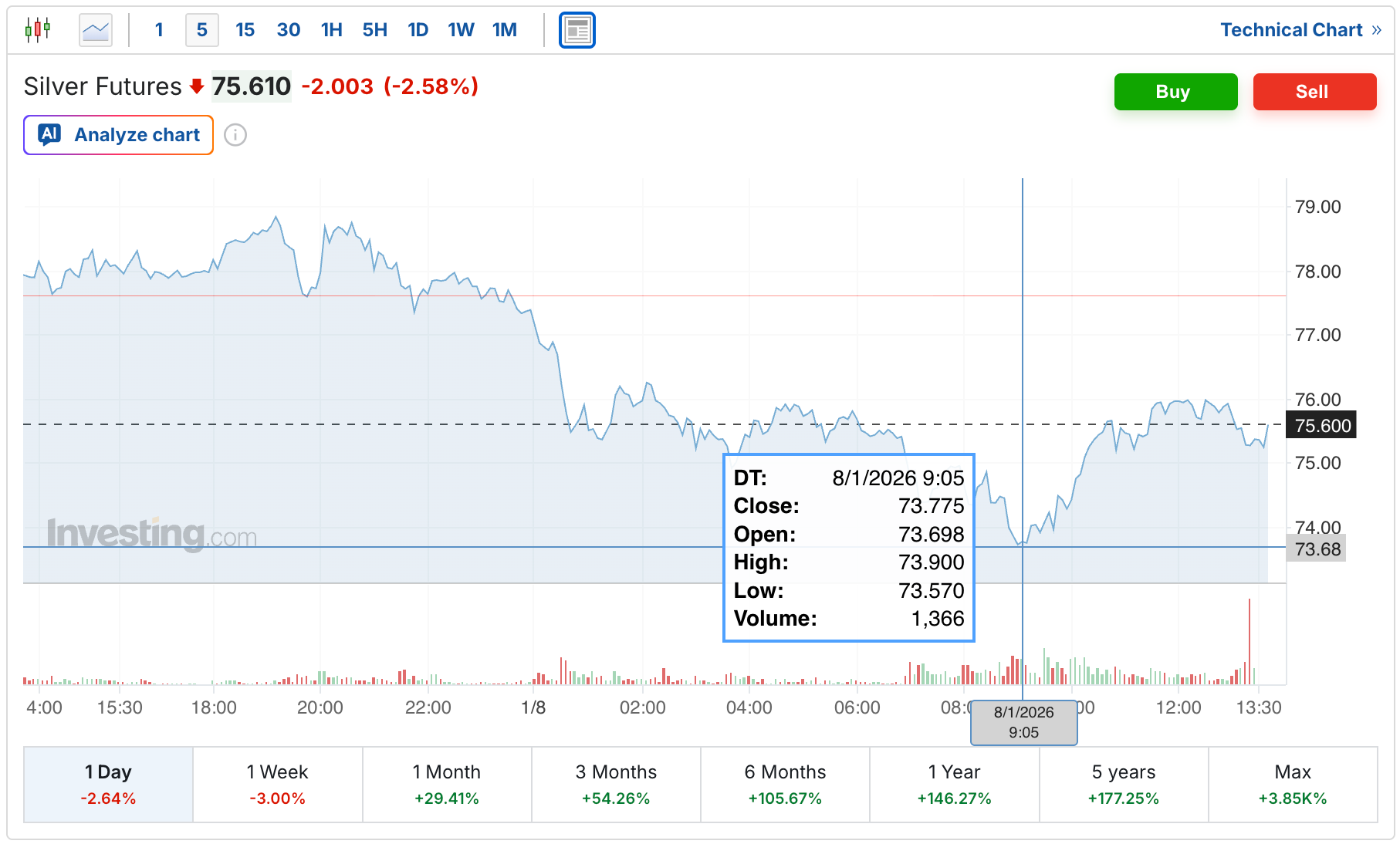
The silver market also remains in backwardation, with the spot price currently 25 cents higher than the March futures.

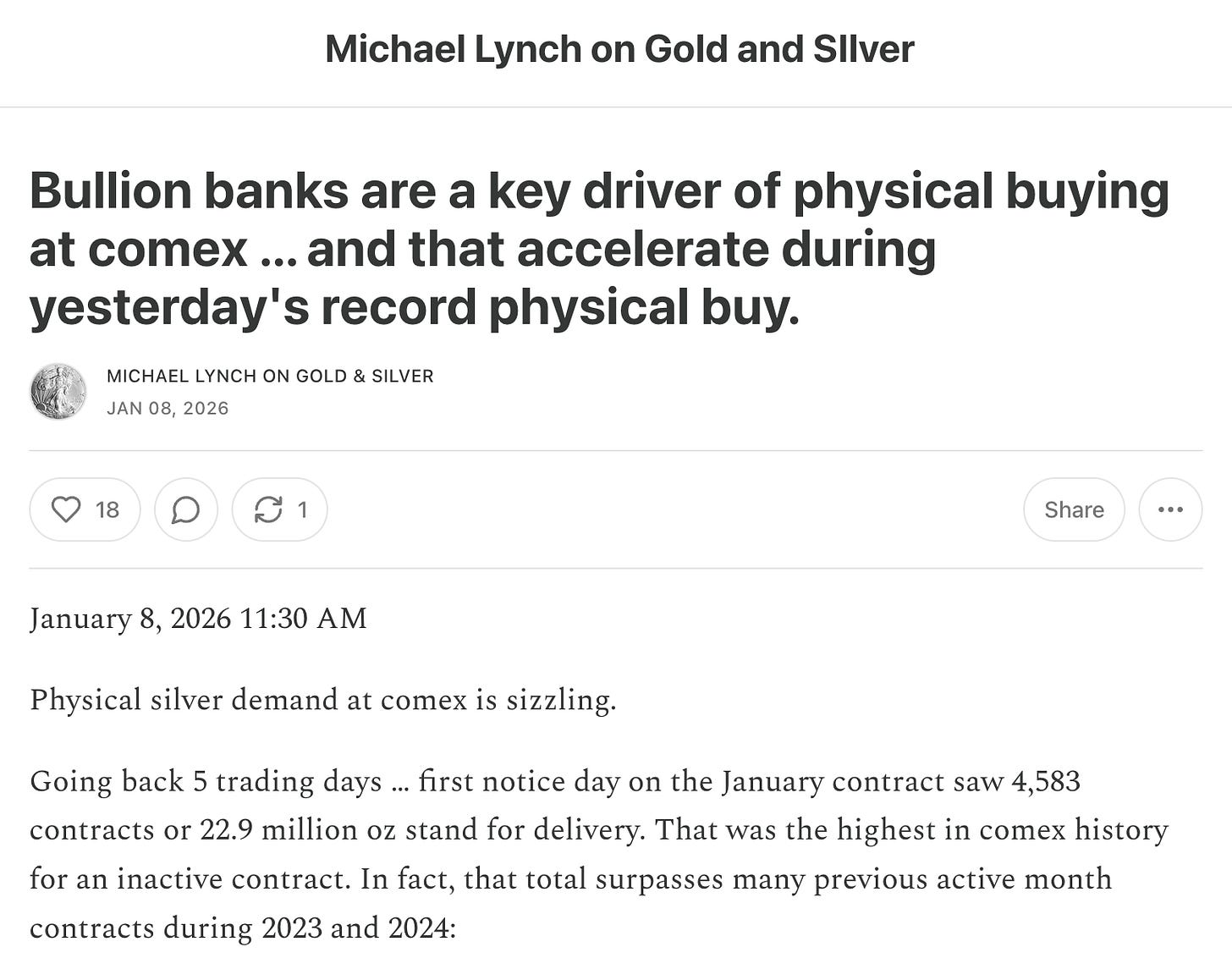
As that’s happening, we’re also seeing elevated deliveries for silver on the Comex in an inactive delivery month.
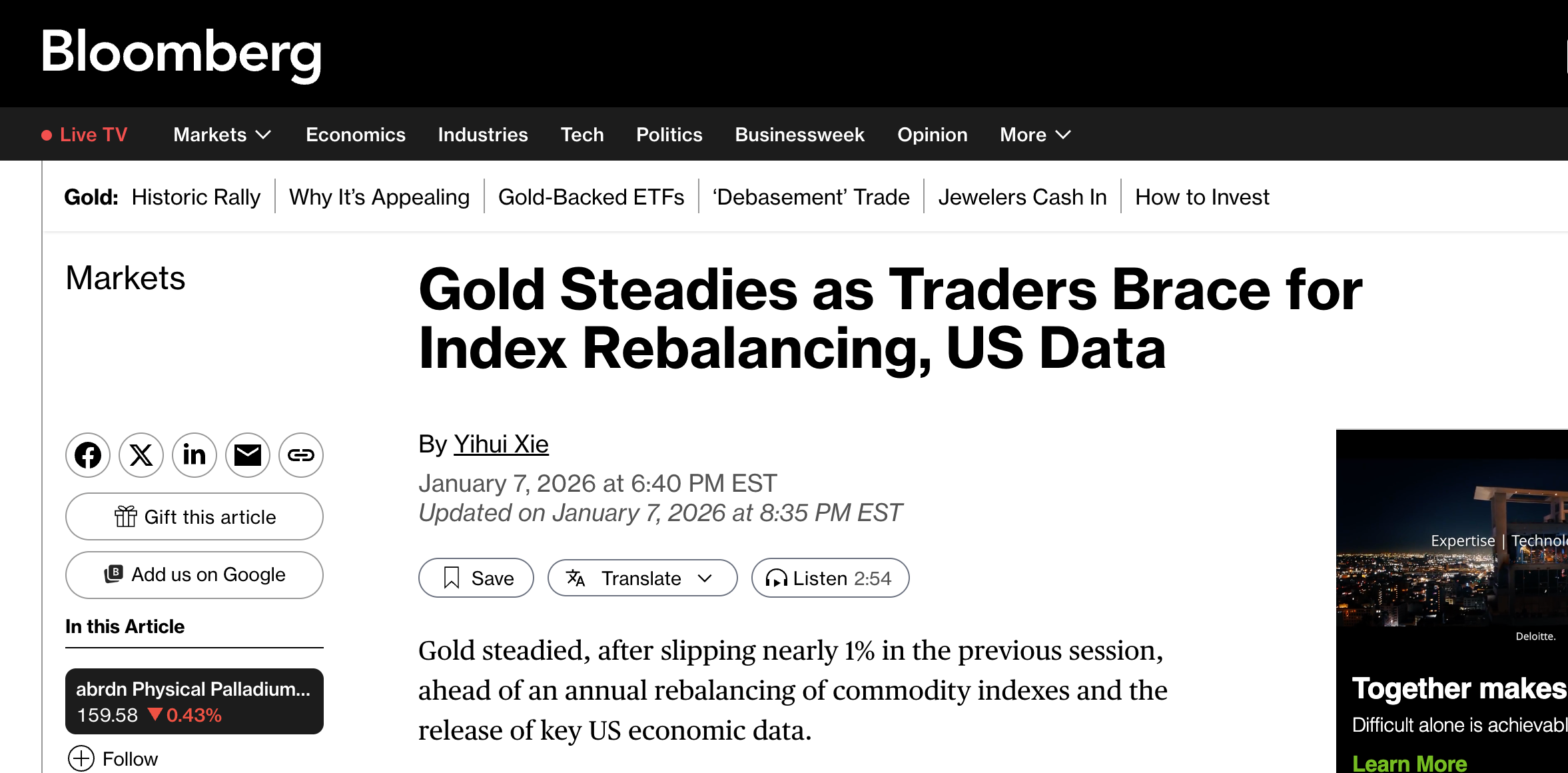
As you may have already noticed, there’s a lot of talk about how the gold and silver prices could be affected by the rebalancing of the Bloomberg Commodity Index and the S&P Goldman Sachs Commodity Index.
For more insight into what this could mean for the metals, my colleague Vince Lanci did talk about that in his morning broadcast today.
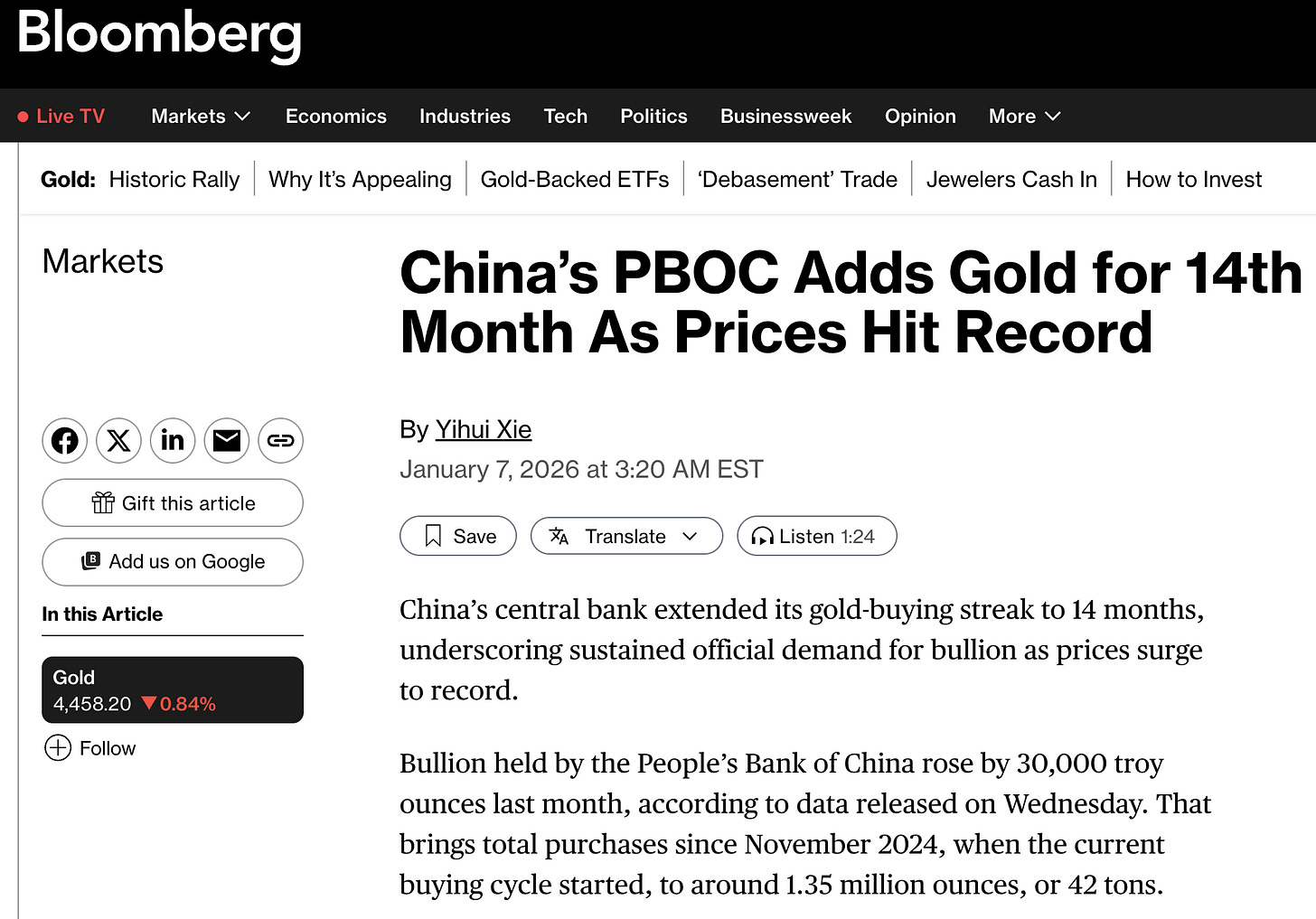
Although that hasn’t stopped the Chinese central bank from continuing to add gold, as Bloomberg is reporting that they increased their holdings for the 14th straight month.
Meanwhile, Uruguay’s central bank head is now trying to convince the constituents of one of Latin America’s most dollarized nations that ‘their love affair with the U.S. currency is bad for both the economy and their pocketbooks.’
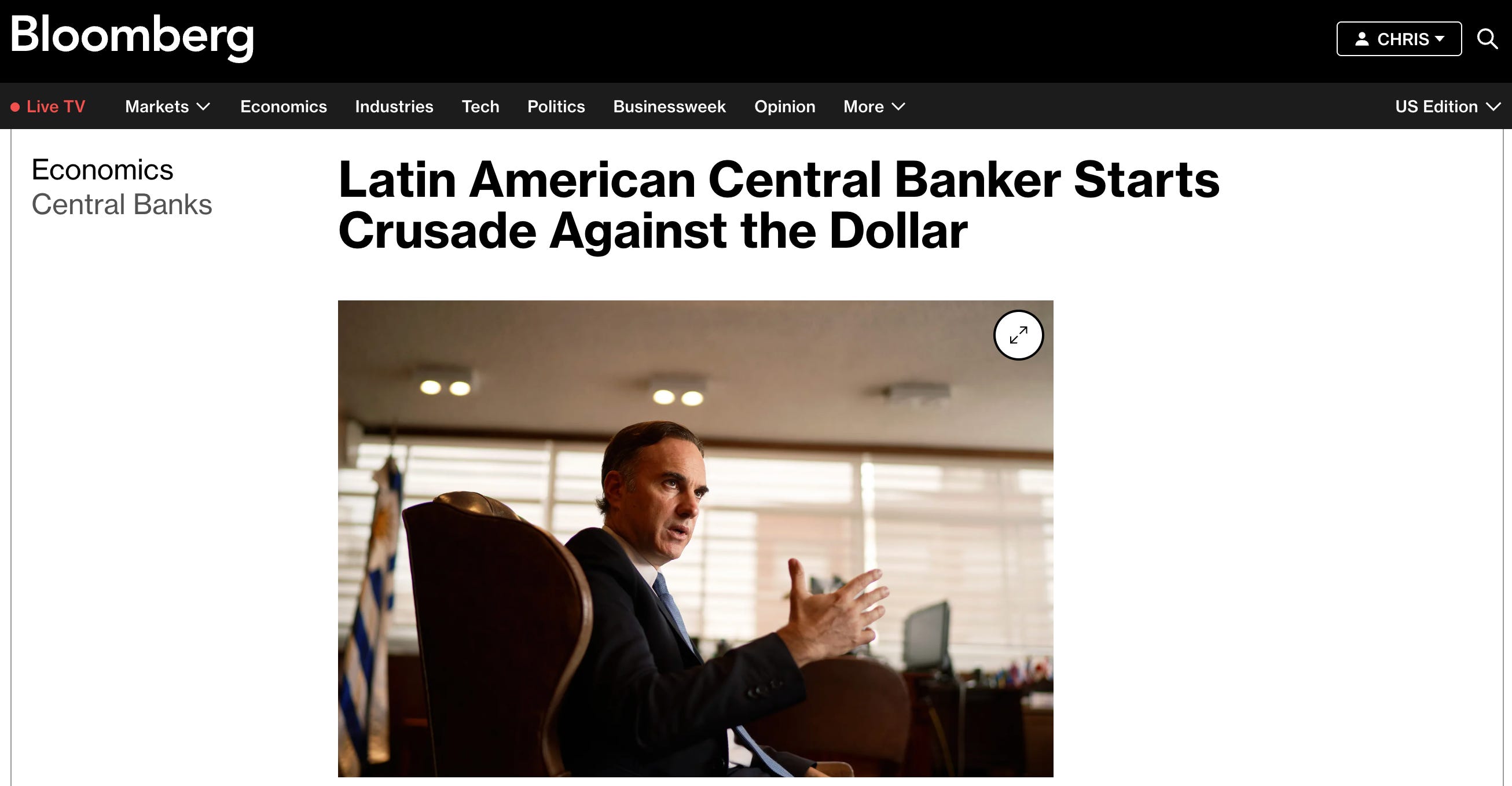
Guillermo Tolosa says Uruguay’s attachment to the dollar reflects an old habit formed in times of economic instability — one he believes the country has outgrown.
“Let’s give up the pacifier once and for all,” he told business leaders in September. “Your purchasing power when you invest in dollars is going to be very volatile. Investing in dollars in a context like this is a form of gambling, like a casino.”
Uruguay’s move to reduce its reliance on the greenback, though driven largely by domestic concerns, also reflects a broader international debate about the future of the dollar.
On one hand, we’ve been seeing developments like this for years now. Although it also feels somewhat telling that even the nations that have traditionally been fond of using the dollar are now starting to have a change of mind as well.
For our last topic of the day, I have a few notes to share regarding the recent Venezuelan military operation by the U.S., and some of the reports that have popped up in the days since.
An expert on Venezuelan politics I am not, although there’s a bit of a history between Venezuela and the Bank of England regarding Venezuela’s gold, and now the BOE is withholding access to their stash as it refuses to recognize Venezuela’s new leadership.
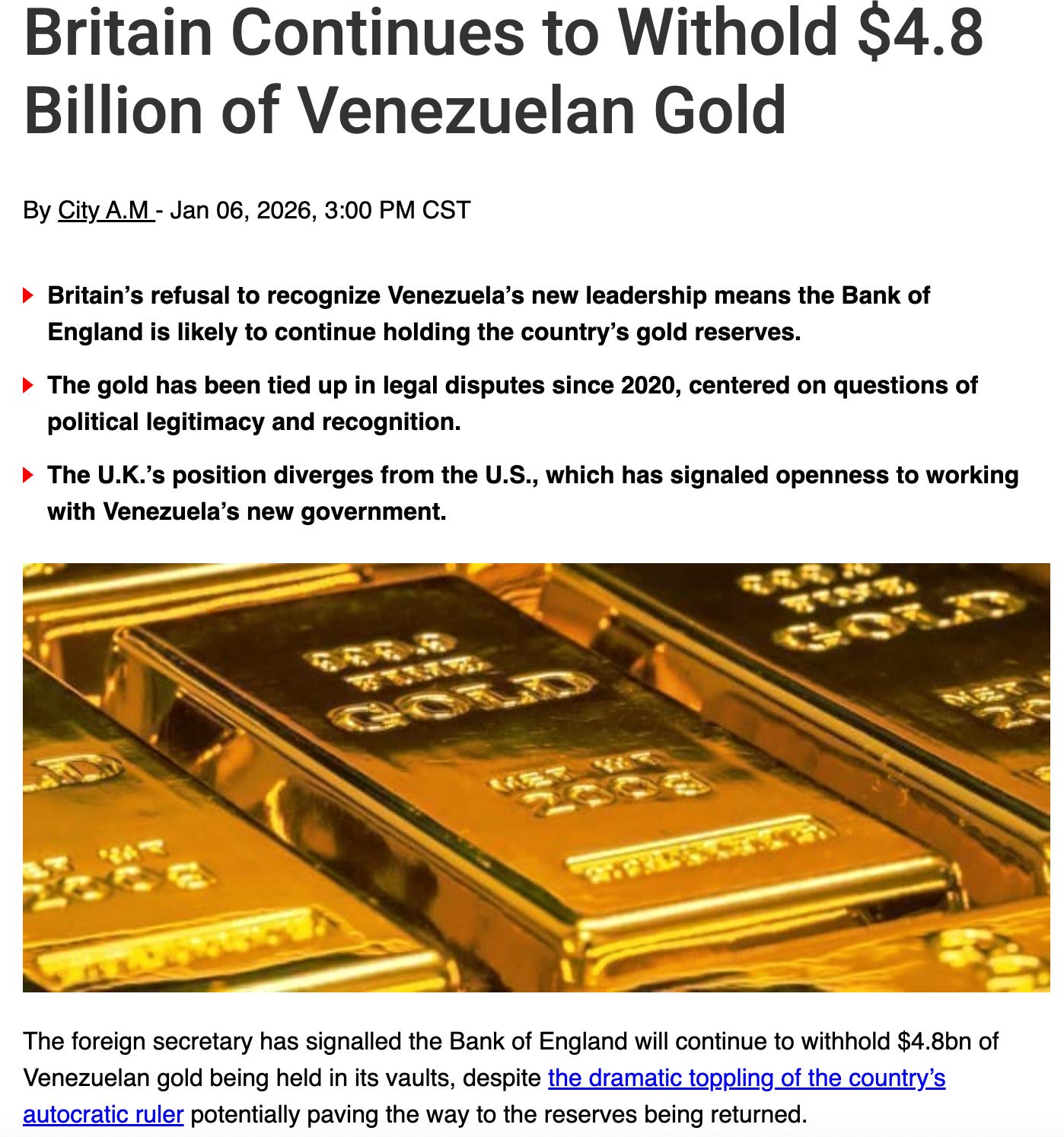
I’m not quite sure how that reconciles with the Trump administration removing Maduro and setting the new administration in place, which now the Bank of England is refusing to recognize. But it sounds like there’s likely more going on behind the scenes, which perhaps we’ll find out more about in the coming weeks and months.
However, Tucker Carlson’s new newsletter had some thoughts on the Trump administration’s latest military budget request, as well as what just happened in Venezuela.
The United States spends more on its military than any other country, and it isn’t close. Our $900 billion 2025 defense budget surpassed runner-up China’s by over $550 billion. According to Donald Trump, it still isn’t enough.
The president proposed a gargantuan military spending increase on Wednesday, calling on Congress to allocate $1.5 trillion for defense in 2027.
“In these very troubled and dangerous times, our Military Budget for the year 2027 should not be $1 Trillion Dollars, but rather $1.5 Trillion Dollars,” Trump wrote on Truth Social. “This will allow us to build the ‘Dream Military’ that we have long been entitled to and, more importantly, that will keep us SAFE and SECURE, regardless of foe.”
Full disclosure warning: while I try to keep personal politics to a minimum in this column and stay focused on gold and silver, this note does bring up a few thoughts that I’d like to share. So if you don’t care to hear that part, I can certainly understand that, and feel free to skip the rest of today’s column.
But unless the United States plans to maintain its self-anointed role as policeman of the world, which I personally don’t support (especially given all of the issues that we already have at home, as well as the fact that the gold and silver prices are already soaring, in large part due to how indebted the country already is), I’ve always been confused at the rationale behind the need for such large amounts of defense spending.
We’ve wasted a fortune on Middle East wars that have accomplished nothing aside from getting a lot of people killed and lodging the U.S. even deeper into debt. Additionally, it’s hard to read the part about how they’re keeping the U.S. safe and secure, when we’re all still digesting the latest government scandal in Minnesota, that is seemingly an example of the exact opposite of safety.
Maybe having a massive military budget has played some role in the fact that there have only been two attacks on American soil in the past hundred years (Pearl Harbor and September 11). Although given the ample body of evidence that makes it difficult to believe that September 11th occurred without any government assistance, as well as how multiple historians have noted that the Pearl Harbor attack was not only known in advance, but even designed by U.S. officials to antagonize the Japanese into an attack, I struggle to see how the only way to keep people safe is by continuing to spend massive amounts of money that the government doesn’t have, just to build more weapons of destruction and death.
Also in that column from Tucker Carlson was the following note about the recent operation in Venezuela.
According to U.S. officials, the operation ended 75 lives. Venezuela says the number is even higher.
That part hasn’t been mentioned quite as much, and even if we assume that Maduro is who the U.S. government says he is, a large number of people don’t get to wake up tomorrow, while their families don’t get to see them again. And even if some of them may have indeed been ‘the bad guys,’ it’s more than a bit disconcerting to see so little attention paid to the collateral damage that always seems to accompany these events.
As someone who has studied and researched the September 11 attacks for the past 15 years, partly because I have a fascination around the situation due to being there and running from the dust cloud after the towers collapsed, I still have yet to see the evidence that allowed U.S. officials to declare so conclusively that Osama bin Laden was unquestionably the mastermind, without any foreign or domestic government involvement.
Remember that bin Laden was an ally of the CIA when it was convenient for them to use him back in the late 70s and into the 80s when the U.S. wanted to drive the Soviet Union out of Afghanistan. And the fact that the elder George Bush and several of his business associates in the Carlyle Group were actually meeting with bin Laden family members on the morning of September 11th, yet while the air traffic for the rest of the country was grounded, somehow the family members of the person the government claims was the sole mastermind, beyond a shadow of a doubt, were still given an escort out of the country without even being bothered with a single question, is still a large elephant stomping around the room almost 25 years later.
Then a few years after September 11th, Iraqis were being killed based on the premise of weapons of mass destruction, that not only turned out not to exist, but we later found out that the government officials that pushed for that war knew darn well that they didn’t exist, but just decided to lie about it and go ahead with killing more people anyway.
Yet this same government feels that it has the authority to decide which leaders to capture, while other people aside from that leader get killed, but 25 years later, the architects of a war based on fraud are still celebrated as heroes. Then, after it’s all said and done, we’re told that we just need to push the country further into debt and that even more military spending is going to somehow fix the problem.
However, in the week since the operation in Venezuela, not only have we found out that the Trump administration is suggesting that Venezuela is not likely to be the only target of such an operation, but in addition to saying that the Trump administration is going to “temporarily” run Venezuela, while Trump repeated the phrase “we’re going to take so much wealth out of the ground there” ad nauseum, deputy White House chief of staff and Homeland Security adviser Stephen Miller went on CNN and said the following:
“We’re a superpower, and under President Trump we are going to conduct ourselves as a superpower. It is absurd that we would allow a nation in our own backyard to become the supplier of resources to our adversaries but not to us.
We are in charge because we have the United States military stationed outside the country. We set the terms and conditions. We have a complete embargo on all of their oil and their ability to do commerce.”
Between Trump’s press conference comments about how much wealth they’re going to take out of the ground, as well as what Miller said, it leaves me feeling less than convinced that this was done for the altruistic purposes suggested by the administration. Although even if that’s not the case, when you look at the track record of these “temporary” interventions, it’s not easy to find the one that worked out as smoothly as promised at the time it began.
And now with even congressional officials like Marjorie Taylor Greene telling citizens to stop paying their taxes because they’re just being robbed, it sometimes makes you wonder how close we might actually be to some sort of revolt by the people (and I can only wonder what would happen if even some of these people ever noticed how the IRS repeatedly refers to its own tax code as ‘voluntary’).
In my defense, all of this isn’t entirely divorced from what we’re seeing in the gold and silver markets. Putin has been one of the most prominent and vocal critics of the way the U.S. has operated, although he’s hardly the only one, as evidenced by the de-dollarization efforts by the East, as well as the response by central banks to buy record amounts of gold following Russia being kicked out of the SWIFT system. And over a long enough period of time, these things do add up.
Then tack on that the U.S. also just seized a Russian oil tanker, and it makes you wonder just how much separates the U.S. from going after Putin in a similar manner to how they just went after Maduro, save for the fact that the consequences of doing so against Russia would likely have a far more potent blowback.
It sure does feel like a tense time in the world, and perhaps a great reason to just appreciate each day that you can wake up, hug someone you love, and walk out under the sun and smile.
Maybe things are actually getting a lot more intense, or maybe they’ve always been that way and some of these things are just finally coming to the surface. But in either case, we’ll wrap up here for today, and I’ll look forward to closing out the week with you tomorrow.
More By This Author:
Don't Make This Silver Investing MistakeWhere The Answers Lie In The Silver Market In 2026
India Joins The Scramble For Silver


Comments
Log in or sign up to join the conversation.