Long Bonds Vs. The Gold Bull
Image Source: Grok
As I sit down to write this morning Friday January 30, I see that the PMs got hammered overnight, with gold down over 9% and silver off—gulp—over 26%. That may look ominous, but the fact is that this was long overdue. No asset rises in a straight line forever, and the PMs surely needed a breather after their extraordinary year. No worries.
Now on to my topic of the day.
What the Fed Does
There is a widespread misconception that the Federal Reserve “sets interest rates.” It doesn’t, with one exception. It sets the federal funds rate, which is what banks charge each other for overnight loans. A very short-term interest calculation. That’s all.
Not that the federal funds rate is insignificant. It’s the liquidity linchpin for the big banks. So it’s closely watched in financial circles. There’s always a lot of teeth-grinding anticipation about what the Fed Chair will announce after the Board’s next meeting.
The reason for this is that other interest rates generally follow the Fed’s lead on the overnight rate. Because what the Fed is really signaling is how it intends to proceed with money creation.
If the funds rate tacks higher, that means the Fed perceives inflation as problematic. To combat it, credit is tightened, borrowing costs rise, the money supply dwindles, and there is a risk of recession. If the rate is pushed lower, then credit eases, money is more plentiful, spending increases, and (hopefully) there is strong economic growth. The prospect of rapidly rising inflation is dismissed.
Home mortgage rates, credit card interest, and Treasury yields all tend to rise and fall in tandem with the funds rate. But there is no rule that says they have to. The bond market, for example, will price the cost of Treasuries in line with demand, and that may or may not accord with what the Fed is doing.
It’s particularly important to keep an eye on the long bond (30-year Treasury), looking for a 5% yield.
Enter the Bond Vigilantes
Bond prices and yields have an inverse relationship. So, for the first two decades of this century, long bonds were a great investment, because yields kept declining as prices steadily rose. People didn’t buy them for income, but for appreciation. Highly leveraged trades were the order of the day.
Then, in mid-2020, the party ended.
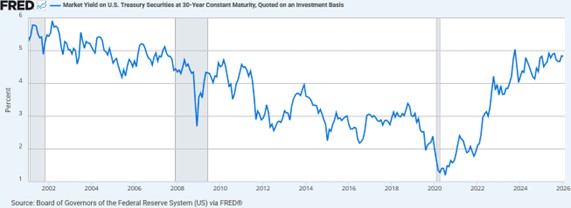
As you can see, as yields pushed continually upward, prices fell into a deep bear market.
Think of that 5% rate as a formidable barrier. It was breached in the fall of 2023, and the spring and summer of 2025, and has been approached on numerous occasions. But as yet it has always drawn back.
Why? There is nothing magical about a 5% yield. But it carries a disproportionate weight with the “bond vigilantes.”
The bond vigilantes are neither a dark conspiracy nor even an organized group. They are merely the heavy hitters: large bond trading houses, FX desks, hedge funds, sovereign funds. Their solvency depends on an ability to accurately read the bond market. They have to make money on both rising and falling prices.
They all read the same tea leaves, and tend to think and act alike. Buying long bonds is a vote of confidence in the system. As noted, this strategy worked really well for 20 years. But if they see worrisome fiscal or monetary behavior on the part of government, they dump bonds. While you can see the short-term yo-yo effect in the chart above, the overall trend is unmistakable. The bond vigilantes are concerned.
In September and October of 2025, there was a brief period of optimism that drove long bond yields from near 5% down to 4.5%. Then gloom set in. Yields rose and have been stuck around 4.8% from then to the present. Movements have been very small for the better part of two months. It’s an eerie calm.
Like everyone else, prediction is hard for me, especially about the future (thank you, Yogi). I can’t say what the bond vigilantes will do next. But the fundamentals that underlie the current trend are unchanged: too much federal debt, excessive money creation, financial and geopolitical instability, stubborn inflation.
I would say that breaking through that 5% barrier is a very distinct possibility.
The Significance of Breaching 5%
And why is that important? Well, it may be largely psychological, but government, corporations, and households all refi off of long rates. If yields exceed 5%, and stay there: mortgage rates rise to 7-8%, stifling a housing market that is already teetering; government interest expense snowballs, and the U.S. feels the political and fiscal pain very quickly; leverage dries up; and the flight to safety factor intensifies, pulling capital from other assets, like stocks. Equities decline.
If the long bond decouples even further from the funds rate than it already has—with yields staying firm through three quarter-point cuts in 2025—then the Fed may be powerless to stave off recession by manipulating the only rate it controls. It could even opt for another round of QE, a/k/a money creation. That would excite inflation, perhaps intolerably.
So…
You may wonder what this has to do with gold. (You trusted that I’d get here, right?)
Answer: a lot. There is a delicate interplay between gold and bond yields, as investors perpetually re-define what constitutes the ideal safe harbor. In general, rising yields put a damper on gold. Yet the gold bull has continued onward, in defiance of the long bond—especially since 2022, as the yield has climbed by three full basis points while gold skied from under $2000/oz. to near $5000 today.
This is a clear sign that confidence in the full faith and credit of the U.S. government has plummeted.
Though gold earns no interest, it has become viewed as more of a haven than long bonds. Outside of the U.S., central banks are divesting from their Treasuries and stockpiling gold. Private citizens are voting with their wallets as they become increasingly skeptical that government can put its fiscal house in order. This demand appears rate-insensitive, at least for now.
Also worth noting is that if the Fed adheres to an easy money policy—which it seems committed to doing—it will ignite inflation and devalue the dollar. Gold has always been the ultimate protection against that scenario.
In my view, the precedent has been set for gold to remain strong even as long bond yields rise.
Here’s why: gold does not fear high yields per se. When yields rise because of a healthy or overheating economy, gold should be expected to struggle. However, when yields rise because the system is stressed, as is the case today, gold shrugs off the bond market. We can’t know how long the two might ascend together, but there is no theoretical limit.
Shakeup at the Fed?
Expecting a caveat? Of course there is one, and here y’go. The Fed is as concerned with the 5% yield barrier as the bond vigilantes. If it looks as though the yield will break through that level and perhaps head even higher, the Fed may panic and more aggressively lower the funds rate, and/or jack up the money supply. It’ll probably have to, in a desperate attempt to lower interest payments on the federal debt, which already amount to about $1 trillion per year.
That matters. The debt is already rapidly approaching $39 trillion. Having to roll over obligations at a higher rate will be ruinous.
Which leaves the Fed walking a tightrope. So far, Chairman Powell has avoided any drastic moves, preferring to inch the funds rate lower. Most recently the Fed kept the rate where it is. That infuriates the president, who wants much lower rates, which he thinks will stimulate borrowing and invigorate the economy. He doesn’t believe inflation will be a problem. Powell disagrees.
Today, Trump announced he will nominate Kevin Warsh to replace Powell as Fed Chair, when his term ends in May. That’s a stunner, to say the least. Warsh is universally regarded as an interest-rate hawk. He has consistently been a very strong critic of QE, ultra-low interest rates, and expansion of the Fed’s balance sheet through direct purchase of Treasuries. Why Trump thinks he will align with the president, we can only guess.
Regardless, it doesn’t seem plausible, under either Powell or Warsh, that we will return to the near-zero funds rate of 2009-15 and 2020-22. But the pressure is going to be intense to push it lower. If it steadily falls, this could cause the bond vigilantes to sell and further widen the gap between the funds rate and the long bond. This means…
The potential for a real fiscal crisis is looming, and it’s no joke.
We must hope it won’t happen, and the needed rate decline is carefully managed and not allowed to go too far. That could cause gold to undergo a retracement (read: buying opportunity), though the metal might equally front-run coming rate cuts. We can’t know.
Where We Go From Here
Powell is halfway between hawk and dove. Warsh has historically been a hawk, but there’s no telling how his views might change when he assumes the Chair (Greenspan, for example, was transformed from gold bug to massive money printer after he was appointed). It appears to me that both of them will have no choice but to continue to ease the funds rate, albeit very slowly. That seems baked in the cake.
This must eventually accelerate inflation. That’s only one factor affecting the gold price, of course. But rising inflation would surely help set the stage for gold’s next leg up as it enhances its status as the global reserve asset—not to mention creates another heady increase in profitability for the miners covered here.
Disclaimer: Our employees and contractors, and their immediate family, will not buy within 5 trading days of a NEW pick, and will wait 2 trading days AFTER a new pick or change in recommendation ...
more


Comments