

Image Source: Unsplash
Bitcoin started the week with a decline. The price dropped below $90,000. Just days earlier, some investors expected a move toward $100,000. That optimism faded quickly.

Market sentiment shifted fast. Buyers stepped back. Sellers are not rushing either. The result is a narrow trading range with little movement in either direction.
Geopolitical tensions are adding pressure. Trump announced new tariffs targeting countries that opposed his push to bring Greenland under US control. The tariff package includes a 10% rate. This development brought more uncertainty to financial markets.
The Supreme Court held sessions in January about presidential authority on tariffs. Investors waited for clarity. No decision came. That lack of direction left Bitcoin and other cryptocurrencies in a suspended state.
David Dobrovitsky, CEO of Dobrovitsky Strategic Advisory, said the market is stuck. Neither buyers nor sellers are showing strong conviction. Bitcoin is consolidating around $89,000 to $90,000. Selling pressure has cooled down. But buyers are not stepping in aggressively yet.
Liquidity remains thin. Momentum is weak. Many altcoins have lost value in a structural way over time. Capital has moved toward Bitcoin and a small group of stronger projects. The rest continue to fade.
ETF Outflows Show Institutional Caution
Bitcoin ETFs recorded outflows of nearly $709 million on January 21. This was the largest single-day outflow since November 20, 2024, when outflows reached $903 million. The data comes from CoinGlass.
(Click on image to enlarge)
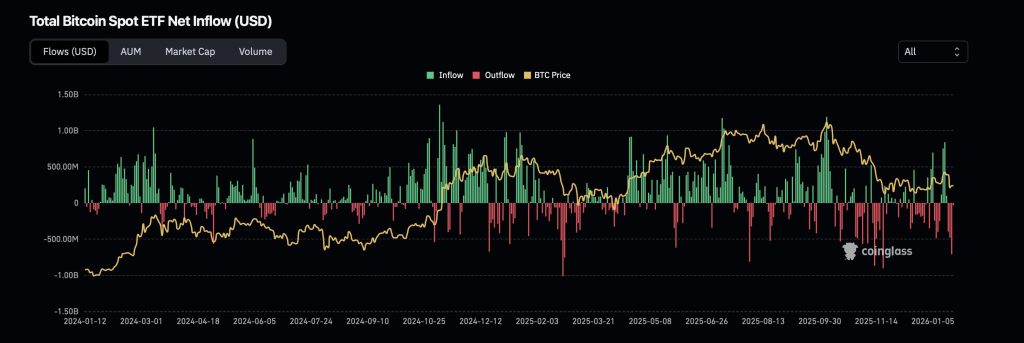
Source: Coinglass
Institutional players appear cautious. They are focused on reducing risk rather than adding exposure. This adds to the lack of momentum in Bitcoin’s price.
Over the past few weeks, Bitcoin attempted to recover. The price climbed to $98,000 multiple times. Each time, sellers stepped in quickly. Those who bought earlier are now using rallies to exit at breakeven or small gains.
Analysts at Glassnode described the current setup as a “moderate bear phase.” The market has been moving between support near $81,100 and the average cost basis of short-term holders. There is no panic selling. But every upside move runs into supply from investors who accumulated earlier in 2024.
Inflation Data Shows a Different Picture
A real-time inflation tracker now shows US inflation close to 1.2%. This data updates daily. It is based on millions of prices from online shopping, housing, food, fuel, and other expenses.
The official inflation figure still sits near 2.7%. That number only updates once a month. It reflects prices from weeks ago. The gap between the two readings is wide.
Real-time inflation data analyzes current prices. It does not replace official data. But it helps people see where inflation may be heading next. In the past, large gaps between real-time and official inflation were later followed by official data moving in the same direction.
Lower inflation often leads to easier financial conditions over time. This process does not happen quickly. It usually takes weeks or months. That is why Bitcoin has not reacted strongly yet.
Maybe $BTC could repeat the last 2 bottom structures. pic.twitter.com/42jrSP9TL8
— Ted (@TedPillows) January 23, 2026
Bitcoin is trading near $89,500. The price has stayed in this area for several days. There has been no strong move higher and no sharp drop lower. This happens when buyers and sellers are both active but neither is rushing.
Bitcoin is still trading inside an upward price channel. The lower edge of that channel held earlier this week. The price bounced from there but the move remained small. From current levels, Bitcoin needs to move about 2% to reach $91,200. That area has acted as resistance before.
$BTC
— BACH (@CyclesWithBach) January 23, 2026
Since the 2022 cycle low, Bitcoin has followed the same playbook:
Big drop -> 7–8 weeks of consolidation -> continuation higher.
So far, it hasn’t failed... pic.twitter.com/Bie8opEOXN
Bitcoin has not moved immediately when inflation data changed in past cycles. Price often followed later once interest rate expectations became clearer. Right now, interest rates remain unchanged. Policymakers are still cautious. They rely on official inflation data rather than real-time trackers.
More By This Author:
XRP Price Eyes Potential Uptrend With Key Resistance Break At $2.1
Bitcoin And Ether ETFs Face Nearly $1 Billion In Outflows Amid Market Volatility
XRP Ledger Stands Out In WEF’s $1B Private Equity Tokenization Report

Comments
Log in or sign up to join the conversation.