
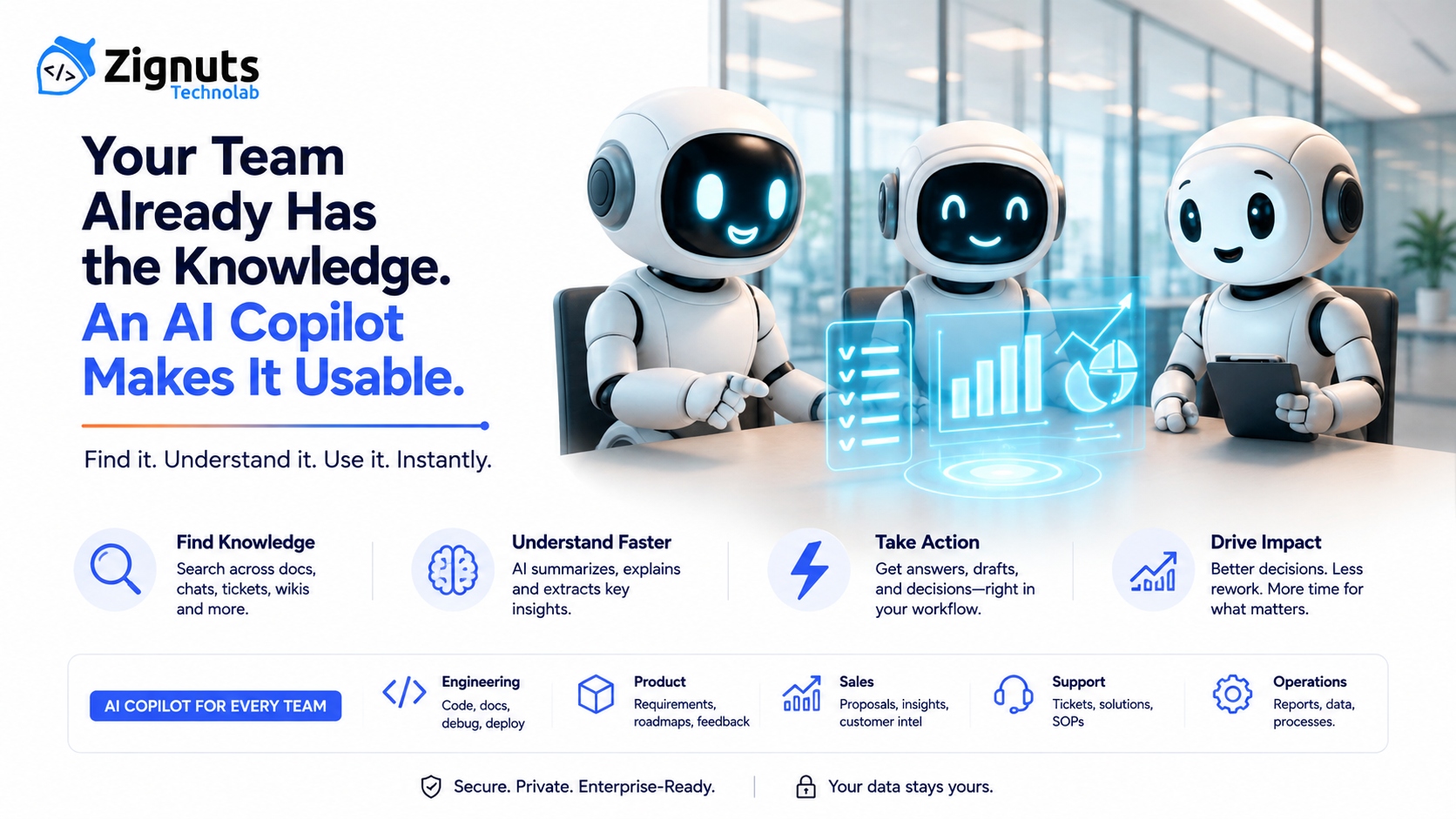
Your enterprise does not have a knowledge problem. If you look inside your cloud storage, ticketing systems, and legacy messaging channels, you will find petabytes of brilliant operational intelligence. The problem is that this knowledge is effectively dead. It sits trapped in buried PDF files, outdated employee onboarding wikis, and forgotten chat rooms, completely inaccessible to the frontline worker who needs to make an executive decision in the next sixty seconds.
The common corporate reflex is to buy another collaboration tool or launch a multi-month database migration project. This approach assumes that better organization creates utility. But your employees do not want a cleaner filing cabinet. They want an automated partner that extracts exact context, answers complex structural questions, and executes actions immediately based on existing records.
To transform this passive information into a true competitive advantage, technology leaders are moving beyond basic search bars. They are prioritizing the integration of multi-agent systems for enterprise and deploying intelligent AI assistants that work across business functions. This structural transition turns silent corporate knowledge into an active, collaborative network of autonomous software modules that find, verify, and apply institutional memory to daily workflows without adding technical debt.
Industry Context: The Paradox of Toxic Data Abundance
The current enterprise technology landscape is defined by a frustrating paradox. Organizations are generating more data than ever before, yet their operational velocity is slowing down. Teams spend a significant percentage of their workweeks simply searching for internal resources, policy documents, or historical customer records needed to perform routine tasks.
At the same time, the cost of specialized labor continues to rise. When an experienced engineer, underwriter, or operations manager leaves a company, they carry decades of unwritten context out the door with them. The resulting operational brain drain costs businesses millions in lost productivity and repeated mistakes.
To combat this, the modern technological framework has evolved rapidly. Businesses are realizing that simple, single-prompt conversational assistants are insufficient for complex enterprise environments. The market now demands distributed intelligence architectures where multiple specialized agents communicate via semantic middleware to dynamically retrieve corporate records, validate facts, and automate execution paths.
Why Traditional Thinking Falls Short
When critical workflows break down due to missing context, the historical management response has been to launch massive manual auditing initiatives or mandates for better documentation. While well-intentioned, these old strategies fail to address the core limits of static content delivery.
Process Inefficiencies: Forcing a customer support agent or field technician to manually read through a one hundred page technical manual while a transaction is pending causes long delays.
Entrenched Data Silos: Traditional documentation approaches keep information separate. An operations framework cannot naturally reconcile insights from a sales contract with a logistics spreadsheet without manual human effort.
Poor Scalability: As an enterprise grows, its internal documentation grows exponentially, eventually becoming too complex for any human team to navigate, update, or audit effectively.
The fundamental flaw in this traditional approach is the belief that knowledge management is a storage problem. In reality, knowledge management is a retrieval and execution problem. Focusing entirely on where data lives rather than how it is actively utilized ensures that your digital transformation programs will deliver disappointing results.
Modern Business Strategy: Activating Institutional Memory
A successful modern business strategy must reframe institutional knowledge as an active utility rather than a passive archive. When you connect your internal data repositories to an ecosystem of collaborative agents, you essentially turn your documents into a real-time advisory board.
This paradigm shift changes how organizations scale human productivity:
Context-Aware Automation: Systems no longer just follow rigid rules. They evaluate historical ticket resolution text and internal slack communications to resolve exceptions dynamically.
Adversarial Fact Checking: By deploying an execution agent alongside a dedicated auditing agent, the network can cross-reference internal compliance manuals before executing a transaction, reducing human error.
Automated Knowledge Production: The system constantly analyzes gaps in your data infrastructure, auto-generating updated instruction sets as daily operating conditions shift.
The AI Value Stack Framework
Successfully transforming silent records into operational outcomes requires a structured technical approach. Leaders must stabilize each tier of the enterprise framework to prevent system hallucinations and operational failures.
             ┌─────────────────────┐
             │   Business Impact   │
             └──────────▲──────────┘
                        │
             ┌─────────────────────┐
             │ Intelligent Actions │
             └──────────▲──────────┘
                        │
             ┌─────────────────────┐
             │ AI Reasoning Layer  │
             └──────────▲──────────┘
                        │
             ┌─────────────────────┐
             │  Data & Knowledge   │
             └──────────▲──────────┘
                        │
             ┌─────────────────────┐
             │ Business Processes  │
             └─────────────────────┘
Business Processes
The absolute foundation of the framework. This layer outlines the operating procedures, team workflows, and corporate strategies that need computational support.
Data & Knowledge
The corporate asset layer. This includes all structured databases, internal product wikis, chat histories, old training manuals, and legal contracts that contain the company's collective intelligence.
AI Reasoning Layer
The cognitive processing engine where foundational models read the extracted data context, evaluate meaning, plan step-by-step solutions, and decide the best path forward.
Intelligent Actions
The deployment engine where individual agents use internal software systems, trigger APIs, write basic scripts, and work together to complete workflows without manual intervention.
Business Impact
The peak commercial outcome achieved by the stack, visible through lower onboarding costs, higher compliance accuracy, and expanded operating margins.
Strategic Operations Matrices
Deploying multi-agent networks to activate enterprise data requires structured corporate prioritization. Leaders can use the following planning matrices to align engineering focus with real economic value.
Business Value Matrix
Business Capability | AI Readiness | Expected Business Value | Implementation Difficulty | Priority |
Field Maintenance Routing | Medium | High | High | Tactical |
Complex Contract Discovery | High | High | Medium | Immediate |
Customer Support Co-Pilots | High | Medium | Low | Quick Win |
Global Regulatory Validation | Medium | High | High | Strategic |
Automated Product Mapping | Low | Medium | High | Defer |
Executive Decision Matrix
Decision Area | Questions Leaders Should Ask | Risk if Ignored | Success Indicator |
Data Accessibility | Are our internal document repositories structured to allow safe semantic search queries? | High model hallucination rates and fragmented answers. | Relevant context retrieved in under two seconds. |
Security Boundaries | How do we prevent an automated agent from displaying executive payroll data to junior workers? | Severe corporate data leaks and regulatory non-compliance. | Zero security boundary violations recorded during internal audits. |
Human Supervision | At what complexity score must the system hand off a knowledge task to a senior expert? | Systemic distribution of incorrect or outdated policy guidelines. | Escalation rates stay low, below six percent of total inquiries. |
Infrastructure Spend | Are we balancing API query costs against the actual hours saved by our operations teams? | Massive cloud compute bills that outweigh organizational savings. | Total cost per automated query falls steadily quarter over quarter. |
Real-World Applications Across Core Industries
To show the practical value of automated knowledge activation, let us examine how interconnected agent networks operate in production across four distinct industries.
Professional Services: Automated Proposal and RFP Generation
Business Problem: A multinational consulting firm lost significant partner margin because manual proposal teams spent weeks digging through old project archives to answer custom Request for Proposal questions.
Technology Approach: The firm built an integrated multi-agent network. A Discovery Agent scanned thousands of historical case study documents, a Drafting Agent compiled tailored answers, and a Compliance Agent cross-checked responses against current legal templates.
Implementation Challenge: Filtering out outdated project pricing figures from historical files required building a precise time-based metadata ranking framework.
Measurable Business Outcome: The average time needed to complete a comprehensive RFP dropped by seventy percent, allowing the firm to chase more concurrent deals.
Healthcare: Clinical Guideline Retrieval and Onboarding
Business Problem: A network of urgent care clinics suffered from high onboarding costs and inconsistent operational quality because incoming medical staff struggled to locate specific clinical guidelines quickly.
Technology Approach: The clinical leadership group introduced a multi-agent knowledge layer. An Extraction Agent parsed internal medical policy PDFs, a Synthesis Agent answered complex situational questions for doctors, and a Tracking Agent updated internal training logs.
Implementation Challenge: Ensuring absolute clinical precision without allowing any model hallucinations during rare diagnostic queries.
Measurable Business Outcome: New provider onboarding times dropped by fifty percent, and adherence to standard internal clinical safety protocols rose by fifteen percent.
Finance: Complex Commercial Loan Underwriting
Business Problem: A commercial lending institution faced transaction backlogs because risk teams took days to review historical borrower records, corporate structures, and local asset values.
Technology Approach: The risk management department integrated a multi-agent framework. An Audit Agent gathered tax data across external registries, a Financial Analyzer Agent checked data against internal risk models, and a Briefing Agent produced final credit memos.
Implementation Challenge: Connecting autonomous modules with older legacy accounting databases that lacked clear API documentation.
Measurable Business Outcome: Underwriting turnaround cycles were reduced from eight business days down to under six hours, increasing customer satisfaction.
Customer Operations: Tier-Three Technical Support Resolution
Business Problem: A global enterprise SaaS vendor saw customer satisfaction drop because complex engineering support tickets sat in queues while junior staff searched for specialized developers.
Technology Approach: The support organization deployed a contextual agent network. An Ingestion Agent evaluated the technical log files, a Knowledge Base Agent found the exact patch notes from old developer wikis, and an Action Agent drafted complete code workarounds.
Implementation Challenge: Preventing the models from displaying unreleased product roadmap data to external clients during open chat sessions.
Measurable Business Outcome: The average resolution time for complex tier-three technical tickets fell by forty-five percent, stabilizing renewal rates.
Quantifiable Operational Benefits
Moving past passive data storage toward an active, integrated digital workforce yields significant, measurable advantages:
Improved Operational Efficiency: By delivering exact context directly to workers, organizations remove the administrative friction that slows down daily production lines.
Faster Decision-Making: Interconnected agent networks analyze complex data sets simultaneously, providing optimized choices to managers in real time.
Reduced Manual Burden: Eliminating routine text formatting, searching, and filing tasks allows your top professionals to focus on high-margin strategic work.
Greater Scalability: The technology stack handles sudden increases in operational volume effortlessly, scaling computing power without requiring immediate hiring surges.
Increased Productivity: Departments operate smoothly with fewer communication breakdowns, increasing the economic output per employee across all core operations.
Better Compliance Auditing: Because every single step taken by an agent is logged alongside the exact corporate document it utilized, regulatory reporting becomes completely transparent.
Navigating the Friction: Challenges and Mitigations
Activating corporate data through autonomous agent infrastructure introduces real organizational hurdles that require intentional management.
Document Decay and Contradictory Data
If your cloud drives contain old, conflicting versions of the same policy document, your agents will quickly generate inaccurate answers. An agent using an old 2022 policy guide will misinform the execution system.
Mitigation Strategy: Establish strict document lifecycle rules and configure automated validation scripts that flag or archive files that violate version schemas.
Security Deficits Across Legacy Permissions
Connecting modern cognitive agents to older, unorganized shared drives can lead to internal data access issues if file permissions are poorly maintained.
Mitigation Strategy: Implement strict role-based data access filters at the vector search layer, ensuring no agent can process files above the user's explicit security clearance.
Infrastructure Token Cost Control
Running multiple autonomous agents that constantly scan massive corporate documents can lead to high cloud compute expenses if left unchecked.
Mitigation Strategy: Set up strict query limits and daily compute ceilings. Route basic data extraction tasks to smaller open-source models while saving advanced models for complex analysis.
Executive Best Practices for Implementation
Start with the Business Bottleneck: Never deploy an agent system simply because it sounds innovative. Target a specific operational department with clear, historical friction metrics before investing capital.
Prioritize High-Impact Opportunities: Do not try to automate your most disorganized, completely unmapped legacy archive on day one. Select a high-value process where clean documents are already available to ensure a fast win.
Clean Up Core Data Assets First: The performance of any advanced automation system is limited by the quality of its inputs. Dedicate time to organizing your internal knowledge bases before scaling applications.
Assemble Cross-Functional Project Teams: Combine your software developers and security engineers with the actual department heads who use the data daily to guarantee system designs match real workplace needs.
Define and Monitor Concrete KPIs: Track measurable metrics like average cycle time reductions, process error rates, and human escalation frequencies from day one to prove value to the board.
Frequently Asked Questions
What is this technology?
It is a software architecture that connects your internal corporate documents with networks of specialized AI models. Instead of using passive search windows, this framework deploys autonomous agents that read data sources, collaborate, and execute multi-step business processes with minimal human oversight.
Why does it matter more than a traditional corporate wiki?
Traditional corporate wikis are passive storage systems that require humans to manually find, interpret, and copy information. This technology matters because multi-agent systems for enterprise actively read your records, contextualize the data for specific problems, and execute tasks across applications autonomously.
How much does implementation cost?
Developing a pilot system focused on a single corporate workflow generally costs between fifty thousand and one hundred and fifty thousand dollars. Expanding that architecture into a full production setup across multiple departments can scale into the mid-six figures, depending on data cleanliness.
How is ROI measured?
ROI should be tracked using clear operational metrics over time. This includes calculating total hours saved from manual searching, accelerated transaction cycles, lower processing error rates, and the value generated by moving staff to revenue-generating work.
How long does implementation take?
A focused pilot program targeting a single department workflow can be successfully built and launched within six to ten weeks. Transitioning that framework into an integrated production environment across several business units typically takes four to nine months.
What mistakes should businesses avoid?
The most expensive mistake is connecting autonomous agent networks to dirty, completely unorganized document folders. Leaders must also avoid launching platforms without strict human verification limits and role-based data visibility controls.
Conclusion: From Storage to Action
The pursuit of sustainable competitive advantage through technology is moving past the era of passive digital archiving. Continuing to spend capital on storing petabytes of data while your frontline workers waste hours manually searching for basic context is a strategy designed to yield diminishing returns.
Real operational leverage comes from turning your existing corporate knowledge into an active participant in your workflows. By linking specialized agent networks with your institutional data assets, you can eliminate structural friction, protect your operating margins, and scale your business smoothly. As you evaluate your strategic investments for the coming quarters, one critical question remains:
Which core department in your company is currently losing momentum, not because your team lacks the knowledge, but because that knowledge remains completely trapped in a silent data silo?
Comments
Log in or sign up to join the conversation.