
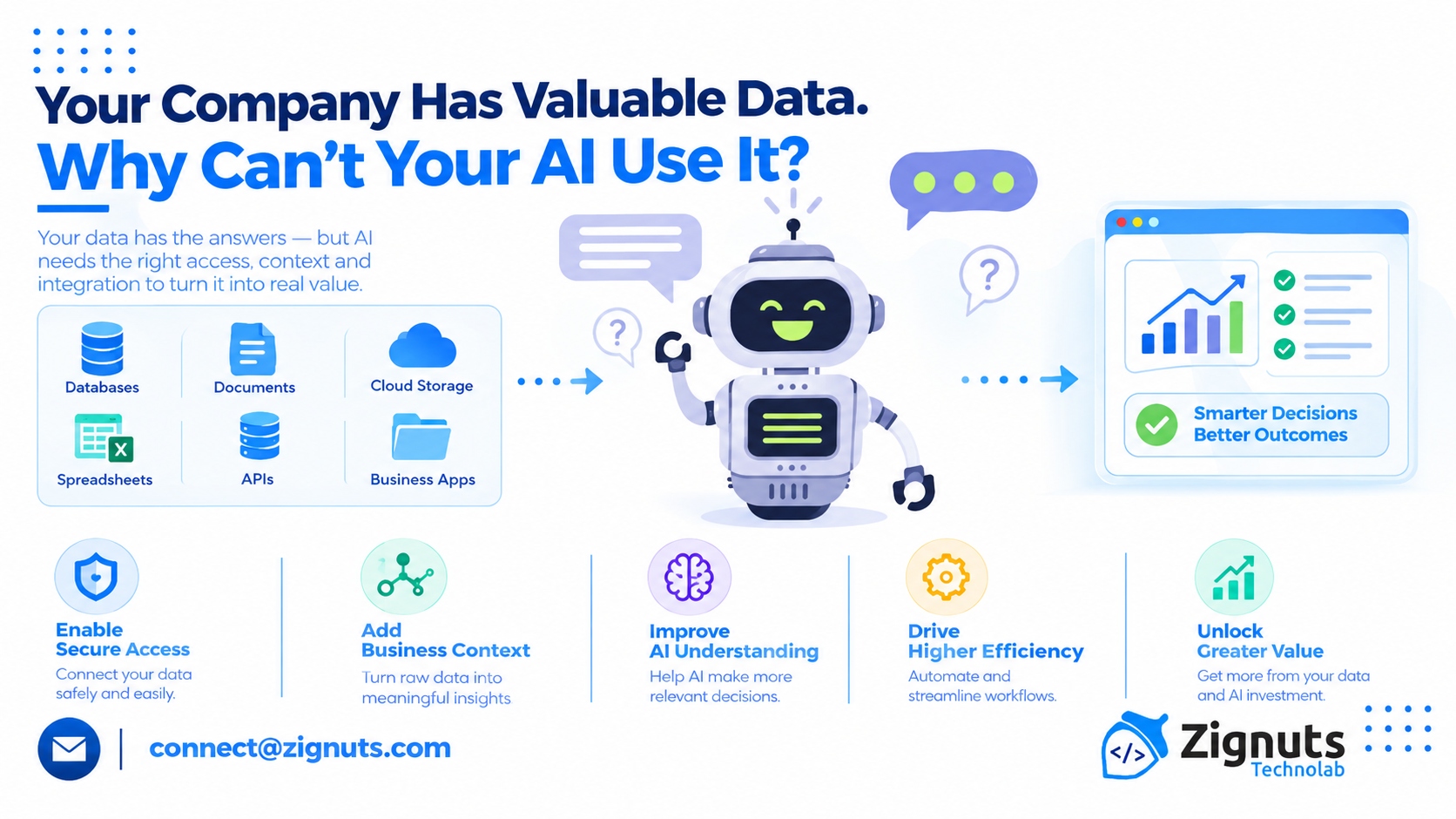
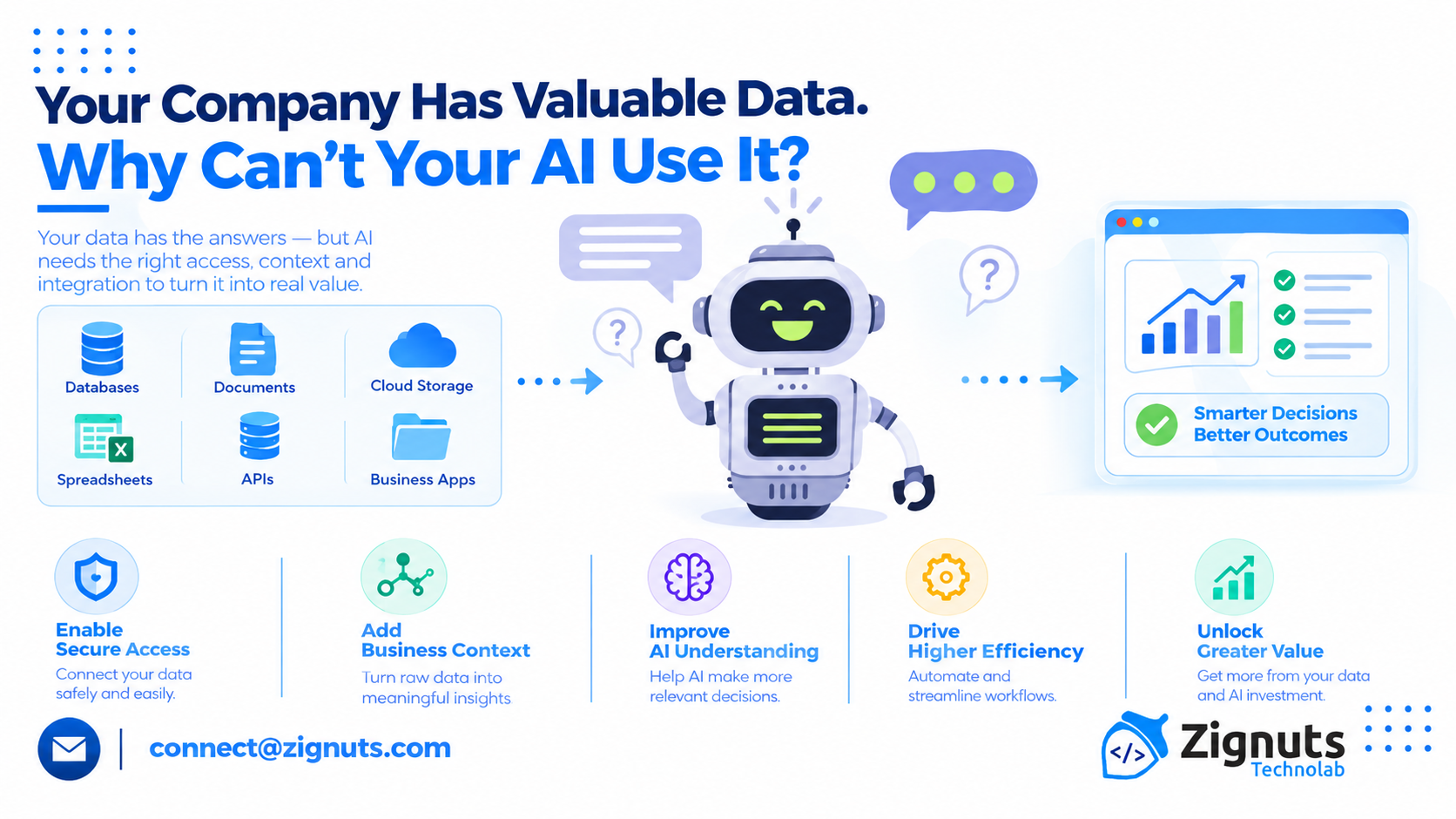
Your organization may have years of valuable business information, including customer records, technical documents, operational policies, product details, and internal reports. Yet when employees ask an AI assistant a company-specific question, the system may provide a generic answer or admit that it does not know. Custom RAG solutions help address this gap by connecting AI applications with business-owned information through retrieval, controlled context, and workflow-specific integrations. The challenge is not simply giving AI access to more data. It is making sure the right information can be found, interpreted, protected, and used for a particular business purpose.
Enterprise AI Priority in 2027 | Business Challenge | Executive Recommendation |
|---|---|---|
AI applications use more proprietary business knowledge | Generic models may not understand company-specific processes | Build retrieval around clearly defined business use cases |
Enterprise data is distributed across multiple platforms | Fragmented sources can affect response quality | Develop an integrated and governed knowledge architecture |
AI supports more sensitive workflows | Unauthorized or outdated information can create risk | Apply access controls, source validation, and monitoring |
Businesses expect measurable AI value | A technical demonstration may not deliver operational impact | Connect RAG performance with workflow and business metrics |
Why Valuable Business Data Often Remains Unusable
Most organizations do not lack information. They often struggle with how that information is organized, accessed, maintained, and shared.
A company may have product documentation in one repository, customer information in a CRM system, process guidelines in an internal portal, and operational data in several databases. Employees may know that the information exists, but locating the correct source can require multiple searches and manual verification.
A general-purpose AI model cannot automatically access these systems or understand their internal rules.
Even when documents are connected to an AI application, the results may remain inconsistent if the content is outdated, poorly structured, duplicated, or not filtered according to user permissions.
Custom RAG solutions are designed to address these specific organizational requirements. They allow businesses to build retrieval and response workflows around their own data, applications, security policies, and operational objectives.
What Makes a RAG Solution Custom?
A standard RAG implementation may provide a general retrieval pipeline for documents and questions. A custom solution is designed around the organization's unique data, workflows, users, integrations, and governance requirements.
Customization can involve:
Selecting business-specific knowledge sources.
Designing retrieval for specialized terminology.
Integrating structured databases and APIs.
Applying user and department permissions.
Supporting real-time or frequently updated information.
Creating industry-specific response rules.
Adding source references and validation.
Connecting AI responses with existing business workflows.
Monitoring performance according to business outcomes.
The level of customization should depend on the complexity and risk of the use case. Not every application needs a completely unique architecture. Some organizations may benefit from reusable retrieval components combined with workflow-specific configuration.
A Custom RAG Architecture
A custom RAG application should connect business information with a controlled retrieval and response process.
Business Data Sources → Data Preparation → Custom Retrieval Layer → Permission & Context Checks → LLM Generation → Validation & Workflow Output
The process begins with approved data sources. Content is cleaned, structured, indexed, and enriched with relevant metadata. When a user submits a question, the retrieval layer searches appropriate information and applies context and access rules.
The selected information is then supplied to the language model. Depending on the business process, the response may undergo validation, source checking, formatting, or human approval before reaching the user or triggering an action.
This architecture allows organizations to optimize individual components without treating the entire AI application as one undifferentiated system.
1. Define the Business Problem Before Designing the Solution
A custom RAG project should begin with a specific business challenge.
A company may want to reduce the time employees spend searching for internal policies. A customer support department may need faster access to product troubleshooting information. A technical team may want to retrieve documentation based on system versions and incident details.
Each use case has different requirements.
Before selecting technologies, teams should clarify:
Who will use the system?
What questions or tasks will it support?
Which sources contain the required information?
What happens when the information is missing?
How current must the information be?
What level of accuracy is required?
Which actions require human approval?
How will success be measured?
A clear use case prevents the project from becoming a broad data-indexing exercise without a defined business outcome.
2. Identify and Classify Proprietary Data
Custom RAG solutions depend on access to useful and reliable business information. However, not every internal source should automatically be included.
Organizations should classify data according to its purpose, sensitivity, ownership, and update requirements.
Potential sources may include:
Internal documentation.
Product and service information.
Customer support knowledge.
Employee policies.
Technical manuals.
Business process guides.
Contractual documents.
Structured records.
Approved application APIs.
Historical reports.
Data classification helps determine which sources can be indexed, which require restricted access, and which should be retrieved in real time.
It also supports decisions about storage, retention, monitoring, and compliance.
3. Prepare Data for Retrieval
Data preparation is one of the most important stages in a custom RAG project.
Business documents may contain inconsistent formatting, duplicated content, outdated versions, unclear headings, and information that depends on surrounding context. Simply uploading these documents to a vector database does not guarantee useful retrieval.
A preparation process should include the following activities.
Content Cleaning
Remove unnecessary duplication, broken formatting, irrelevant material, and obsolete content where appropriate.
Meaningful Chunking
Divide documents into sections that preserve the context required to understand each passage. Chunk size should be tested according to document type and retrieval behavior.
Metadata Enrichment
Add information such as department, document owner, version, publication date, region, sensitivity, and content category.
Version Management
Track document changes and prevent outdated versions from being prioritized when current information is required.
Source Ownership
Assign responsibility for maintaining and reviewing the content. Business knowledge needs ongoing ownership after the AI application is deployed.
A strong data foundation can improve retrieval relevance and reduce the amount of unnecessary context sent to the model.
4. Design Retrieval Around Business Language
Organizations often use specialized terms that may not appear in general-purpose datasets.
A manufacturing company may use internal equipment codes. A financial services organization may have specific product terminology. A technology company may use internal project names, system identifiers, or abbreviations.
A custom retrieval system should be evaluated against the language employees and customers actually use.
Possible retrieval techniques include:
Semantic search for related concepts.
Keyword search for exact identifiers.
Hybrid search for mixed requirements.
Metadata filtering for department or document type.
Reranking for improved result prioritization.
Query rewriting for unclear or incomplete requests.
Structured queries for database-driven information.
The right combination depends on the information architecture and the business workflow.
Retrieval should be tested using real questions, including incomplete queries, synonyms, abbreviations, and domain-specific terminology.
5. Connect Structured Data With Document Knowledge
Many enterprise questions cannot be answered through document retrieval alone.
A policy document may explain the conditions for a business process, but the application may also need to check a live customer record, transaction status, inventory value, or service request.
Custom RAG solutions can combine unstructured content with structured business information.
For example, a customer asking whether an order qualifies for a return may require:
The applicable return policy.
The order date.
Product category.
Current order status.
Customer location.
Relevant exceptions.
The policy can be retrieved from approved documentation, while order details may come from a secured API or database query.
The application should distinguish between information retrieval and business actions. Retrieving a record does not automatically authorize the system to modify it.
Custom RAG Use Cases Across Enterprise Functions
A custom RAG architecture can support different departments when retrieval, access, and evaluation are designed for the relevant workflow.
Business Function | Custom RAG Application | Primary Requirement |
|---|---|---|
Customer Support | Retrieve account-specific guidance, product documentation, and approved solutions | Permission-aware retrieval and current information |
Internal Knowledge | Search company policies, procedures, and operational documents | Source ownership and document version control |
Technical Operations | Combine manuals, incident records, and system information | Accurate indexing and environment-specific context |
Sales and Marketing | Retrieve approved product details and customer-facing content | Content governance and commercial accuracy |
Compliance | Search policies, controls, and documented requirements | Traceability, restricted access, and review workflows |
The same technical components may be reused across departments, but the evaluation criteria should be adapted to each use case.
6. Make the Solution Context-Aware
Business information becomes more useful when it is connected to the context of the request.
The application may need to consider:
User role.
Department.
Customer account.
Geographic region.
Product type.
Current workflow stage.
Document version.
Permission level.
Conversation history.
Real-time system status.
Context should be limited to information that is relevant and authorized. Collecting unnecessary personal or operational information can increase privacy and security risks.
For example, an internal HR assistant may need to consider an employee's region and policy category, while a technical support assistant may need to know the system version and current incident status.
The objective is to provide the model with useful context without creating excessive complexity or exposing information unnecessarily.
7. Add Validation and Source Traceability
A custom RAG system should not be judged only by whether it produces fluent responses.
The application should also assess whether the answer is supported by relevant and authorized information.
Depending on the use case, validation may include:
Source reference checks.
Required-field validation.
Document freshness checks.
Business-rule verification.
Structured output validation.
Contradiction detection.
Human review.
Confidence or uncertainty handling.
Source references can help users verify information, but citations do not guarantee that the response is accurate. The application must still evaluate whether the model interpreted the source correctly.
If the system cannot find sufficient information, it should communicate the limitation or request clarification rather than create unsupported details.
Executive Questions Before Building a Custom RAG Solution
Decision-makers should consider the following questions before approving the project:
What business workflow will the solution improve?
Which internal data sources are essential to the use case?
Who owns the quality and maintenance of the data?
Which information must be retrieved in real time?
How will the system enforce user and document permissions?
What retrieval approach fits the organization's terminology?
How will structured data and documents be combined?
What happens when sources conflict or information is missing?
Which responses require human review?
How will cost, latency, accuracy, and business value be measured?
These questions help connect architecture decisions with operational requirements.
A Practical Custom RAG Implementation Roadmap
Phase 1: Select a Focused Use Case
Choose one business workflow with a clear knowledge gap, defined users, approved sources, and measurable outcomes.
Phase 2: Audit and Classify Data
Review source quality, sensitivity, ownership, access restrictions, freshness, and integration requirements.
Phase 3: Prepare the Knowledge Base
Clean documents, create meaningful chunks, add metadata, and define rules for content updates and removal.
Phase 4: Build the Retrieval Layer
Select and test keyword, semantic, hybrid, or structured retrieval methods based on the business questions.
Phase 5: Integrate Enterprise Systems
Connect approved databases, APIs, document repositories, or workflow platforms. Add authentication and permission validation.
Phase 6: Connect and Configure the Model
Design prompts, context assembly, response formats, source references, and fallback behavior.
Phase 7: Evaluate With Realistic Scenarios
Test normal questions, ambiguous requests, outdated information, conflicting sources, unauthorized access, and unavailable integrations.
Phase 8: Deploy and Monitor
Track retrieval quality, response accuracy, latency, cost, security events, user feedback, and maintenance requirements.
Risks and Challenges to Manage
Custom RAG solutions can create significant value, but organizations need to plan for several challenges.
Data quality issues: Incomplete, duplicated, or outdated information can affect response reliability.
Retrieval failure: The correct content may exist but remain undiscovered because of poor indexing or unsuitable search methods.
Permission complexity: Different users, departments, and documents may require different access rules.
Integration dependency: AI applications may depend on the availability and performance of external systems.
Context overload: Excessive retrieved information can increase cost and reduce response clarity.
Maintenance requirements: Documents, APIs, business policies, and access permissions change over time.
Evaluation challenges: A fluent response may still be inaccurate, incomplete, or unsupported.
Vendor dependency: Dependence on a particular model, database, or infrastructure provider may affect future flexibility.
Scalability: Retrieval volume, indexing requirements, concurrency, and monitoring needs may increase as adoption grows.
These risks should be addressed through testing, governance, observability, and clear operational ownership.
Measuring the Performance of Custom RAG
Measurement should combine technical indicators with business outcomes.
Useful metrics include:
Retrieval relevance.
Source coverage.
Answer accuracy.
Unsupported response frequency.
Citation quality.
Data freshness.
Response latency.
Cost per request.
Error rates.
User satisfaction.
Workflow completion time.
Human escalation frequency.
Permission-related incidents.
The selected metrics should reflect the consequences of failure. A low-risk internal knowledge assistant may have different evaluation requirements from a system supporting financial, legal, or customer decisions.
Why Customization Should Be Practical
Customization does not mean making every component unique.
Organizations should reuse reliable components where they fit the requirements and customize only the areas that create meaningful business value. These areas may include domain-specific retrieval, permissions, integrations, context assembly, evaluation, and workflow logic.
A modular architecture can make future changes easier. Businesses may change models, add new data sources, update policies, or expand to other departments without rebuilding the entire application.
The best custom RAG solution is not necessarily the most complex one. It is the solution that meets the required business, security, performance, and governance standards without adding unnecessary engineering overhead.
Conclusion
Your company may already possess the information needed to make AI more useful. The challenge is turning that information into a reliable, searchable, permission-aware, and workflow-specific knowledge layer.
Custom RAG solutions can help businesses connect proprietary documents, structured records, enterprise applications, and business processes with AI models. However, success depends on more than retrieval technology. Organizations need strong data preparation, appropriate search strategies, contextual filtering, secure integrations, validation, and continuous monitoring.
For executives and technology leaders, the priority should be to build around a clear business problem rather than simply indexing large amounts of data. When customization is guided by business requirements and supported by governance, AI can become a practical way to use knowledge that the organization already owns.
FAQs
1. What are Custom RAG solutions?
Custom RAG solutions are retrieval-augmented AI systems designed around an organization's specific data, workflows, integrations, access rules, and business requirements.
2. Why would a business need custom RAG instead of a standard RAG system?
A business may require custom retrieval methods, specialized terminology, real-time data, permission controls, structured integrations, or workflow-specific validation that a basic implementation does not provide.
3. Can Custom RAG solutions connect to databases?
Yes. A custom architecture can combine document retrieval with structured database queries and approved APIs, depending on security and integration requirements.
4. How do Custom RAG solutions protect proprietary information?
They can use authentication, permission-aware retrieval, data classification, secure integrations, data minimization, monitoring, and governance controls. Protection depends on correct design and implementation.
5. Does custom RAG require fine-tuning an LLM?
Not always. Many RAG applications can use existing models with suitable retrieval, prompting, context assembly, and validation. Fine-tuning may be considered when the use case has specific behavioral or formatting requirements.
6. How can a company keep its custom RAG knowledge current?
Organizations can use content synchronization, scheduled indexing, document version control, source ownership, freshness checks, and processes for removing outdated information.
7. What should businesses measure after deploying Custom RAG?
Businesses should evaluate retrieval relevance, answer accuracy, source traceability, latency, cost, data freshness, security, user satisfaction, and workflow-specific business outcomes.
Comments
Log in or sign up to join the conversation.