
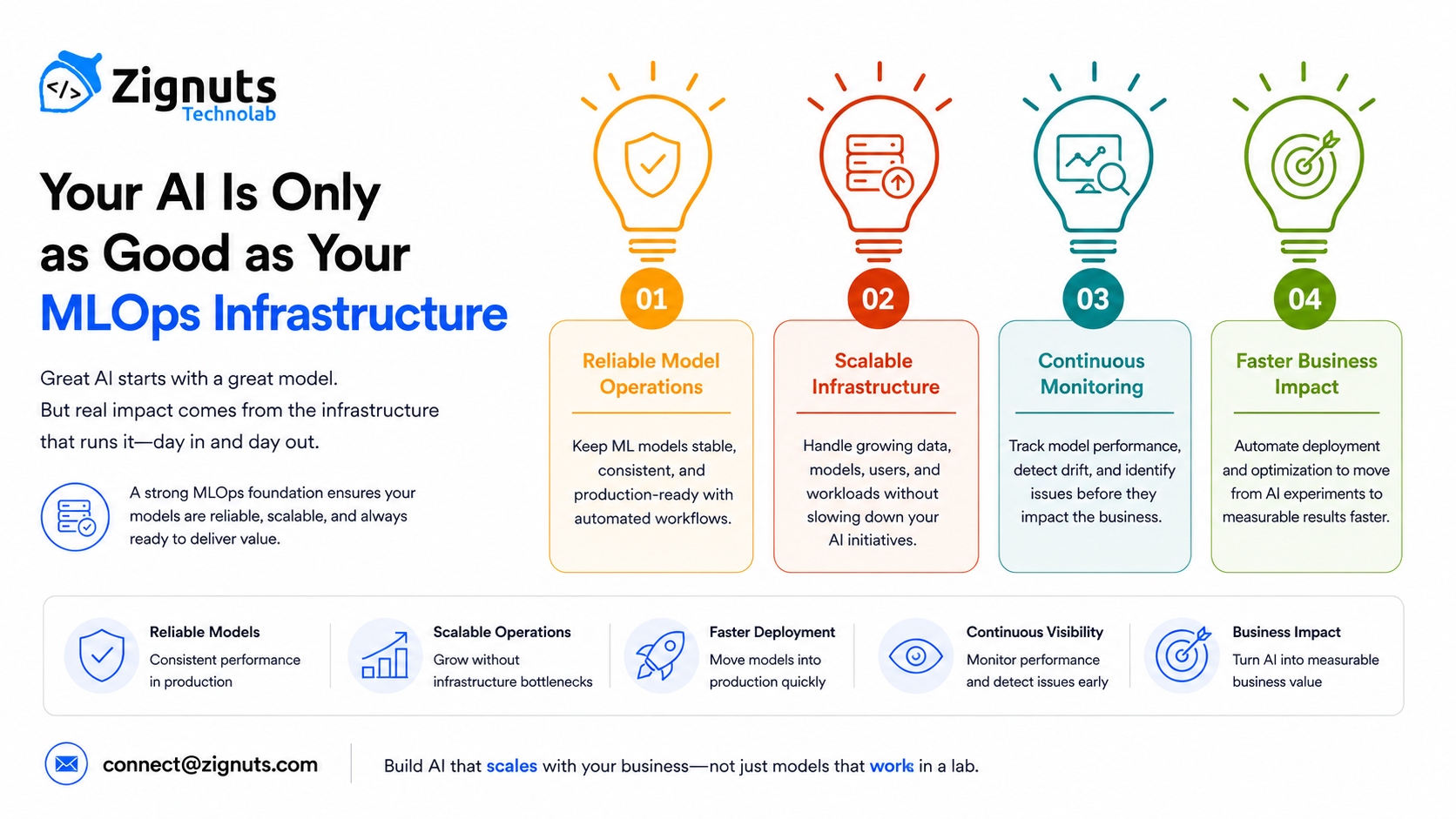
An impressive AI model can lose its business value when the infrastructure around it cannot support reliable production use. Models need consistent data, dependable deployment, continuous monitoring, scalable compute, and controlled updates to remain useful after launch. For organizations moving beyond AI experiments, Enterprise MLOps Services provide the operational foundation for managing machine learning systems as long-term business capabilities rather than isolated technical projects.
2027 Insight | Business Impact | What Leaders Should Do |
|---|---|---|
MLOps infrastructure will become a core part of enterprise AI strategy | Weak operational foundations can limit AI scalability | Treat ML infrastructure as a strategic capability |
Automated monitoring will become increasingly important | Teams need faster visibility into model and data issues | Establish continuous observability across the ML lifecycle |
Governance will become embedded into ML operations | More production models create greater accountability requirements | Define ownership, access, approvals, and audit processes |
Reusable ML infrastructure will support faster innovation | Teams can avoid rebuilding operational workflows for every model | Standardize common deployment and lifecycle components |
Why Infrastructure Determines ML Success
Businesses often focus heavily on model selection, training data, and algorithm performance.
Those areas matter, but production success depends on much more.
A machine learning system must interact with databases, APIs, applications, data pipelines, cloud infrastructure, monitoring systems, security controls, and users. If those surrounding components are unreliable, the model itself cannot consistently deliver business value.
This creates an important distinction between building AI and operating AI.
A model can be technically impressive while the system supporting it remains difficult to maintain.
The Hidden Infrastructure Behind Every Production Model
A production ML environment typically involves several interconnected layers:
Data ingestion and storage
Data processing and validation
Feature management
Model training infrastructure
Experiment tracking
Model repositories
Deployment environments
Inference services
Monitoring and observability
Security and access controls
Retraining workflows
Each layer introduces operational considerations.
For example, a model may be successfully deployed but still become unreliable if the data pipeline changes unexpectedly. Similarly, an accurate model can become expensive to operate if inference infrastructure is poorly optimized.
MLOps brings these components into a more structured lifecycle.
From AI Infrastructure to Business Outcomes
Business Need → Data & Infrastructure → ML Development → Production Operations → Measurable Business Outcome
The purpose of the infrastructure is not to create more technology.
It is to provide a dependable path between business requirements and production ML outcomes.
When infrastructure is designed around that objective, technical decisions become easier to evaluate.
Why Enterprise ML Requires a Different Approach
Enterprise environments introduce additional complexity.
Organizations may have multiple cloud platforms, legacy applications, internal databases, security policies, compliance requirements, and teams working across different business units.
A model cannot simply be deployed in isolation.
It may need to integrate with:
Customer relationship systems
Enterprise resource planning platforms
Internal APIs
Customer-facing applications
Identity systems
Security platforms
Business intelligence tools
This makes architecture and integration important parts of MLOps planning.
Business Benefits of Strong MLOps Infrastructure
Greater Reliability
Production systems need predictable behavior.
Standardized infrastructure, automated testing, monitoring, and controlled deployment processes can help reduce operational uncertainty.
Faster Deployment
Reusable pipelines can reduce the effort required to move models through development, testing, staging, and production.
Better Scalability
Infrastructure designed for growth can accommodate increasing model volume, data processing requirements, and inference demand.
Improved Productivity
Data scientists and engineers can spend less time solving repetitive deployment and environment problems.
Stronger Governance
Centralized processes can make it easier to manage access, versioning, approvals, and audit requirements.
Where Enterprise MLOps Creates Value
Financial Services
Banks and financial organizations can use machine learning for fraud detection, risk analysis, customer analytics, forecasting, and transaction monitoring.
These systems can require strong monitoring and governance because their outputs may influence important business processes.
Retail and E-commerce
Retail organizations can apply ML to recommendations, personalization, demand forecasting, inventory planning, and customer segmentation.
As customer behavior and product catalogs change, production infrastructure must support continuous model management.
Manufacturing
Manufacturers can use machine learning for predictive maintenance, quality control, anomaly detection, and operational forecasting.
Reliable infrastructure can help connect model outputs with production systems while maintaining appropriate monitoring.
Healthcare
Healthcare organizations can use machine learning for research, operational analytics, forecasting, and administrative processes.
Data protection, access management, governance, and auditability can be particularly important in these environments.
Enterprise SaaS
SaaS companies can integrate ML into search, recommendations, personalization, classification, and forecasting.
As customer usage grows, MLOps infrastructure can help teams manage increasing model and inference workloads.
The Infrastructure Decisions Leaders Need to Make
Decision Area | Key Question | Business Consideration |
|---|---|---|
Architecture | Where should ML workloads run? | Balance scalability, security, performance, and cost |
Automation | Which lifecycle processes should be automated? | Prioritize repetitive and error-prone activities |
Monitoring | What should be observed continuously? | Connect technical monitoring with business outcomes |
Governance | Who controls production ML? | Define ownership, approvals, access, and accountability |
A strong infrastructure strategy does not mean implementing every available platform or tool.
It means creating an environment that supports the organization's actual ML requirements.
Data Is the Foundation
Infrastructure cannot compensate for poor data.
Production ML systems need reliable data pipelines that can handle changing schemas, missing values, unexpected distributions, and pipeline failures.
Organizations should establish appropriate validation processes before data reaches critical model workflows.
Data lineage can also become important.
Teams should be able to understand where important datasets originated, how they were transformed, and which models depend on them.
This becomes increasingly valuable when investigating production issues or preparing for audits.
Model Deployment Needs Engineering Discipline
Deployment should be repeatable.
Manual deployment can make it difficult to determine exactly what changed between versions. It can also increase the likelihood of configuration differences between environments.
Automated deployment pipelines can standardize activities such as:
Model validation
Artifact packaging
Security checks
Environment preparation
Health verification
Monitoring activation
The exact process should reflect the organization's risk profile.
Higher-risk applications may require additional approval gates before production release.
Monitoring the Entire ML Environment
Production monitoring should extend beyond infrastructure availability.
Teams should observe multiple dimensions.
Infrastructure
Monitor resource utilization, latency, availability, and system errors.
Data
Track quality, schema changes, missing values, and unexpected distributions.
Models
Monitor prediction behavior, performance indicators, and potential drift.
Business Outcomes
Where possible, connect model behavior with meaningful business indicators.
This layered approach helps organizations distinguish technical failures from model problems and business performance changes.
Scaling Without Losing Control
ML adoption can grow quickly after an initial successful project.
One model can become five. Five can become dozens across different departments.
Without standardized infrastructure, each model may create a separate operational process.
This increases maintenance requirements and makes governance more difficult.
Reusable MLOps components can help organizations create common patterns for deployment, monitoring, access management, and lifecycle operations.
The goal is not complete uniformity. Specialized use cases may require specialized architecture. The goal is to standardize what can reasonably be standardized.
Security and Governance
Enterprise ML infrastructure must account for security from the beginning.
Important considerations include:
Identity and access management
Data permissions
Model access
Secrets management
Environment separation
Network controls
Audit logging
Deployment approvals
Incident response
Governance should also define who owns a model after deployment.
Someone needs to be responsible for monitoring, maintenance, incident response, performance reviews, and eventual retirement.
Executive Decision-Making
Before investing in MLOps infrastructure, leaders should evaluate the business and operational requirements.
What business problem does the infrastructure support?
Avoid building infrastructure without a clear production use case.
How many models do we expect to operate?
Infrastructure requirements change significantly as the model portfolio grows.
What systems need to be integrated?
Identify data platforms, applications, APIs, security systems, and existing development infrastructure.
What are the security requirements?
Determine what data is involved and what controls are necessary.
How much automation is appropriate?
Automate repetitive processes while preserving human review where risk demands it.
What will infrastructure cost over time?
Evaluate not just initial implementation expenses, but also compute, storage, monitoring, maintenance, licensing, and engineering requirements.
How will success be measured?
Consider deployment efficiency, reliability, infrastructure utilization, model performance, development productivity, and business outcomes.
A Practical Implementation Roadmap
Step 1: Assess Existing Infrastructure
Document current data platforms, cloud environments, ML workflows, deployment processes, and monitoring capabilities.
Step 2: Select a Priority ML Use Case
Start with a model that has clear business importance.
Step 3: Identify Infrastructure Gaps
Determine where data, deployment, monitoring, integration, security, or scalability problems exist.
Step 4: Establish Standardized Workflows
Create repeatable processes for testing, deployment, monitoring, and version management.
Step 5: Add Governance
Define access controls, ownership, approval processes, and audit requirements.
Step 6: Measure Operational Performance
Track improvements in deployment speed, reliability, productivity, infrastructure utilization, and relevant business outcomes.
Step 7: Expand Carefully
Reuse successful architecture patterns while adapting them to the requirements of additional ML workloads.
Common MLOps Infrastructure Challenges
Building an MLOps environment can create complexity if the architecture is not carefully planned.
One common risk is tool sprawl. Organizations may adopt numerous specialized platforms that perform overlapping functions.
Another challenge is integration. Enterprise environments often contain legacy systems that were not designed for modern ML workflows.
Cost management also requires attention. Training and inference workloads can consume substantial infrastructure resources depending on the use case.
Vendor dependency is another consideration. Organizations should understand how much of their ML lifecycle depends on a specific cloud or platform.
Finally, infrastructure alone cannot solve organizational problems. Teams still need clear responsibilities, processes, and communication.
Build vs. Buy for MLOps Infrastructure
Organizations should decide whether to build custom infrastructure, use managed capabilities, or adopt a hybrid approach.
Building can make sense when customization and control are strategic requirements.
Managed services can make sense when the organization prioritizes faster implementation and reduced infrastructure maintenance.
A hybrid model can provide flexibility by combining managed components with custom workflows where necessary.
Leaders should compare:
Total cost of ownership
Security requirements
Integration needs
Internal engineering capabilities
Scalability
Customization
Vendor dependency
Long-term maintenance
The best architecture is the one that supports business requirements without creating unnecessary operational overhead.
Preparing for 2027 and Beyond
As organizations move from individual AI experiments toward broader ML adoption, infrastructure will increasingly become part of the AI strategy itself.
The ability to operate models reliably across changing data, applications, teams, and workloads will influence how quickly businesses can expand their machine learning capabilities.
This means leaders should think about MLOps infrastructure before operational complexity becomes a bottleneck.
Conclusion
Machine learning performance depends on more than the model.
The infrastructure supporting data, deployment, monitoring, security, scaling, and lifecycle management determines whether that model can remain useful in production.
Enterprise MLOps Services can provide a structured foundation for managing these challenges, helping organizations move from isolated ML projects toward repeatable production capabilities.
The right approach is not to build the most complicated infrastructure possible. It is to create an operational environment that matches the organization's business goals, technical maturity, risk profile, and growth plans.
When ML infrastructure is designed around reliable business outcomes, machine learning becomes easier to operate, scale, and improve.
FAQs
What is Enterprise MLOps?
Enterprise MLOps is the structured approach to managing machine learning development, deployment, monitoring, governance, and lifecycle operations across an organization's production environment.
Why is MLOps infrastructure important?
It provides the systems and processes required to operate machine learning reliably after deployment, including monitoring, automation, version control, security, and scalability.
Does every company need complex MLOps infrastructure?
No. The level of infrastructure should match the number of models, production requirements, business risk, data environment, and organizational maturity.
What should enterprise ML infrastructure include?
It may include data pipelines, training environments, model registries, deployment systems, inference infrastructure, monitoring, security controls, and governance processes.
How does MLOps help reduce ML deployment problems?
Standardized workflows, automated testing, version control, monitoring, and controlled releases can reduce inconsistencies and make production issues easier to investigate.
What is the biggest infrastructure mistake businesses make?
A common mistake is building a complex technology stack before clearly defining the business problem, ML workload, and operational requirements.
How should leaders measure MLOps infrastructure success?
They can evaluate deployment efficiency, reliability, development productivity, infrastructure utilization, model performance, governance maturity, and relevant business outcomes.
Comments
Log in or sign up to join the conversation.