

The Fed, reportedly, took action in 2019 - with its massive flip-flop, cutting rates drastically and expanding its balance sheet at the fastest pace since the financial crisis -in order to 'fix' the yield curve which had dropped into the media-terrifying inverted state... but what investors (and The Fed) appear to have forgotten (or choose to ignore) is that it is now much more concerning.
The last few months have seen the yield curve steepen dramatically, up 35bps from August's -5bps spread in 2s10s to over 30bps today - the steepest since October 2018...
(Click on image to enlarge)

Source: Bloomberg
That is great news, right? No more recession risk, right?
Wrong!
(Click on image to enlarge)

Source: Bloomberg
While investors buy stocks with both hands and feet, we take a look at how risk assets perform after the curve flattens and/or inverts. According to backtests from Goldman, while risky assets, in general, can have a positive performance with a flat yield curve, risky asset performances tend to be lower. This is consistent with Goldman's base case forecast combining low (but positive) returns from here given the lack of profit growth and a less favorable macro backdrop.
What is far more notable, as we showed most recently last July, is that since the mid-1980s, significant stock drawdowns (i.e. market crashes) began only when term slope started steepening after being inverted.
(Click on image to enlarge)
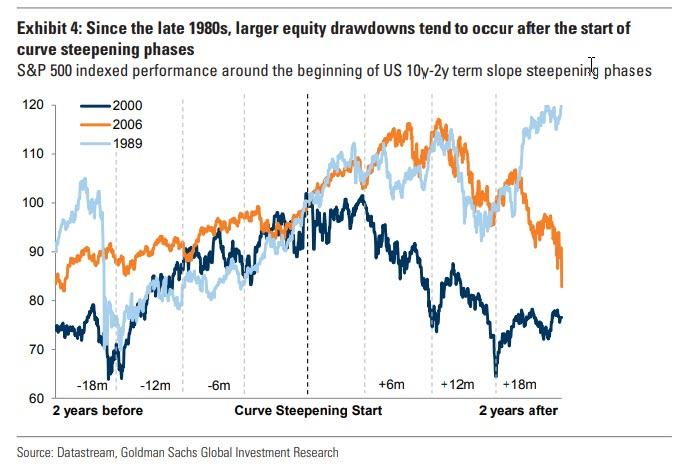
So, be careful what you wish for... and celebrate; because as history has shown, the un-inverting of the yield curve is when the recessions start and when the markets begin to reflect reality.



Comments
Log in or sign up to join the conversation.