

For much of the past two years, income investors operated under a workable assumption: the Federal Reserve’s easing cycle would keep long-duration yields in check, preserving the relative premium that dividend-paying equities commanded over risk-free alternatives. That assumption is now being stress-tested in real time. The 10-year Treasury yield climbed to 4.38% on April 2, 2026, its highest reading in over a year.
This comes after breaching the psychologically significant 4.35% level on March 20-a move that analysts at primary dealer desks described as a “fundamental recalibration of the cost of capital,” not a transient spike.
Traders who had priced in multiple Fed cuts through 2026 have abandoned that positioning entirely, rotating toward a structurally higher neutral rate unseen in nearly two decades. The inflation data supporting that view has not softened: consumer prices remain sticky at 2.4%, and energy market disruptions are adding fresh upward pressure on the cost outlook.
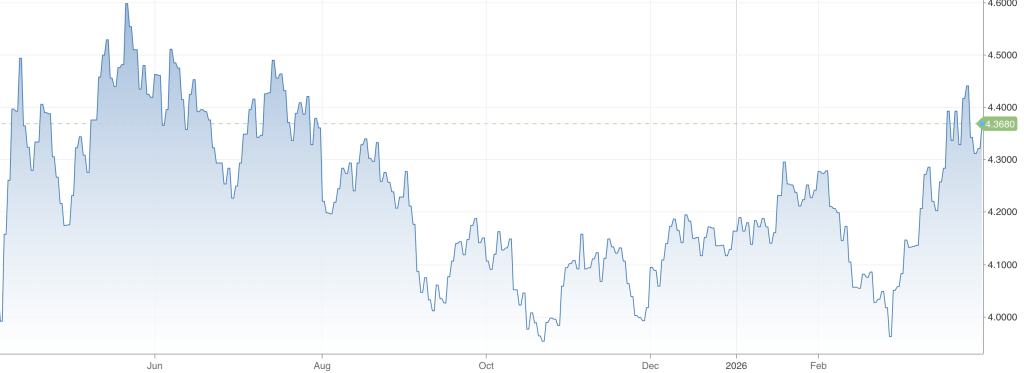
Source: CNBC
What that repricing means specifically for Dividend Aristocrats-the 66 S&P 500 constituents that have grown their dividends for at least 25 consecutive years-is the compression mechanism now accelerating across income-oriented portfolios.
These stocks were built for a different rate environment. As the yield curve steepens with the long end rising faster than short-term rates, the equity risk premium embedded in Aristocrat valuations is narrowing to a point that is forcing a reappraisal of whether the income they offer still justifies the additional volatility and liquidity trade-off versus Treasuries.
The Yield-Dividend Compression Mechanism: Why Rising 10 Year Treasury Rates Hit High-Yielders Disproportionately
The mechanics are straightforward but often underappreciated in magnitude. Dividend Aristocrats are structurally long-duration equity instruments-their valuations depend heavily on the present value of stable, predictable cash flows extending decades into the future.
When the discount rate (the rate applied to those future cash flows in a DCF model) rises, the present value of those streams falls, even when the underlying business hasn’t changed at all. A 50-basis-point move in the 10-year Treasury yield, the approximate increase recorded over the past month, translates into a meaningful multiple compression for companies whose earnings growth is measured in low single digits.
At a 10-year yield of 4.38%, the yield spread between a typical Dividend Aristocrat-which might offer a 2.8% to 3.2% dividend yield-and the risk-free rate has inverted into negative territory.
That means the 10-year Treasury now yields more than the dividend alone on many of these stocks, before equity risk premium, volatility, and liquidity discount are even applied.
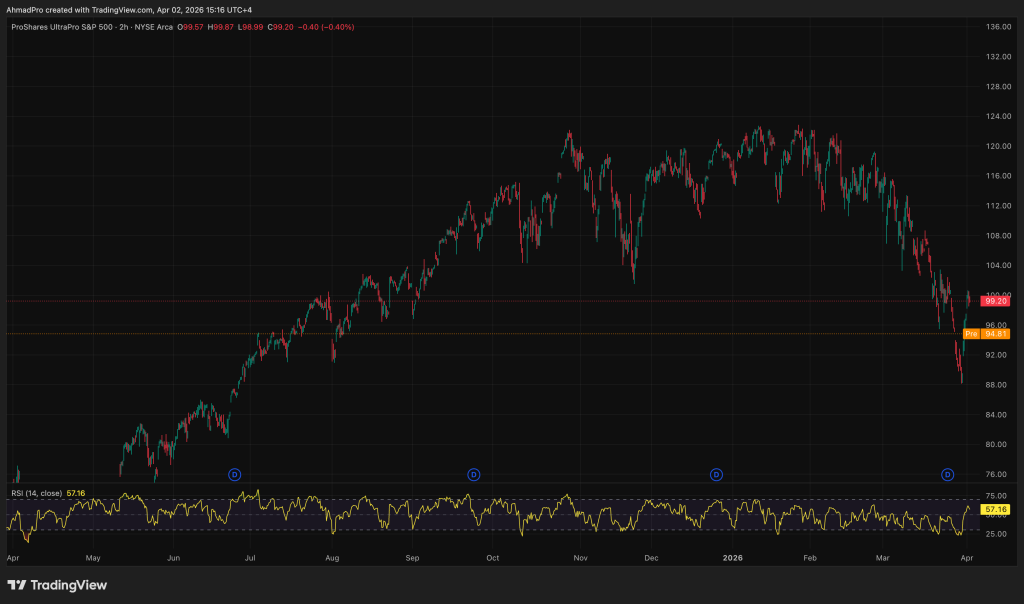
Source: TradingView
At prior yield peaks in 2023, when the 10-year briefly touched 5%, dividend-heavy ETFs like the ProShares S&P 500 Dividend Aristocrats ETF (NOBL) saw drawdowns of 12% to 15% from their highs.
The current trajectory-with forecasts pointing to 4.44% by quarter-end-suggests the market has not yet fully priced the duration risk embedded in these portfolios.
The yield curve’s steepening shape compounds the problem. A steeper curve (long rates rising faster than short rates) historically signals that markets expect either stronger growth, persistent inflation, or both-neither of which is particularly supportive of the regulated, low-growth business models that dominate the Aristocrats universe.
What makes this steepening particularly punishing is that it is happening while interest rate expectations remain uncertain, preventing the “buy the dip” reflex that stabilized Aristocrats during the 2022-2023 rate cycle.



Comments
Log in or sign up to join the conversation.