

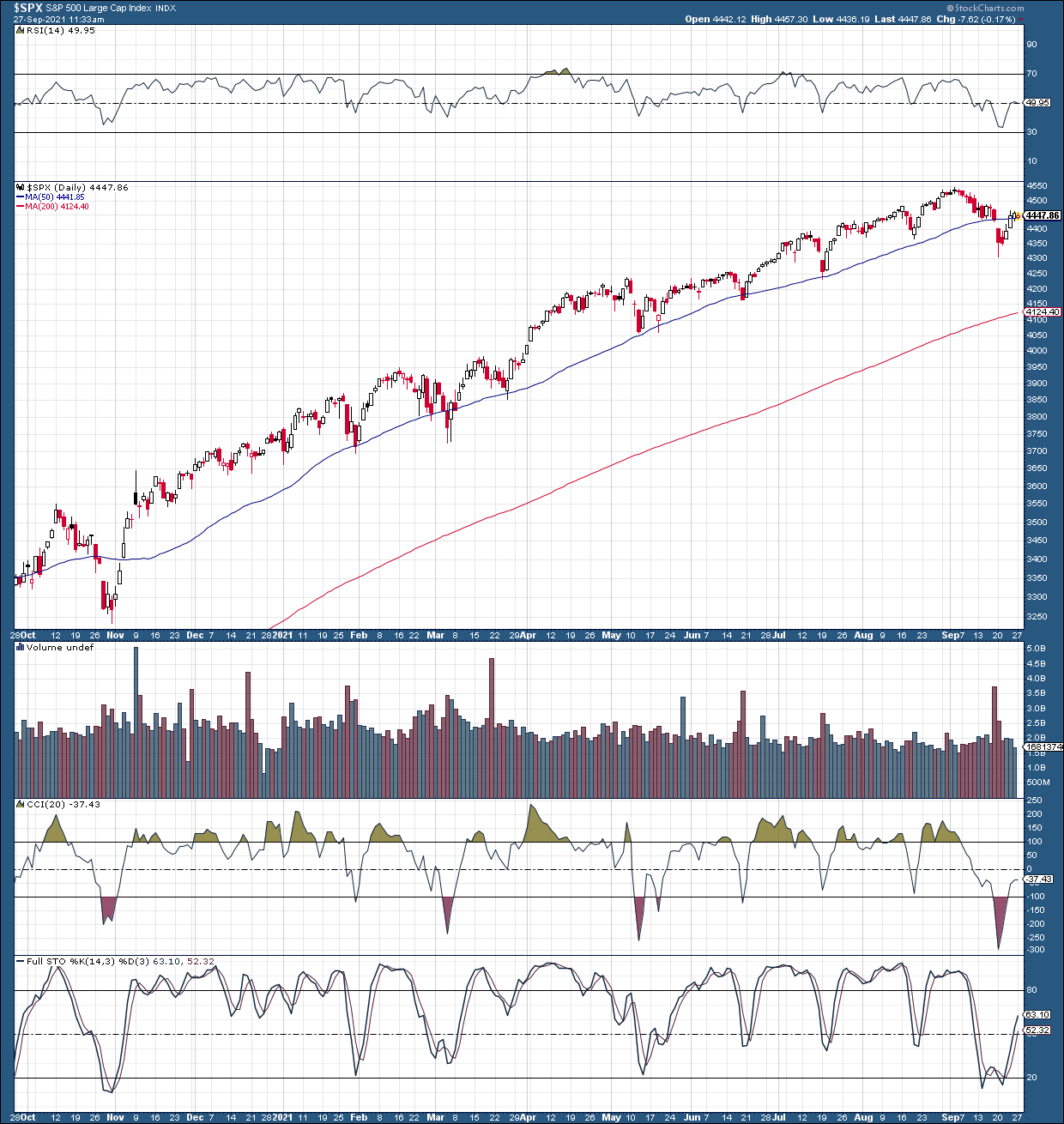
I began warning about the "pullback" in early September, right as the S&P 500/SPX (SP500) started stalling around its all-time highs. Technical momentum slowed, market participants got shaky about the upcoming Fed meeting, and the atmosphere became suitable for a pullback. Therefore, a 5-10% reset made perfect sense, which is what the market saw.
(Click on image to enlarge)
Source: StockCharts.com
The SPX hadn't made a trip below the 50-day moving average ("MA") in about 6 months before the recent decline. The relative strength index ("RSI") and other technical indicators began to show signs of worsening momentum. Also, the bearish technical setup coincided with uncertainty about the September Fed meeting and market jitters about tapering. The 50-day MA finally broke down, and the SPX got its badly needed pullback of 5.5%. While this decline was 1-2% less than the optimal outcome, I am content with the result.
The $64,000 Question
Is this pullback over, or is this decline going to grow into a full-blown correction? To answer this question, let's look at another chart.
S&P 500 futures
(Click on image to enlarge)
Source: thinkorswim
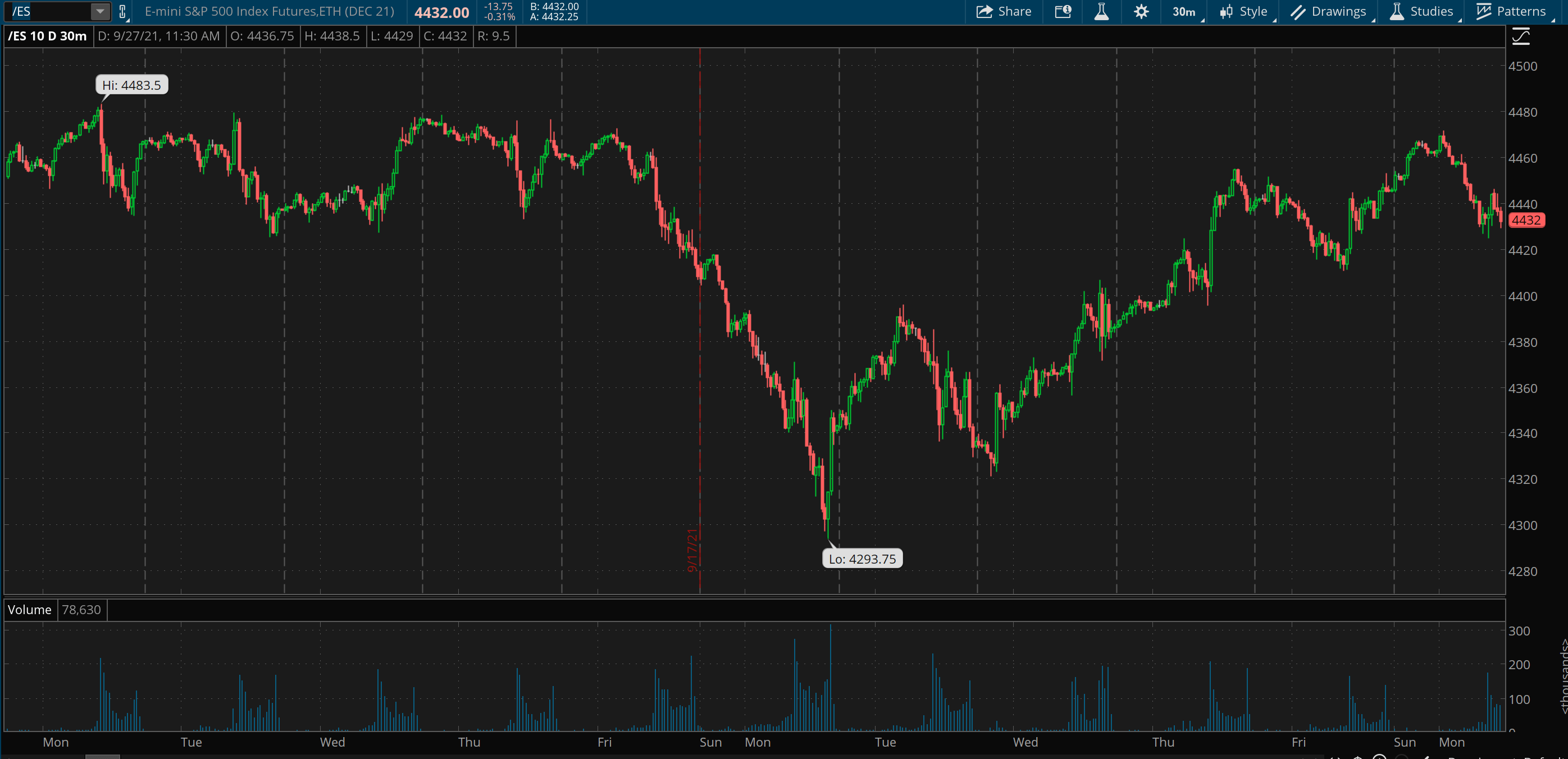
While SPX futures likely bottomed around the critical 4,290-4,300 support level, technically, stocks may not be out of the woods quite yet. Yes, we see a series of higher highs coupled with higher lows developing. Yet, two things need to happen from a technical standpoint before I get more bullish here. First, the initial support level around 4,400-4,420 needs to hold, and second, SPX futures have to make a decisive breakthrough above critical resistance at the 4,480-4,500 level. Once these two factors occur, the probability for new all-time highs and notably higher SPX levels move up substantially.
What About The Fed Taper?
The pre-taper tantrum just happened. Yes, the Federal Reserve will reduce its asset purchasing program, but it is yet to start even. Here's what Fed Chair J Powell said:
The taper could get announced officially in November.
If the taper gets announced in November, it will likely begin in December.
Once the taper begins, it will likely reduce asset purchases by $15 billion per month.
Some factors to keep in mind:
- The Fed's balance sheet towers at a massive $8.5 trillion now, roughly a $4 trillion increase since this latest round of QE began.
- An immense amount of capital is being pumped into the finical system. The Fed's been purchasing about $120 billion in assets in recent months.
- Tapering can be adjusted as we advance. If the economy or the stock market begins to slip, the Fed may scale back tapering, or the agency can increase QE at any time.
- The decrease in asset purchases has been well telegraphed, and the market may not need a big selloff ahead of the taper.
- In prior instances of Fed tapering, the stock market continued to rally through the taper and into early rate hikes.
- The Fed will probably forgo raising interest rates for at least another year.
- The Fed can push back interest rate increases if the economy begins to slow.
The Bottom Line
Just because the Fed's policy is less loose, it does not mean that monetary policy will be tight. We're talking about a very gradual tapering process that is yet to begin, that's been exceptionally well telegraphed and could be adjusted or even reversed at essentially anytime the Fed sees fit. At the same time, the finical system remains flooded with enormous capital that's still searching and should continue to look for a place to go.
Treasuries and other "safe-haven" plays aren't very attractive right now. Considering that inflation is running relatively hot, market participants will likely continue to receive a negative real rate of return holding most high-rated bond instruments. Real estate seems overheated in many areas and is not liquid enough. The cryptocurrency market may be too risky, is not big enough yet, and many market participants still prefer not to participate. Many parts of Europe and Asia face growth issues and other concerns. Parking your money in cash doesn't make much sense, given the current rate of inflation.
So, where are you going to invest your money, buy gold? Well, maybe some gold, but it only makes sense to have a relatively small part of your portfolio in metals. No, you and I will very likely continue to invest a lot of our capital in the U.S. stock market. We're confronted with a phenomenon of essentially unlimited money, and possibly the best place to invest it is in the U.S. stock market right now. This unprecedented dynamic will likely push the SPX and other major market averages much higher into year-end and early next year. Therefore, I am keeping my year-end price target range at 4,800-5,000 for the S&P 500, and I continue to favor U.S. equities here.

Comments
Log in or sign up to join the conversation.