

Key Takeaways
Japan’s Ministry of Finance deployed an estimated $52.8 billion in what appears to be the largest single-day yen intervention on record, with U.S. coordination adding credibility absent from prior unilateral efforts.
In our view, a durable yen recovery requires the Bank of Japan to narrow the rate differential, and with the policy rate held at 1% since June, intervention alone is more likely to buy time than change the regime.
The WisdomTree Japan Hedged Equity Fund (DXJ) seeks to neutralize yen movement for U.S. investors, while the WisdomTree Japan Opportunities Fund (OPPJ) spans four distinct sleeves including the Sogo Shosha, high shareholder yield companies, corporate governance improvers, and GeoAlpha.
Japan’s Ministry of Finance has repeatedly intervened to support the yen over the past four years. Until now, the pattern has been familiar. Authorities stepped in, the currency rallied briefly, and depreciation resumed once markets returned to the underlying interest rate differential.1
The latest intervention felt different. The move was larger, the market reversal was sharper, and Japan received support from the U.S. That combination gives the intervention more credibility than prior unilateral efforts. Even so, it does not remove the central problem. A durable yen recovery will ultimately require help from the Bank of Japan (BoJ).
A Stronger Intervention after Years of Limited Success
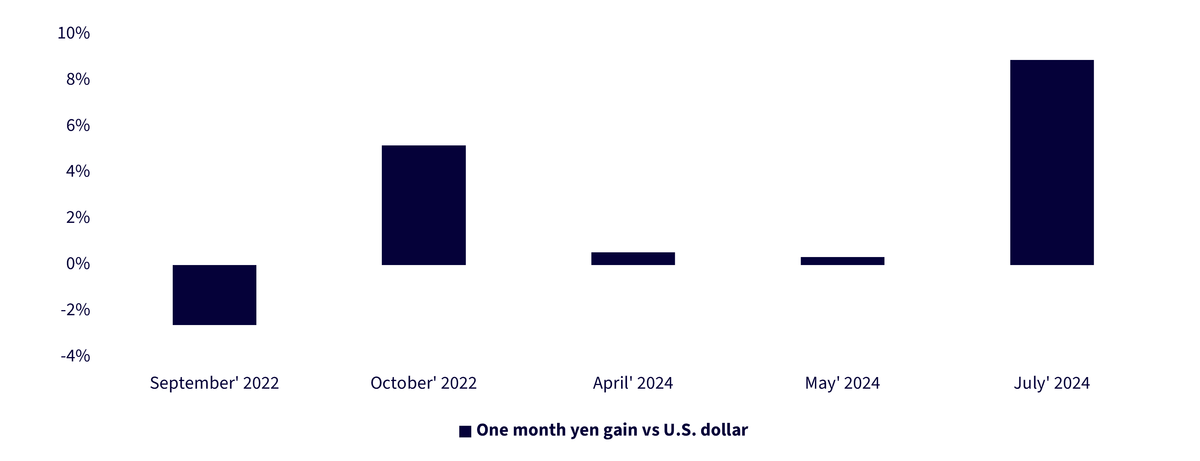
Japan began its current intervention cycle in September 2022, when it bought yen for the first time since 1998. Since then, the Ministry of Finance has reportedly spent at least ¥22trn (US$139bn) supporting the currency, excluding the latest operation. Despite that commitment, the yen continued to weaken as the return available on dollar assets remained substantially higher than that on comparable Japanese assets.2
Figure 1: Yen Impact after Previous Five Yen Intervention Episodes
Bloomberg Finance L.P., WisdomTree as of July 31, 2026. Past performance is not indicative of future results.
The estimated US$52.8bn deployed would represent the largest single day intervention on record.3 Its timing and scale indicate that the authorities are becoming less willing to tolerate disorderly depreciation. The Yen rose by 3.78% during the initial move, its sharpest 1-day advance in multiple years.4
The changing intervention threshold is also revealing. Four years ago, markets appeared to treat roughly ¥145 per dollar as an important line for policymakers. The latest action came much closer to ¥160, suggesting that investors had become increasingly confident in testing the authorities’ resolve. That confidence may now be less secure.
Why U.S. Participation Matters
The intervention carried more weight because Japan did not act entirely alone. U.S. involvement reportedly included rate checks and coordinated yen purchases, signaling that Washington is also concerned about the consequences of uncontrolled depreciation.
The U.S. has several reasons to support Japan. A sharp fall in the yen could destabilize Japanese government bonds, encourage Japanese institutions to sell overseas assets, and place upward pressure on U.S. Treasury yields. Japan is one of the largest foreign holders of U.S. government debt, so the stability of Japanese markets has direct implications for U.S. financial conditions.
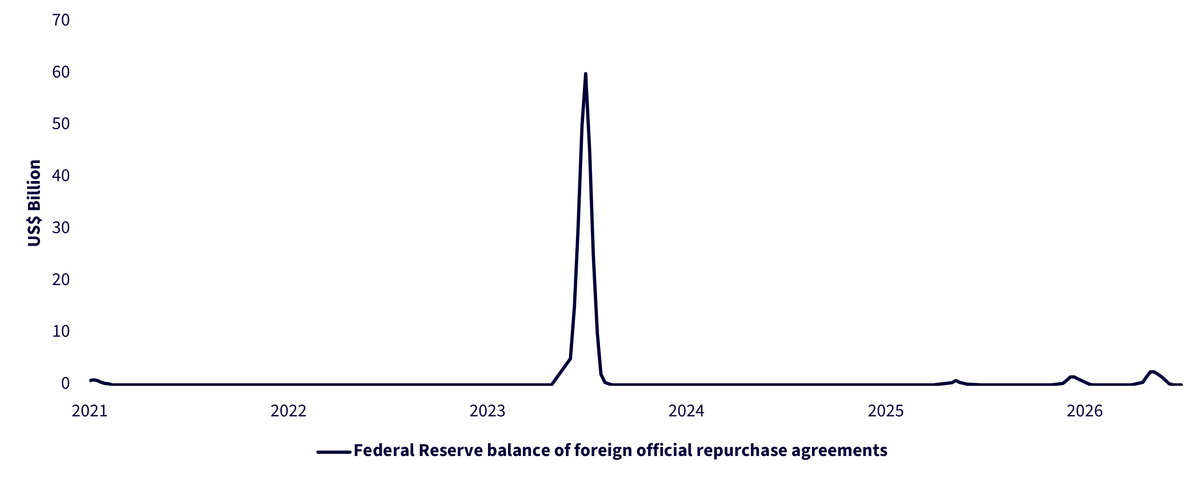
The Federal Reserve’s (Fed) Foreign and International Monetary Authorities Repo Facility, known as FIMA, could make future intervention easier to finance. Scott Bessent described the FIMA program as an important support for Japan’s efforts and said: “We would encourage it to be upsized in the coming months.”5 Japan can pledge U.S. Treasury securities in exchange for dollars rather than selling those bonds outright. The dollars can then be exchanged for yen.
Figure 2: Federal Reserve’s Foreign Repo Facility is Rarely Used
Source: Federal Reserve, Bloomberg Finance L.P., WisdomTree, as of July 31, 2026.
This approach reduces the risk that intervention itself causes a selloff in U.S. Treasuries. It is an important improvement in the mechanics of currency support, although it does not change the fundamentals determining the exchange rate.
The Carry Trade Raises the Global Stakes
The yen’s importance extends far beyond Japan. For years, investors have borrowed at low Japanese interest rates and invested the proceeds in higher-yielding currencies and assets. This carry trade has been one of the most reliable strategies in global markets, benefiting from both the yield differential and persistent yen weakness.
A sudden appreciation changes the calculus. Investors with short yen positions may be forced to buy the currency to close their trades, reinforcing the initial rally. That feedback loop can become disorderly, particularly when positioning is crowded.
The recent intervention had already interrupted what had been a remarkably steady carry trend. The ¥155 per dollar level is a potentially important threshold.6 A sustained break below that level could trigger stop losses and encourage Japanese exporters to convert more overseas revenues into yen. This is one reason the latest intervention may prove more effective than previous attempts in the short run. It arrived alongside broader dollar weakness, crowded positioning and increasing official coordination.
Intervention Can Change Behavior, but Not the Rate Differential
Currency intervention works by altering the immediate supply and demand balance, signaling policymakers’ discomfort and raising the cost of speculative positions. It can be particularly effective when it pushes the market through widely watched technical or corporate planning levels.
The BoJ’s Tankan survey suggests that many Japanese companies have based their current fiscal year assumptions on exchange rates around ¥150 to ¥155 per dollar.7 A sustained move below that range could lead exporters to sell dollars more actively, adding private-sector support to official intervention.
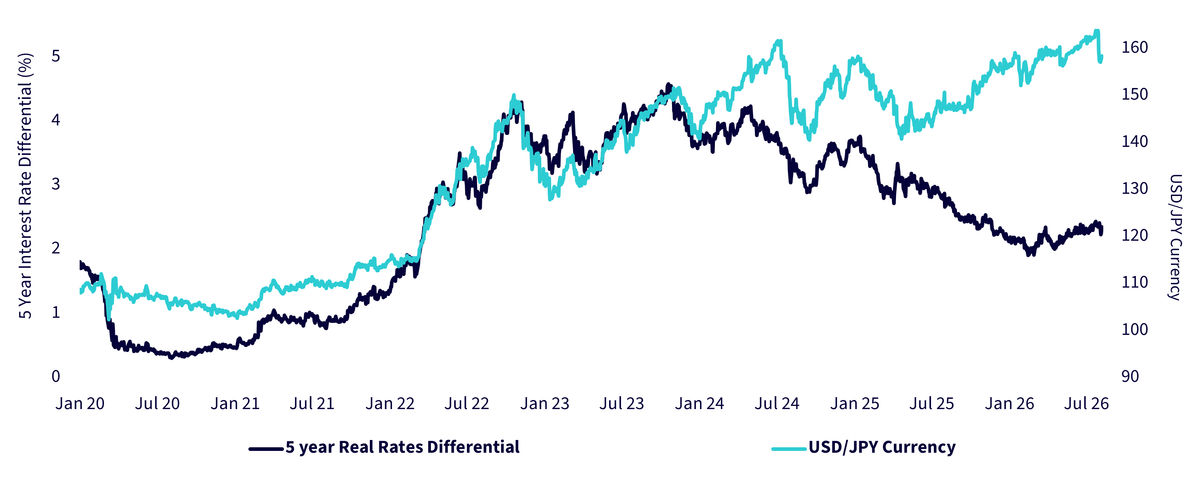
But the interest rate differential remains the dominant longer-term force. The yen’s depreciation has closely tracked the widening gap between expectations for U.S. and Japanese monetary policy. If the Fed maintains or even raises rates while the BoJ tightens only slowly, dollar assets continue to offer a large yield advantage.
Figure 3: Real Interest Rate Differentials versus USDJPY Exchange Rate
Source: Bloomberg Finance L.P., WisdomTree as of August 6, 2026.
Amidst the ongoing conflict in Iran, higher oil prices compound the pressure. Japan imports most of its energy, so rising crude prices increase demand for dollars and worsen the country’s terms of trade. At the same time, Prime Minister Sanae Takaichi’s growth-focused fiscal policy may support activity but also reinforce concerns about inflation and public finances. These forces are less likely to be offset by buying yen in the market.
The Bank of Japan Remains Decisive
The BoJ raised its policy rate to 1% in June, the highest level since 1995, but then held steady.8 Market expectations still point to a limited number of further hikes, despite the inflationary risks created by energy prices and yen weakness.
That cautious stance explains why intervention alone faces a credibility problem. If the central bank remains reluctant to narrow the yield gap, investors may eventually rebuild short yen positions once the immediate fear of further intervention fades.
The intervention creates a bridge to faster tightening. Authorities can stabilize the currency first, then reinforce that move with a more hawkish BoJ path. This would give investors a fundamental reason to hold yen rather than merely fear official action. If inflation remains persistent, wage growth stays firm and the yen again weakens sharply, the pressure on the BoJ to accelerate normalization is likely to rise. The intervention may reinforce expectations for future rate increases while USD/JPY remains in the ¥150s.
Without that follow-through, the intervention is more likely to buy time than create a new currency regime.
Implications for Japanese Equities
The WisdomTree Japan Hedged Equity Fund (DXJ) focuses equity exposure on dividend-paying, globally-oriented businesses of Japan. Any movement in the Japanese yen versus the U.S. dollar is neutralized from a returns perspective, leaving investors with the return stream of the underlying equities. Importantly, positioning the currency hedge for U.S. investors also allows them to collect the interest rate differential, which we mentioned above, so long as U.S. interest rates are higher than those in Japan.
The WisdomTree Japan Opportunities Fund (OPPJ) creates a diversified array of potential avenues to benefit from a Japanese equity exposure. The four distinct sleeves include:
The Sogo Shosha, five trading houses cited as long-term holdings of Berkshire Hathaway.9
High Shareholder Yield Companies
Corporate Governance Improvers
GeoAlpha, which specifically focuses on companies positioned to benefit from geopolitical events, fiscal and monetary policy shifts, technological innovation and shifting consumer preferences.
OPPJ also has a dynamic currency hedge that can be adjusted on a monthly basis.
At WisdomTree, we continue to see strong opportunity in the underlying fundamentals of Japan’s equity market, and this remains the key driver that is the catalyst for our interest in this market.
1 Source: Ministry of Finance Japan. (n.d.). Foreign exchange intervention operations.
2 Source: Ministry of Finance Japan. (n.d.). Foreign exchange intervention operations.
3 Source: Bloomberg News. (2026, July 31). BOJ data suggest Japan intervention of about 8.45 trillion yen. Bloomberg.
4 Source: Bloomberg News. (2026, July 30). Japan's yen posts biggest gain since April as market eyes possible intervention. Bloomberg.
5 Source: Bessent, S. [@SecScottBessent]. (2026, August 2). The Trump Administration delivers for America's trusted partners... [Post]. X.
6 Source: Bloomberg News. (2026, August 4). After historic intervention, 155 emerges as yen's next big test [Video]. Bloomberg.
7 Source: Bank of Japan. (2026, July 1). Tankan outline (June 2026).
8 Source: Bank of Japan. (2026, June 16). Change in the guideline for money market operations [PDF].
9 Source: Buffett, W. E. (2024). 2023 annual report: Letter to shareholders. Berkshire Hathaway Inc.


Comments
Log in or sign up to join the conversation.