

Theory of x-date trading:
Each quarterly dividend payment reflects the dividend earned during the previous quarter. Consequently, a dividend earned in April covers the company's distribution of monies earned during January, February, and March. Should those shares be sold prior to the x-date, the buyer will receive that dividend. If those shares are sold on or after the x-date, the seller retains the dividend. Consequently, shares sold prior to the x-date are more valuable because of the quarterly dividend that comes along with the shares. Likewise, because the buyer will not capture the previous quarter's dividend, he will, consequently, bid less for those shares on the x-date. Obviously, it's no secret that a stock's price will trend higher prior to the x-date and fall on that x-date. Knowing this, I was determined to formulate a trading strategy designed to best take advantage of this information.
Dividend Capture Strategy:
As a novice investor, I immediately attempted the obvious. Wow! I could capture three months on interest simply by buying securities shortly before their x-dates. Then, I could turn around and sell them on or shortly after the x-date, or even hold them for a month or two before selling them. The result: occasionally it worked, but more often than not, I was stuck with a stock, which was not terribly bad in a rising market. However, if the market fell, the chance of my suffering losses exceeding the dividends earned was significantly increased. Furthermore, when I purchased shares in anticipation of adding them to my portfolio as a long-term hold, I soon discovered it was, more often than not, better to buy them on the x-date or shortly thereafter. First, because of the taxes, I would have to pay on those captured dividends, which, in effect, reduced my profit margin. Secondly, I discovered, to my chagrin, that on the x-date share price fell by at least the amount of the dividend and often more simply as a result of momentum. And on occasion, that share price fell as much as double the dividend amount. For example, a share priced at the close of trading on the day prior to the x-date was $10.00 and the dividend paid was fifty cents. Not only did the market price open the following morning at $9.50, it often fell dramatically during the first trading hour, or so, to $9.00. This is not an unusual scenario. Consequently, for both the above reasons, I would have been much better off to have placed a low-ball offer for the shares at $9.00, hoping for a price drop of twice the dividend earned. Worst case scenario the share price did not fall sufficiently to meet my bid. Nothing ventured, nothing gained, and nothing lost. Additionally, had I truly wanted the stock, I could have easily increased my bid to meet the ask at any time during that day or on subsequent days. This led me to my second trading strategy, the double down strategy.
Double Down Strategy:
Chastened by the overall result of my initial trading strategy, I still believed I was on to something and study of stock price movement in relation to the x-date. Accordingly, I now focused on that precipitous drop in price during the first hour and a half of trading on the x-date. I also noticed that, more often than not, there was a price rebound at times during the remainder of the day. However, it didn't predict the day's share price movement, and certainly not how they would end up at the end of the day, but in most instances, there were a number of times during the day that share price would be somewhat higher to substantially higher than that first precipitous drop during the first hours of trading. A nice way to earn some extra cash, I reasoned, as I searched the net for sites forecasting upcoming x-dates. The best free site I found was The Street's Dividend Calendar, which lists upcoming x-dates and the amount of the declared dividends. This site is also updated daily as new dividend declarations were announced.
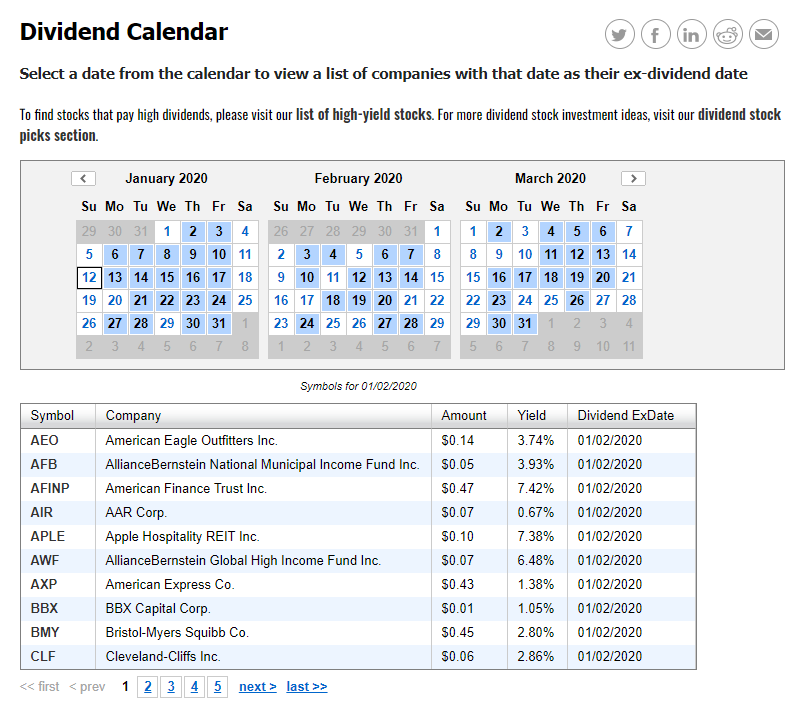
I had devised a simple strategy, which I set in motion by first establishing the parameters with which I would determine the companies I would choose to work with. After careful thought, I determined the dividend had to be above .35 and the yield above 8.5%. I chose .35 as the base amount of the dividend because I believed it was a figure tempting enough to warrant sufficient price movement. And on those occasions when the trading strategy for a particular stock didn't work out as I had planned, and I was stuck holding its shares, I wouldn't terribly mind holding a security that was paying a modest 8.5% dividend yield.
Let's apply my strategy to the above-mentioned $10.00 stock paying the .50 dividend. In the morning prior to the market's open, I placed a limit bid for 1,000 shares at $9.00, which was good for the day. If the morning price failed to fall to $9.00 or below and I wasn't able to make the purchase, I would cancel the bid before 11:30 a.m., the time I had chosen to cancel all bids that had not been executed. Nothing ventured, nothing gained, and nothing lost. However, in the event I made the buy, I immediately offered the shares for sale at $9.50 or higher, which depended on how the market, or sector,—the sector of the particular stock in play—was trending during the day. If it were solidly up, I might ask $9.75 or even yesterday's closing price of $10.00.
Conversely, when the market was trending down I'd immediately attempt to dump those shares, willing to accept even a modest gain. In the event the share price dropped below my purchase price, I had the option to sell it at a loss or wait a few days to sell it at, hopefully, a more advantageous price. On several occasions when the dividend yield topped 12%, and after careful study, I liked the company; I usually kept the stock, yet still offered it on a good-till-cancel sale basis, at a price that would give me a modest profit. More often than not, this strategy earned a modest return; however, it was labor-intensive and not worth the energy and angst for a nice, yet what I considered, was such a limited return.
However, for those of you anxious to build your fledging fortunes, the double-down trading strategy is a nice and entertaining way to increase your profits.I discuss this and other ways to increase your wealth in my Dividend Investor's Guide.


Comments
Log in or sign up to join the conversation.