

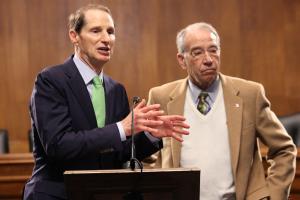
Gilead's GILD Sovaldi/Harvoni HCV regimen has been saving lives and that's a good thing. After Senator Bernie Sanders' HCV rant in March over veterans' inability to afford the drug, Gilead's pricing has been in the spotlight. Recent findings from the Wyden-Grassley report will likely keep Gilead in the spotlight. Senator Wyden (Oregon) and Senator Grassley's (Iowa) 18-month investigation into the pricing and marketing of Gilead's HCV regimen highlighted the following:
"Drawing from 20,000 pages of internal company documents, dozens of interviews with health care experts, and a trove of data from Medicaid programs in 50 states and the District of Columbia, the investigation found that the company pursued a marketing strategy and final wholesale price of Sovaldi - $1,000 per pill, or $84,000 for a single course of treatment - that it believed would maximize revenue. Building on that price, Harvoni was later introduced at $94,500. Fostering broad, affordable access was not a key consideration in the process of setting the wholesale prices."
GILD was down nearly 1% in mid-day trading; this came after falling nearly 2% on Monday. Below are other findings from the report and my interpretation:
Wyden-Grassley
"In the 18 months following Sovaldi's approval, Medicare spent nearly $8.2 billion before rebates on Sovaldi and Harvoni. Over that same span, Medicare's monthly spending on Hepatitis C treatments increased more than six-fold. In 2014 alone, Medicare and Medicaid combined to spend more than $5 billion on Sovaldi and Harvoni before rebates. That total is projected to climb in 2015. Gilead's recent financial statements show U.S. sales of Sovaldi and Harvoni, including through public programs and private payers, totaled $20.6 billion after rebates in the 21 months following Sovaldi's introduction."
Shock Exchange Interpretation:
- The $8.2 billion spent by Medicare highlights that the government is a major buyer of Gilead's HCV regimen. A buyer of this size typically wields a lot of power over vendors. Medicare/Medicaid may be able to extract deeper discounts for Gilead going forward.
- The six-fold increase in spending on HCV treatments indicates that a larger part of government spending has gone for HCV treatments, of which Gilead is a direct beneficiary. HCV sales of $20.6 billion - after rebates - illustrates that Gilead is indeed making money. If anyone gripes about the government's attempt to punish Gilead politically, Wyden-Grassley need only refer to the $20.6 billion sales figure for cover.
Wyden-Grassley
"Gilead pursued a calculated scheme for pricing and marketing its Hepatitis C drug based on one primary goal, maximizing revenue, regardless of the human consequences. There was no concrete evidence in emails, meeting minutes or presentations that basic financial matters such as R&D costs or the multi-billion dollar acquisition of Pharmasset, the drug's first developer, factored into how Gilead set the price."
Shock Exchange Interpretation
Gilead is in the business of returning profits to shareholders. There is nothing revolutionary about this fact. Pharmaceutical companies typically try to give a semblance that their pricing is tied to the need to recoup R&D spending; GILD longs have also made this argument. However, the fact that Gilead has not documented any evidence that its pricing was tied to R&D does not bode well. If furor over Gilead's HCV pricing reaches the court of public opinion, the company will be hard-pressed to differentiate itself from other firms like Valeant (NYSE:VRX) or Turing.
Wyden-Grassley
"Documents acquired during the course of investigation illustrate that Gilead was aware it was in a position to create clear savings for payers, but chose to pursue a "regimen neutral" price justified by "cost-per-cure" calculations that resulted in greater revenue per treatment than previous direct acting anti-virals ... Given the increased clinical efficacy of Sovaldi, Gilead believed that it was more than justified in using the cost-per-cure pricing model."
Shock Exchange Interpretation
When I first learned that Sovaldi would be priced over $80,000 per regimen, I too was taken aback. Since the drug was a cure and not simply a treatment, I was okay with the pricing initially. It all begged the question for payers, "What is the price of a life?" For those who could not afford the drug, it would take an entire family and/or community to help raise the money. The tradeoff was that it could save a person's life.
The flip side is that no matter what Gilead priced Solvadi for, the government and naysayers were going to find a reason to bring the price down. By starting at an "ask" of over $80,000, Gilead ensured that the government's "bid" would be a discount of that figure. Lastly, it was inevitable that the $80,000 ask was going to be ethereal. That headline price was discounted after Abbvie (NYSE:ABBV) entered the market late last year. Longs should brace themselves for further price declines going forward.
Wyden-Grassley
"Gilead considered a number of factors in determining a price point for Sovaldi, including costs for the existing standard of care for Hepatitis C treatment and setting a high baseline for the next wave of drugs, such as Harvoni [32-58] ... By elevating the price for the new standard of care set by Sovaldi, Gilead intended to raise the price floor for all future Hepatitis C treatments, including its follow-on drugs and those of its competitor."
Shock Exchange Interpretation
Wyden-Grassley are exactly right here. Longs were excited that Sovaldi was saving lives, so its price point was justified. They were even more excited about Gilead's next generation HCV regimen - Harvoni. According to SA author Jeff Ross, Harvoni was a game changer given that it was the first combination pill to treat HCV, had high efficacy rates and minimal side effects. Once Sovaldi's price had been accepted in the market place, Harvoni's price of greater than $90,000 per regimen had to be fair, right?
Gilead only had to wait for the PR machine - longs, financial news networks - to sing the company's praises. In my opinion, the headline HCV prices of $80,000 or greater were never going to last. The government - Senator Sanders, former Senator Hillary Clinton and Senators Wyden and Grassley - have spoken. It would behoove investors to factor further declines in HCV prices into Gilead's shares.
Forward Looking On Gilead
HCV represented 58% of Gilead's Q3 product sales; as HCV goes, so goes Gilead. Pent up demand for Harvoni may have caused U.S. starts to peak in Q1 at 70,000; U.S. starts fell to 60,000 in Q3. Total HCV revenue fell 2% sequentially in Q2; however, respective revenue declines in the U.S. and Europe were 6% and 21%. The company was buoyed by sales in Japan of $454 million last quarter. Japan HCV sales were de minimis prior to Q3.
At some point HCV sales in Japan could flatten out just like those in the U.S. and Europe. Secondly, based on the Wyden-Grassley report, HCV prices in the U.S. could decline from here. A decline in prices combined with flat to declining volume sounds rather foreboding for GILD.


Comments
Log in or sign up to join the conversation.