


West Texas Intermediate (WTI), the US crude oil benchmark, is trading around $100.75 during the early European trading hours on Wednesday. WTI rises after an attack on a refinery in Saudi Arabia renewed concerns around supply risks from the major exporter.
Reuters reported that Yemen's Iran-aligned Houthis on Tuesday had launched a ballistic missile toward the Ras Tanura oil refinery in eastern Saudi Arabia, the kingdom’s largest refinery.
For now, the market is still pricing in a greater likelihood of re-escalation, said ING commodity strategists. "Oil prices remain elevated as the market waits for greater clarity on President Trump's next move toward Iran," ING strategists added.
US crude oil inventories fell last week. According to the American Petroleum Institute (API), crude stockpiles declined by 2.031 million barrels in the week ending October 23, compared to a fall of 4.93 million barrels in the previous week.
Traders await the release of the Energy Information Administration (EIA) crude oil stockpiles report later on Wednesday. A larger-than-expected crude oil inventory draw indicates stronger demand and could lift the WTI price, while a bigger build than estimated signals weaker demand or excess supply, which might undermine the WTI price.
Oil outlook stays skewed higher as Middle East risks and freight costs bite
According to TD Securities, crude prices are likely to remain biased higher in the near term, with analysts arguing that “we expect crude oil will remain skewed to the upside in the near term as escalation risk ahead of Israeli elections and US midterm elections remains elevated.” They highlight that “recent Houthi strikes have seen risk premium pricing in the market increase, while persistent tanker attacks by Iran appear to have been successful in reducing some Hormuz flows,” further underpinning the geopolitical premium in benchmarks. At the same time, TD Securities stresses that “beyond escalation in the Middle East conflict, freight rates have increasingly become the important marginal driver, with elevated landed prices for refiners potentially putting a cap on crude oil upside as weaker margins may limit refiner runs,” suggesting that rising transport costs could increasingly temper the upside even as geopolitical risks persist.
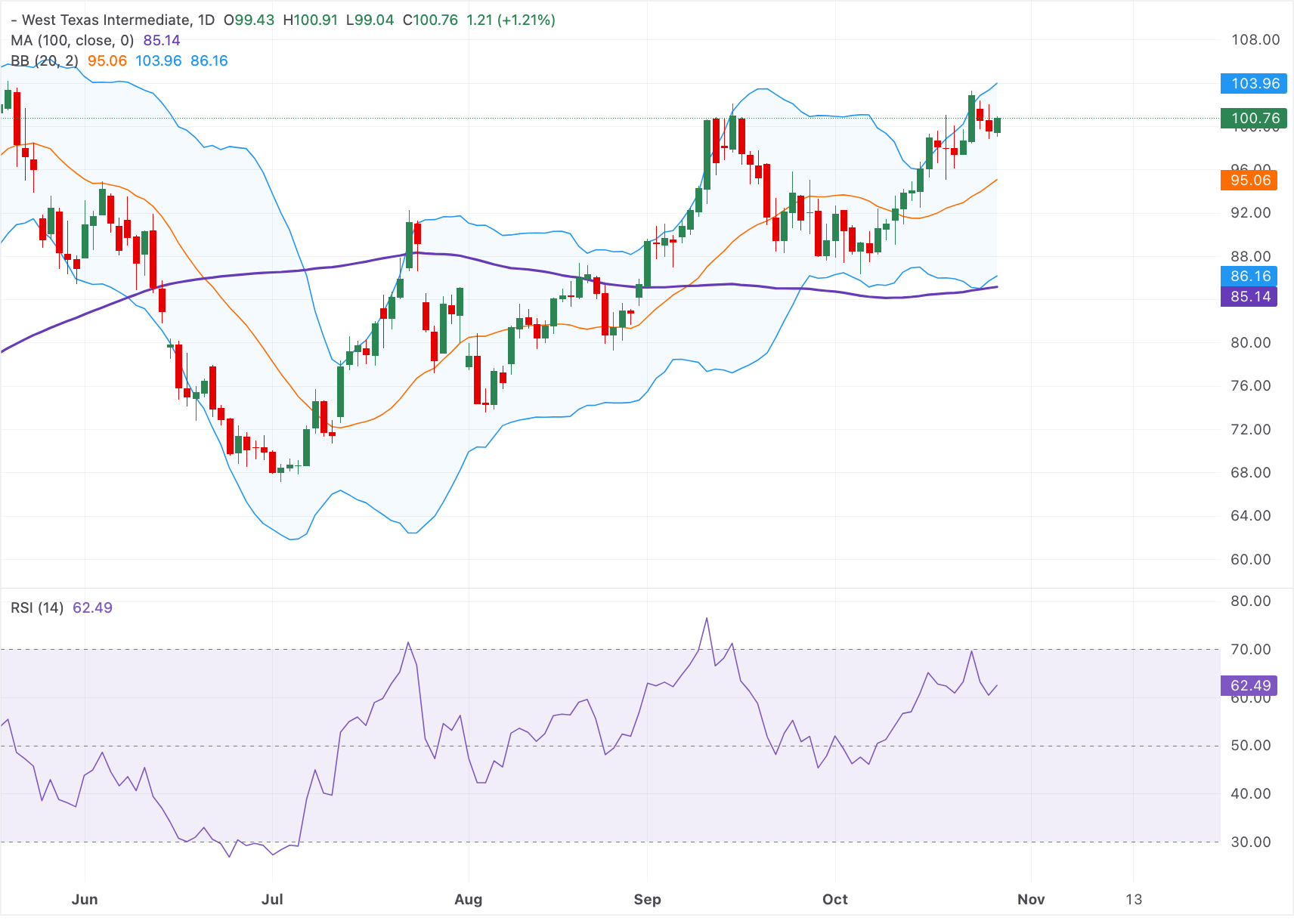
Technical Analysis: WTI retains a constructive outlook above the 100-day SMA
In the daily chart, WTI US Oil maintains a constructive bullish bias as it holds well above the 20-day Bollinger middle band and comfortably above the 100-day moving average. Price action is pressing into the upper half of the Bollinger envelope, while the Relative Strength Index (14) at roughly 62 stays in positive territory without yet flagging overbought conditions, which suggests ongoing upside pressure but with scope for corrective pauses.
On the topside, immediate resistance is aligned with the upper Bollinger band near $103.95, where bulls may face the next meaningful supply zone. On the downside, initial support is seen at the 20-day Bollinger middle band around $95.05, ahead of a deeper cushion from the lower Bollinger band near $86.15 and the 100-day moving average just above $85.00, levels that together define the broader bullish floor as long as they remain intact.



Comments
Log in or sign up to join the conversation.