

“US growth is slowing as the one-off impact of President Donald Trump’s tax cuts wears off; China is struggling to curb excessive leverage and manage the impact of Trump’s tariff increases on exports and confidence; and, in October, Japan will implement a long-planned sales tax increase which threatens to slow consumption growth. Eurozone growth, too, is slowing in the face of declining external demand. So we are back to facing the same question as in 2016: What to do if stagnation threatens when interest rates are already close to zero?” (Adair Turner, Project Syndicate, March 29, 2019)
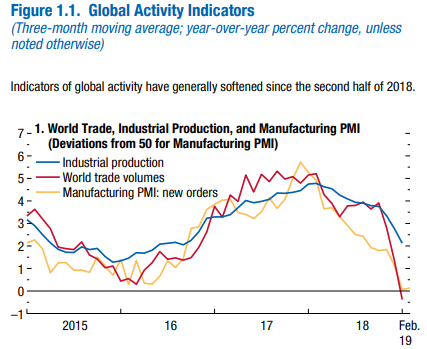
A year ago, a synchronized global economic expansion was the outlook for the near term. Currently, perceptions have changed, and we seem to be experiencing a phase of synchronized global slowing.
Indeed, higher interest rates, tighter credit conditions and the self-inflated wounds associated with China-US trade tensions have resulted in a re-examination of the economic outlook.
Major World Economies At A Glance: 2018-2020
(Real GDP, Annual % Rates of Change)
|
1Yr* |
Quarter* |
2018 |
2019f |
2020f |
|
|
U.S. |
3.0 |
2.2 Q4 |
2.9 |
2.1 |
2.2 |
|
Japan |
0.3 |
1.9 Q4 |
0.7 |
0.8 |
0.7 |
|
Canada |
1.6 |
0.4 Q4 |
1.8 |
1.5 |
2.0 |
|
Germany |
0.6 |
0.1 Q4 |
1.4 |
0.7 |
1.1 |
|
India |
6.6 |
5.1 Q4 |
7.0 |
7.2 |
7.3 |
|
China |
6.4 |
6.1 Q4 |
6.6 |
6.2 |
6.0 |
|
U.K. |
1.4 |
0.9 Q4 |
1.4 |
0.8 |
0.9 |
|
Euro 19 |
1.1 |
0.9 Q4 |
1.8 |
1.0 |
1.2 |
|
World |
|
3.6 |
3.3 |
3.4 |
12 months % change and annual change.
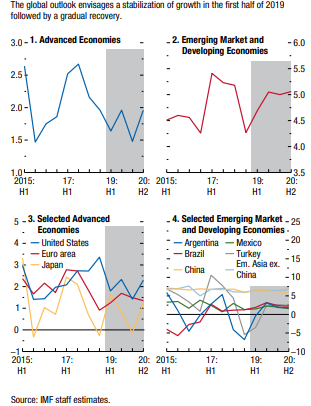
For example, the IMF predicts that the world economy will only expand about 3.3% this year compared with 3.8% growth in 2018, and 3.6% in 2020.
This economist does not expect the re-acceleration to be quite as strong in 2020 and is expecting only 3.4% global growth.
At its essence, the latest IMF report recognizes that the world economy hit a soft patch in the second half of 2018. Relatively slow economic growth will continue in the first half of 2019, and then the global economy should regain some stronger momentum into 2020.
There are obvious downside risks for the advanced economies in this scenario. The world economy is clearly slowing and then there are the trade tensions between the US and China as well as the possibility of a disorderly British exit from the European Union.
Indeed, the IMF correctly observes that some large economies, particularly China and Germany, may need to provide some new short-term stimulus to prop up their economies.
Clearly slower European Union growth is a problem, which could spill over to other countries. EU growth has already slowed quite substantially, and its troubles already account for much of the weaker global growth outlook.
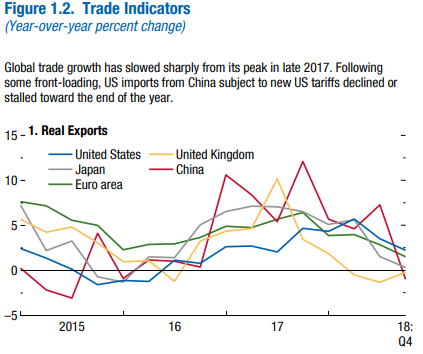
In Germany’s case, the economy has suffered from a softening of its exports and weaker consumer spending.
Unfortunately, America's ongoing tensions with China and other major trading partners remain a serious risk for the global economy.
The IMF foresees the Chinese economy growing 6.3% this year, down from 6.6% in 2018. Nonetheless, the IMF’s latest outlook represents a slight upgrade from the 6.2% growth it had forecast for China in January.
China’s prospects have brightened a bit after President Donald Trump decided to suspend a planned increase in tariffs on $200 billion worth of U.S.-bound Chinese exports.
Still, the IMF is seriously concerned about tensions between the world’s two biggest economies. Both countries have traded tariffs on hundreds of billions of dollars worth of products in a fight over China’s trade surplus with the US and the American sense that it is losing its technological supremacy.
The prospect of Britain’s potential messy departure from the European Union also weighs on the global economy.
The IMF expects growth in world trade to drop to 3.4% this year — a sharp slowdown from the 4% it had expected in January and from 3.8% trade growth in 2018.
(Click on image to enlarge)
(Click on image to enlarge)
(Click on image to enlarge)


Comments
Log in or sign up to join the conversation.