

Wisdom of the “Great One.”
I'm probably the only guy in hockey who can win a scoring title and everybody is saying I had a bad year. I don't worry about it. ~ Wayne Gretzky
This Gretzky Quote can be applied to the U.S. economy. Granted, even I am not thrilled about 2.0% annual GDP growth. However, when I look around the World, it is clear that the U.S. economy is the scoring leader. Yes, the U.S. economy is winning the title by scoring 30 goals instead of 50 goals, but the game has changed. Even Wayne has acknowledged that hockey has changed since he was in his prime and that he could not score as many goals in a season as he did back then, if he played today (he scored 92 goals in 1981-82). Yes, China is growing at somewhere between 4.0% and 7.0%, but as China matures, it is akin to playing at a higher level. At some point, China will probably grow at a pace which is similar to other developed economies. I.E. Slower.
The construct of the U.S. and global economies have changed in recent decades. I believe these changes are manifesting in how equity markets are reacting to oil prices. In a consumer-driven economy, one might expect stocks and junk debt to rally when oil prices fall. However, major equity indices are mainly comprised of companies which do not directly benefit from retail spending. Also, it has become apparent that much of the post-recession expansion was due to the so-called commodities “Super-cycle.” The result could be that lower fuel prices are good for many low-income consumers, somewhat less beneficial for middle income and high income consumers and an overall negative for many businesses.
A good hockey player plays where the puck is. A great hockey player plays where the puck is going to be. ~ Wayne Gretzky
In today’s Wall Street Journal, former Dallas Fed vice president, Gerald O’Driscoll Jr., has written an op/ed discussing the possibility of a global financial crisis. Like me, Mr. O’Driscoll does not see a global financial crisis on the horizon. Mr. O’Driscoll’s analysis of the oil industry and its effect on the economy is similar to mine. He writes:
“Pundits are focused on collapsing oil prices, which reflect the technological revolution in production among nimble private producers, combined with weakening global demand for their product. The result has been layoffs in the energy industry, and there will be more. Weak and highly leveraged energy firms have gone bankrupt and more will. But bankruptcy doesn’t necessarily mean that production will decline.”
This paragraph speaks volumes. Having some oil exploration and production companies file for bankruptcy does not mean that production will slow. Some companies which go completely out of business (Chapter VII bankruptcy) would have their assets, leases, etc. purchased by surviving companies. This would increase efficiencies in the oil patch, which could result in profitability at lower oil prices. In cases where companies file for Chapter XI protection, these companies would be able to shed debt which could make them profitable at lower oil prices. Thus, counting on bankruptcies to send oil prices higher could be a bad strategy.
Then there is the U.S. dollar. Oil trades in dollars, globally. Thus, a stronger USD helps to hold down oil prices. A stronger USD also hurts U.S. exports and, therefore, U.S. multinational corporations. As I wrote in 2014 and 2015, the USD might be the key to everything. This is why I suggested going long the U.S. dollar in June 2014 (where suitable) and to reduce exposure to high yield debt (again, where suitable). I also suggested that equity investors with longer-term time horizons consider high-quality dividend paying stocks to cushion against potential market volatility.
Opinions and ideas I have published during the past two years are largely playing out today. Oil prices declined, albeit even more than I expected. The U.S. dollar has strengthened. High yield debt has been slaughtered in the markets. Emerging economies have been battered by the stronger U.S. dollar, not only in terms of lower commodities prices, but also because many emerging market countries and companies borrowed heavily in U.S. dollars. As the dollar rises versus their home currencies, their debt load (debt service) increased. Unless there is more compatibility between Fed policy and foreign central bank policy, the USD is likely to remain strong. Thus commodity prices should remain low and high yield corporate, and emerging market debt should remain under pressure.
During the past several years, many readers have pointed out that Bond Squad strategy differed from strategy published on the so-called “sell side” of the industry. Some readers questioned my outlook, as competing strategy was along the line of past precedents. What I do not believe was understood by some readers is that many investment strategists were skating to where the puck was. Bond Squad was skating to where I believed the puck would be. This strategy continues to serve Bond Squad well. However, it takes the courage to rely on one’s ability to anticipate how the game will proceed.
There is an old hockey saying which states: “If you don’t keep your head up, you are going to lose it.” In my opinion, if your strategy relies heavily on the past, you are skating with your head down. If your head is down, you can’t see where the puck is going. You also cannot see any large opponents ready throw a devastating check. It really is that simple.
Hockey is a unique sport in the sense that you need each and every guy helping each other and pulling in the same direction to be successful. ~ Wayne Gretzky
The past two days we had important economic data. Yesterday, we had the Dallas Fed Manufacturing Activity Index. The January reading printed at -34.6. This was down significantly from a prior -21.6 (down from -20.1) and a Street consensus of -14.5. Prints below 0.0 indicate deteriorating conditions. Much of the negativity in the Dallas region was probably due top trouble in the oil patch, but economists are concerned as the Dallas Fed index tends to correlate to national manufacturing conditions. In my opinion, the correlation might not be as tight as in the past, but Dallas Fed data probably points to further weakness in the overall manufacturing sector.
The January reading of the Richmond Fed Index came in at 2.0. This was in line with the Street consensus forecast, but down from a prior 6.0. Readings over 0.0 indicate improving conditions. The good news is that the Richmond region (recently, one of the stronger Fed regions) remains in positive territory. The bad news is the conditions are softening. Highlights from the report were:
- Forecast range from -2 to 5 from 11 economists surveyed
- Shipments fell to -6 after 0 the prior month
- New order volume slowed to 4 after 8 the prior month
- Order backlogs rose to 4 after 0 the prior month
- Capacity utilization slowed to 0 after 2 the prior month
- Inventory levels of finished goods slowed to 24 after 27 last month
- Inventory levels of raw goods fell to 21 after 23 last month
- Number of employees fell to 9 from 12
- Average workweek rose to 8 from 7
- Wages rose to 19 from 17
The Richmond Fed data do not augur for a recession, but they do appear to be pointing toward late credit cycle/economic cycle conditions.
The Conference Board’s reading of Consumer Confidence came in at 98.1 versus a prior 96.3 (down from 96.5) and a Street consensus of 96.5. Many market participants look to Consumer Confidence data for clues regarding where the economy and capital markets are going. A rise in Consumer Confidence is generally seen as indicating improving economic and market conditions. There is some truth to this, to a point.
Consumer Confidence tends to peak right before the economy falls into recession, even while the pace of growth had been slowing for months or years.
Consumer Confidence since 1995 (Source: Bloomberg and the Conference Board):
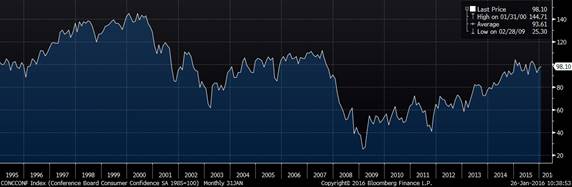
Previously, many economists and strategists believed that peak Consumer Confidence was in the 140 area. That was subsequently lowered to the 120 area. During the past year, many economists and strategists were counting on a return to past conditions. Last June, I opined that Consumer Confidence might be plateauing. Some readers and some of my colleagues wondered if I was acting hastily. I did not think so as current demographic, structural and fiscal conditions were not (in my opinion) consistent with much higher levels of Consumer Confidence.
The above chart illustrates that Consumer Confidence has peaked at lower levels during each of the past two expansions. They also peaked right before the U.S. economy fell into recession. The good news is, Consumer Confidence bumped along (plateaued) for a considerable time before the economy fell into recession. The data indicate that Consumer Confidence might be in the processes of plateauing at the present time. This could mean that while U.S. economic growth has peaked, a recession is probably not around the corner. This is yet another data point supporting my thesis that the U.S. economy is late in the economic/credit cycle.
One of my concerns during the past year was that trouble in the commodities and manufacturing sectors would bleed over (to some extent) into the services sector. The first reading of January Markit Service Sector PMI came in at 53.7, down from a prior 54.3 and lower than the Street consensus of 54.0. The Markit reading of January Composite PMI came in at 53.7, down from a prior 54.0. The data was not all bad. Markit’s press release of Composite data indicated:
- Index falls to 53.7 from 54 in Dec.; Year ago 54.4. Lowest reading since Dec. 2014
- New Orders rise to 53.6 vs 52.6 in Dec. Highest reading since Nov. 2015
- Employment rises vs prior month Highest reading since Sept. 2015
- This is yet another data set which augurs for slower, but sustainable U.S. economic growth.
- The question is: Can the economy maintain a 2.0%-plus pace of growth if the Fed tightens further?
In my opinion, not at first. The persistently strong U.S. dollar and potential damage to the corporate credit markets would likely sink U.S. economic growth to the 1.5% to 2.0% area. However, once the misallocation (dysallocation) of capital is rectified, the U.S. economy should be more structurally sound than it is today. This begs another question: Can the Fed and market participants tolerate a tearing-off of the monetary band aid? Judging by the market’s response to hawkish commentary and policy, the answer appears to be: No.
On the topic of skating where the puck is going: There is some talk on the Street that oil prices might have bottomed. This very well might be the case. However, I would caution readers against becoming to giddy, in terms of risk, about the prospects of higher oil prices. Although oil might have bottomed, the fundamental price of oil is probably fairly low. In my opinion, it is probably in the $35 to $45 (maybe $50) range. This is probably not high enough to prevent a large number of corporate bankruptcies and debt restructurings. It is also probably not high enough to push risk asset markets back to their highs reached during the past two years.

Comments
Log in or sign up to join the conversation.