

After scoring a year of big gains in 2021, the Nasdaq 100 Index entered the new year in bearish fashion. Will the Nasdaq extend its current 3% year-to-date loss OR is the worst behind us?
In this post, we share with you our simple trend analysis, including key support and resistance levels, that may hint at the Nasdaq’s next potential move.
Continue reading and you will also discover how to benefit from a simple way to gauge the trend strength of any stock or index in the future.

Photo by Meriç Dağlı on Unsplash
A Sudden Change Of Trend
Until recently, price action in the Nasdaq 100 Index ETF (QQQ) was volatile, choppy, and indecisive.
Over a two-month period starting in early November 2021, Nasdaq tried several times to break out above its all-time high from November 6–but failed each time.
As is frequently the case, the 50-day moving average initially provided support after the bearish reversals.
However, Nasdaq finally crashed through support of its 50-day MA in ugly fashion on January 5.
The breakdown below the 50-day MA on higher volume caused Nasdaq to lose its uptrend status.
The Nasdaq 100 ETF may also be vulnerable to further selling if the big support level around $380 fails to hold from here.
Check out the annotated chart below for further analysis:
(Click on image to enlarge)
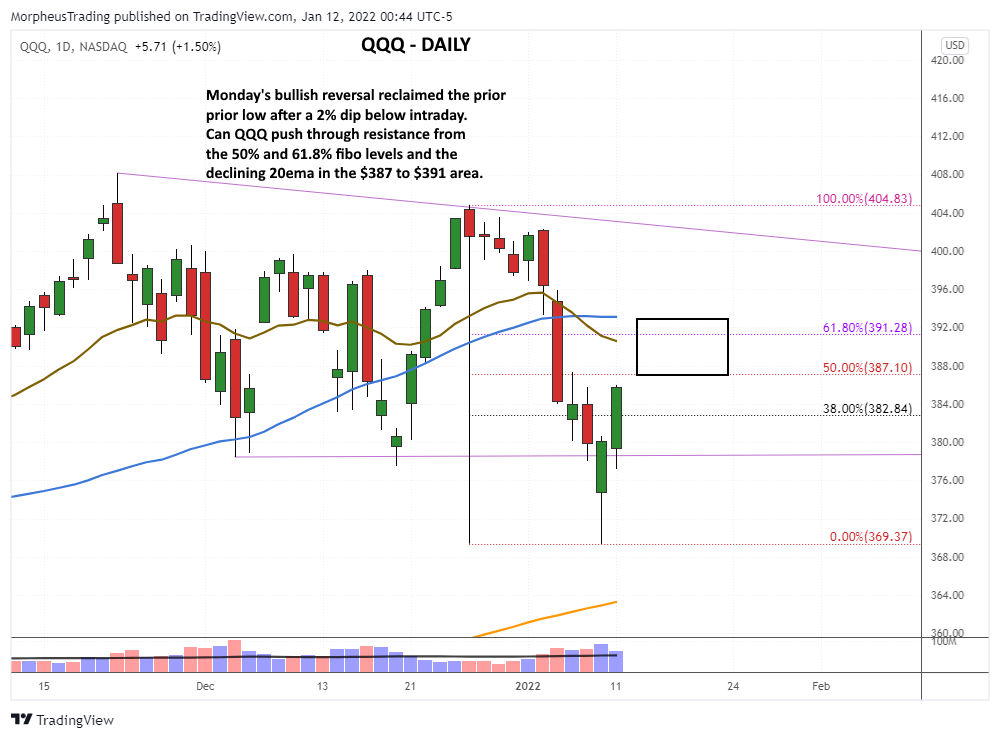
Above, note the momentum is starting to build to the downside, with the 20-day exponential moving average turning down.
Nasdaq has also crossed below its 50-day MA, which has flattened out.
There is also a lower high and lower low in place, which was confirmed by the recent selloff.
How moving averages help gauge the strength of a trend
We mentioned above that Nasdaq lost its uptrend status after breaking below the 50-day moving average.
We use moving averages as a simple, but highly effective way to gauge the strength of a trend.
Here’s how it works…
If the price of a stock or index is:
- Trending above the 10-day MA, the trend is extremely strong.
- Trending above the 20-day EMA, the trend is still strong.
- Trending below the 20-day EMA, but above the 50-day MA, the price is still in an uptrend–but the short-term is likely more sideways.
- Trending below the 50-day MA, the price is no longer in an uptrend and is vulnerable to further selling.
Where is the Nasdaq 100 ETF headed next?
The January 10 bullish reversal back above the prior support level is known as an undercut and rally--which often leads to a sharp reversal.
The bullish reversal that followed the undercut and rally pattern sets the stage for an interesting battle in the coming days.
Currently, the price of Nasdaq is closing in on the 50% and 61.8% Fibonacci retracement levels (measured from the last swing high to swing low).
A stall at the 50% Fiboancci retracement level would suggest the bears remain in control.
This would increase the odds of the price setting a new low–or at the very least, testing the swing low.
A bounce to the 61.8% Fibonacci level and declining 20-day EMA could also lead to a new low or test of the swing low.
However, if the price is able to push through the 50-day MA and hold for a day or two, then a tradeable bottom may be developing.
In this case, we might expect the price to chop around for some time, rather than setting a new low.



Comments
Log in or sign up to join the conversation.