


Last week’s stock market surge sends a message that all is well, but that’s only half a loaf until the bond market confirms the recovery in expectations.
Treasury yields eased last week, although rates remain elevated relative to where they were when the war with Iran started on Feb. 28. The surprisingly weak jobs report for July takes some of the near-term pressure off the Federal Reserve to lower rates to tame inflation. But it’s unclear if the bond market is set to unwind the yield premium that has accrued over the past four-and-a-half months.
Inflation and pinched energy exports due to the war are key drivers behind the rise in yields, but there are other factors that could keep the bond market wary in the weeks and months ahead. One is the federal budget deficit, which continues to deepen. As federal borrowing expands to fill the gap between what the government spends and what it takes in from tax revenue, the growing supply of Treasuries can outstrip investor demand, pressuring prices lower and driving yields higher.
That’s a mounting risk, but one that the bond market has shrugged off for years. No one knows when or if investors will demand a higher yield premium because of the government’s red ink, but as the deficit deepens, as many projections say it will, the red ink may become harder to ignore.
The threat to Fed independence may move back to the fore, too, which could shake bond market stability. President Trump has revived his effort to remove Fed Governor Lisa Cook, giving her 21 days to respond to uncharged mortgage fraud allegations — claims she attributes to clerical errors. The move follows a June Supreme Court ruling that blocked her immediate firing because she was denied procedural due process. Because the Court did not define legal “cause” for removal or rule on the fraud claims, however, it left the door open for Trump to issue proper notice and restart the process to end her term, which runs through 2038.
A more immediate concern for the bond market is inflation, which has been running above the Fed’s 2% target for over five years. The war with Iran exacerbated the overshoot, although inflation’s trend eased in June, suggesting that pricing pressure is starting to cool.
Wednesday’s report on consumer prices in July will be closely read for reassessing how much inflation risk is still pulsing through the economy, and whether the Fed needs to tighten policy at next month’s FOMC meeting. Economists are expecting a relatively tame update, forecasting that year-over-year measures of headline and core inflation will tick lower to 3.4% and 2.5%, respectively, based on Econoday.com’s consensus forecasts.
Even if consumer prices ease again in July, the question is whether the Fed will continue to tolerate inflation running well above its target. A crucial input for answering that question may lie with the bond market, and how it prices inflation risk leading up to the September FOMC meeting.
The front line for gauging bond‑market sentiment is the 30-year yield, the most inflation-sensitive maturity. The long yield eased last week, but it’s unclear if that’s a temporary pause in an ongoing trend that will push rates higher.
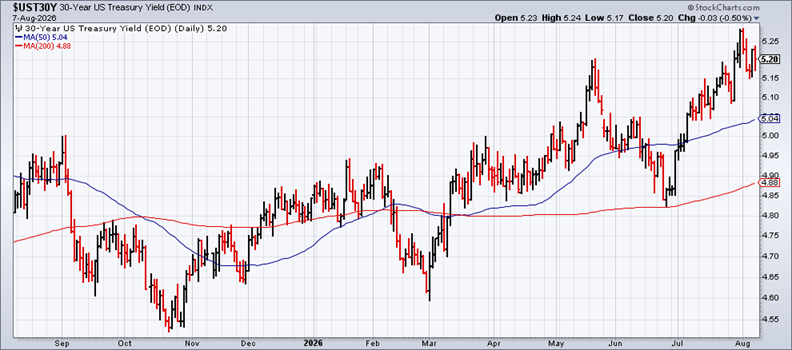
Negotiations with Iran will likely remain a crucial variable for market sentiment. In line with recent developments on this front, the news flow is choppy. Depending on the hour or day, the outlook for a resolution to the crisis alternates between optimism and pessimism and many shades in between.
Rising Treasury yields, in sum, could act as a brake on the stock market’s revived confidence until it’s clear that a durable peace deal has been hammered out. The final verdict, in short, still belongs to the bond market.
Comments
Log in or sign up to join the conversation.