

Momentum continues to stand out as the dominant equity risk factor since the war with Iran began on Feb. 28. Using a set of ETFs as proxies highlights that this slice of the stock market remains, by far, the strongest performer since the Middle East crisis shocked the global economy.
The iShares MSCI USA Momentum Factor ETF (MTUM) has soared more than 32% since the initial attacks on Iran—an extraordinary gain compared with the rest of the field. The second-best performer, high-beta stocks (SPHB), is up 23%, while the market benchmark, the SPDR S&P 500 ETF (SPY), has increased by 8.1%.
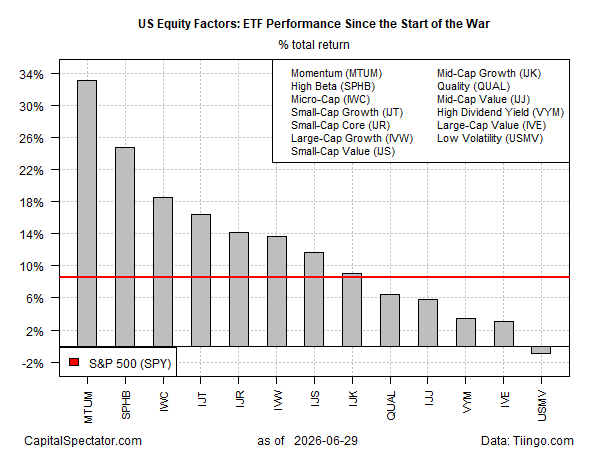
All but one of the factor ETFs are posting gains. The downside outlier is low-volatility (USMV), which is fractionally lower since the war began.
Low vol’s relatively weak run predates the war, raising questions about the factor’s standard selling points: higher risk-adjusted returns and superior capital preservation. Those attributes are arguably still in play, but after trailing the broad market by a wide margin in recent years, the argument that all is well after adjusting for risk has come under increasing strain.
In fact, risk management generally has been on the defensive lately. Taking on more risk can pay off, of course, but the embrace of higher-volatility assets and strategies has enjoyed an unusually strong run lately.
Speaking of underperforming factors, micro- and small-cap stocks are rallying again, inspiring forecasts that the tide is finally turning for these shares. We have heard that call many times in recent years, only to learn that the optimism was premature.
Could this time be different? A change of the trailing timeframe suggests it already is.
Notably, micro-cap stocks (IWC) are handily outperforming momentum (MTUM) as well as the broad market (SPY) over the past 12 months. The relative strength of micro-caps dates back a bit more than a year. After suffering weak performance for years, the tide began to turn in the spring of 2025 and hasn’t looked back since.
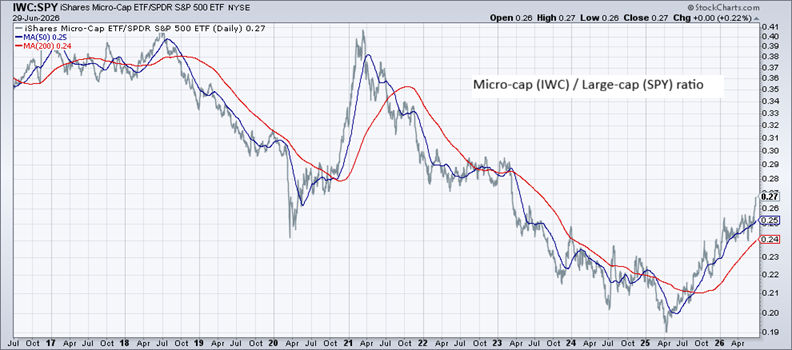
Analysts cite several reasons for the rotation into micro-caps, including the view of some that these stocks are surrogates for private equity, another hot asset class of late. Another line of reasoning points to the relatively resilient earnings reports for smaller firms recently. Low valuations compared with soaring tech and AI shares are another plus.
Whatever the rationale, the trend analysis agrees. As the chart above highlights, a clear shift is underway. After years of false starts, micro-caps—and perhaps small-caps overall—appear poised to deliver competitive results after a lengthy dry spell.


Comments
Log in or sign up to join the conversation.