

The morning ritual of checking analytics dashboards has become an increasingly anxious exercise for digital marketing executives. When the traffic lines flatten and organic search visibility begins to evaporate, the immediate reaction is often a frantic search for quick fixes. However, the search landscape has undergone a profound structural shift. Understanding Why Your SEO Traffic is Dropping and How to Recover in 2026 requires abandoning outdated diagnostic models that treat search engine optimization as a mere checklist of tags and backlinks.
The erosion of organic visibility is rarely a single catastrophic event; rather, it is a compounding sequence of technical regressions, shifting search intents, and the aggressive expansion of artificial intelligence in the discovery process. This decline is characterized by a silent bleed. There are often no manual action penalties in Google Search Console, nor are there glaring server outages. Instead, high value pages slowly slip from position two to position six, while broader informational queries are intercepted entirely by zero click AI summaries. This operational reality means that strategies built for the search algorithms of 2023 are mathematically guaranteed to fail in the current environment.
To reverse these trends, leadership must pivot from chasing superficial metrics to rebuilding the underlying architecture of digital trust. Engaging a specialized performance SEO Agency in Glasgow for procuring a volume of generic content or buying bulk links; it is about deploying advanced semantic architecture, intent based pruning, and machine readable data structures that survive algorithmic scrutiny.
I have seen this operational reality firsthand. Recently, my team and I audited a $10 billion beauty brand facing a severe 23.5% year over year organic decline. Their executive team assumed they had been penalized by an algorithm update. However, when we looked under the hood, the problem was deeply structural. We discovered 349 duplicate page titles, 219 deep seated duplicate content issues, 195 orphaned pages completely disconnected from internal linking structures, and 188 hreflang implementation errors.
Search engines could not efficiently parse the site's architecture. Resolving these compounded crawl anomalies rapidly pushed the domain's technical health score from 64 to 72 out of 100, ultimately yielding a 27% year over year increase in highly qualified organic traffic.
Diagnosing the Decline: Beyond the Dashboard
Misdiagnosing a traffic drop leads to wasted capital and deepens the structural damage. In 2026, organic traffic declines stem from highly distinct causes: algorithm updates, content decay, technical regressions, and AI displacement. The initial diagnostic phase requires moving beyond aggregate traffic numbers to segment user intent and analyze the delta between Google Search Console impressions and Google Analytics sessions.
The Impression vs. Click Divergence
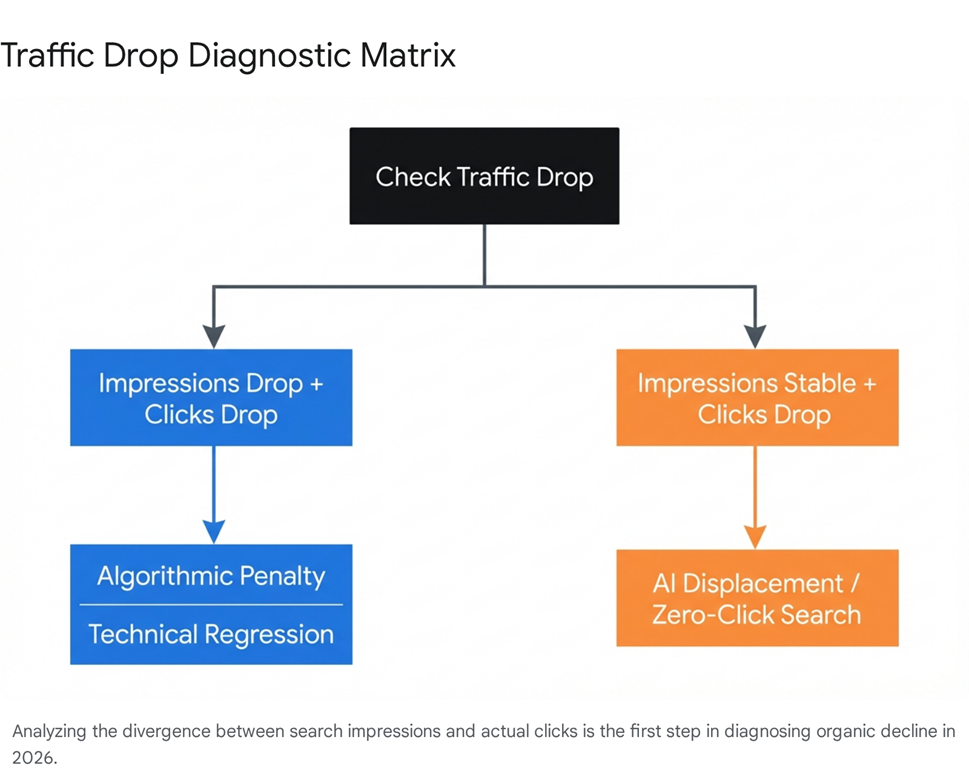
A critical first step is identifying whether the drop is a visibility loss or a click loss. If both impressions and clicks drop simultaneously, the domain has likely suffered a ranking downgrade due to a core algorithm update or a severe technical regression that has caused pages to fall out of the index.
Conversely, if impressions remain stable or even rise while clicks plummet, the domain is experiencing AI displacement. Search results pages have become highly synthesized. Google AI Overviews and platforms like Perplexity now answer queries directly on the search results page, bypassing the need for users to click through to a website. Organic click through rates (CTR) for informational queries drop by as much as 61% when an AI Overview is present. The user's query is satisfied, but the website is starved of traffic.
Anatomy of 2025 and 2026 Core Updates
To understand current algorithmic behavior, one must analyze the cadence and impact of recent Google updates. Core updates no longer target isolated spam tactics; they re evaluate the overall usefulness and trustworthiness of a domain.
The historical rollout data reveals a pattern of continuous, overlapping reassessment. For example, the December 2025 Core Update deployed on December 11 and completed its global rollout over 18 days. This was quickly followed by the February 2026 Discover Update, which specifically targeted the Discover feed and completed over 21 days. By March 2026, the ecosystem experienced simultaneous volatility with the March 2026 Spam Update running for nearly 20 hours alongside the massive March 2026 Core Update, which caused global ranking shifts over a 12 day period.
During these rollouts, Google algorithms placed a stronger emphasis on content depth, verified real world experience, and reduced the visibility of scaled, templated content. If a page drops from position four to position twenty nine after an update, drastic remediation is required; however, fluctuations between positions two and four often naturally correct themselves and require patience rather than immediate site surgery.
The Problem Solution Pivot: Addressing Real World Complications
Standard industry advice often defaults to improving content quality and fixing technical issues. However, these theoretical recommendations fail to address the operational friction inherent in large scale digital marketing. The true cost of organic traffic loss is the compounding revenue bleed caused by systemic architectural failures that executives frequently overlook.
Advanced Technical SEO Complications
When technical infrastructure degrades, search engine crawlers waste their limited resources processing junk URLs rather than indexing revenue generating product pages. This is known as crawl budget waste, and it is a silent killer of organic visibility.
● The Faceted Navigation Crisis: E commerce sites frequently deploy faceted navigation allowing users to filter by size, color, material, and price. Without proper parameter handling, this creates millions of unique, indexable URL combinations. Crawlers become trapped in infinite loops, draining the index budget and resulting in core product pages remaining undiscovered. The operational cost of this unplanned bot behavior is massive mechanical degradation of site authority. The solution involves strict URL parameter controls, selective noindex directives for low value filter combinations, and optimizing the site structure.
● Orphaned Inventory and Site Migrations: In one documented case during my career, a major enterprise executed a top down repricing strategy. To avoid showing incorrect prices during a transition, leadership hid over 10,000 products overnight without informing the SEO team. These pages became orphaned still existing on the server but completely disconnected from the site's internal linking structure. Search engines view orphaned pages as low trust anomalies, causing an immediate crash in traffic that was initially blamed on algorithmic shifts until a deep log file audit revealed the massive product removal.
● The Core Web Vitals Mandate: Google strictly evaluates Largest Contentful Paint (LCP), Interaction to Next Paint (INP), and Cumulative Layout Shift (CLS). A site that takes longer than 2.5 seconds to render its main content (LCP) or experiences visual layout shifts above a 0.1 score will suffer visibility constraints. Slow load times are disproportionately penalized in modern updates. Fixing this requires addressing render blocking JavaScript, optimizing media assets, and leveraging edge caching networks.
The E-E-A-T Reality and Content Decay
Google's E-E-A-T framework (Experience, Expertise, Authoritativeness, and Trustworthiness) has evolved from a subjective rater guideline into a hard algorithmic filter. In 2026, content lacking clear, demonstrable experience signals fails to rank, regardless of keyword density or technical perfection.
A highly visible symptom of poor E-E-A-T is content decay. This is the gradual, month over month decline in traffic as a piece of content ages out of relevance and is overtaken by competitors publishing fresher, more authoritative material.
The recovery protocol requires ruthlessly auditing older content. Mass produced AI articles that lack genuine expertise signals must be removed or heavily overhauled. Pages must be updated with current 2026 data, cite credible sources, and feature verifiable author credentials. Furthermore, user engagement metrics such as dwell time, scroll depth, and return visits are actively monitored to validate whether the content actually satisfies the searcher's intent.
Generative Engine Optimization (GEO) and AI Visibility
Recovering traffic in 2026 mandates a shift from traditional Search Engine Optimization (SEO) to Generative Engine Optimization (GEO). Users are actively migrating to conversational AI assistants for discovery. Research projects that by early 2028, AI driven search experiences could surpass traditional search usage.
Structuring Data for Retrieval Bots
The function of the robots.txt protocol has bifurcated. It is no longer just a simple allow or disallow list for web crawlers; it is a governance document that dictates which AI models can access proprietary data for model training (Training Bots, like GPTBot) versus which can access the data to answer user queries in real time (Retrieval Bots).
To be cited in AI Overviews, content must be formatted so that Large Language Models (LLMs) can extract facts without computational friction. AI Overviews prioritize entities over keywords.
● The BLUF Protocol: Content must adopt a "Bottom Line Up Front" writing style. High value sections should begin with a direct, dense answer of 40 to 60 words before expanding into detail.
● High Fact Density: LLMs seek consensus and verifiable facts. High fact density supported by credible, outbound citations increases the probability of inclusion in an AI generated summary.
● Schema Markup: Implementing structured data (JSON-LD) is non negotiable. Explicitly defining product attributes, organizational details, and FAQ schemas helps AI models recognize the content as an authoritative, machine readable source.
The Evolution of LSI and Semantic Search
For decades, SEO practitioners focused on Latent Semantic Indexing (LSI) keywords a mathematical system created in 1988 for early database document retrieval. Google has explicitly confirmed that it does not use traditional LSI mathematically for search rankings. However, the concept of semantic relevance remains critical.
In the AI era, search engines utilize Natural Language Processing (NLP) to understand context and semantic relevance. The strategy is no longer to sprinkle synonyms across a page, but to build comprehensive topic clusters. Content must fully answer a topic, utilize natural semantic vocabulary, and support meaning with robust internal linking architectures. Adding just two to five highly contextual internal links per 1,000 words accelerates indexing and passes critical link equity to underperforming pages. In one retail case study, adding internal links to underperforming product pages produced a 23% rise in organic traffic without any other modifications.
Quantifiable Benefits: Tracking Metrics That Matter
A successful recovery strategy must discard vanity metrics in favor of metrics directly tethered to business outcomes. Tracking aggregate traffic numbers obscures whether an SEO strategy is actually aligning with revenue objectives. When executing a recovery, stakeholders must focus on a precise layout of quantifiable gains.
Aligning SEO Action with Executive Metrics
To bridge the gap between technical implementation and boardroom expectations, SEO teams must translate operational actions into executive level KPIs. The following table illustrates how tactical SEO recovery initiatives directly influence the profit and loss (P&L) statement.
SEO Operational Action | The Executive Metric (KPI) | Direct Business Impact |
Reputation Triage (E-E-A-T) | Conversion Rate (CVR) | High trust signals correlate with lower Customer Acquisition Cost (CAC) and higher Lifetime Value (LTV). |
Restoring Brand Voice | Contribution Margin | Reversing brand search drops captures high margin, high intent buyers ready to purchase. |
Intent Based Pruning | Profitability Per Visit | Focusing authority on the 20% of pages that drive 80% of revenue removes internal cannibalization. |
Core Web Vitals Optimization | Site Wide Conversion Rate | Faster site speeds and visual stability lower friction, reducing cart abandonment. |
The Power of Intent Based Pruning
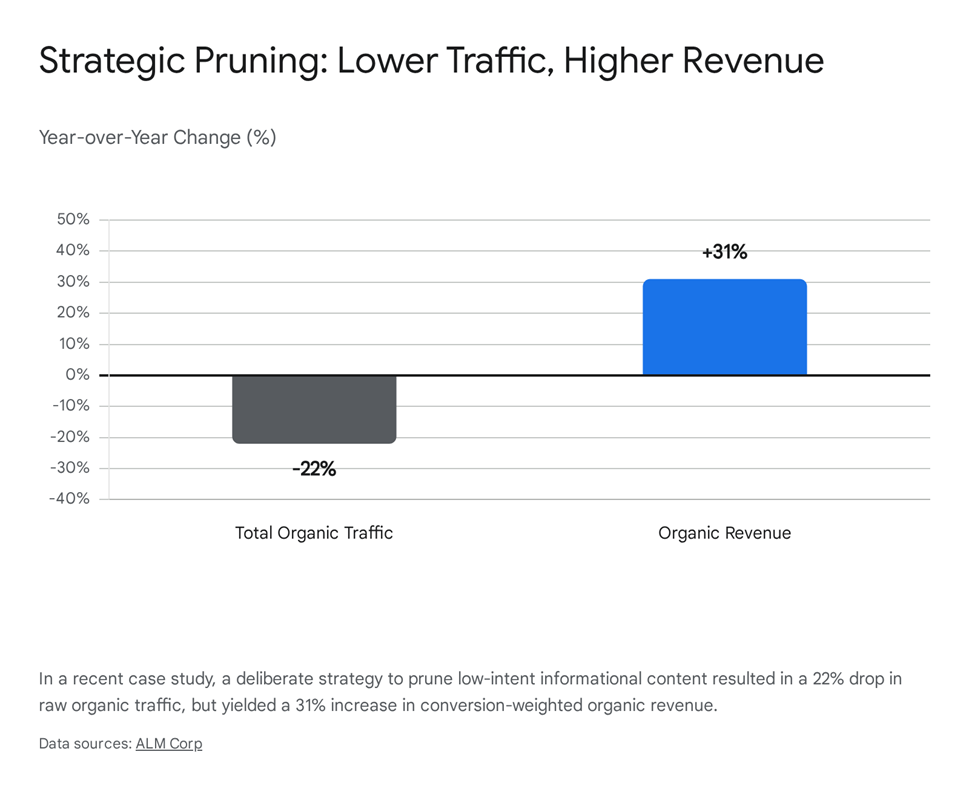
One of the most counterintuitive yet highly effective strategies I employ is intent based pruning. Consider the data from a recent case study involving a regional HVAC company. The company reported a 22% year over year decline in total organic traffic. Initially, this triggered panic. However, further analysis revealed that despite the drop in overall visitors, revenue from organic sources actually increased by 31% during the exact same period.
This divergence was not an accident; it was the result of a deliberate strategic shift. By pruning low intent informational content that attracted high volume but low value, and simultaneously expanding high intent service pages, the company concentrated its domain authority. Fewer total visitors resulted in significantly better business outcomes.
Tracking Qualified Traffic and AI Referrals
Instead of reporting raw keyword rankings, modern recovery efforts calculate visibility based strictly on high intent commercial keywords. This metric, often called Conversion Weighted Visibility, ensures the focus remains on terms that have a proven history of generating revenue.
Furthermore, traffic referred directly from AI platforms must be meticulously tracked through proper attribution modeling. Because users arriving from synthesized AI search environments like Perplexity or ChatGPT arrive already informed and further along in their buying decision, this highly qualified traffic can convert at up to 4.4 times the rate of standard organic clicks. Tracking this shift ensures that marketing budgets are allocated to platforms actually driving pipeline growth.
Voice Search Optimization: The Conversational Imperative
The proliferation of smart devices has fundamentally altered query syntax. By 2026, with over 8.4 billion voice enabled devices in use globally, voice search has evolved from a novelty feature into a dominant discovery method. Statistics show that 50% of U.S. consumers now utilize voice search daily.
Voice queries are inherently different from typed text. They are longer, highly conversational, and heavily contextualized around immediate needs and geographic location. A user typing might search "best SEO agency," but that same user speaking into a smart device asks, "What is the top rated performance SEO agency near me?".
Optimizing for this conversational imperative requires a distinct set of tactics:
● Conversational Long Tail Targeting: Content must mirror natural speech patterns. Structuring pages to answer specific "who, what, where, when, why, and how" questions directly aligns with the natural language processing algorithms driving voice assistants.
● Position Zero Optimization: Voice assistants generally read a single answer aloud the Featured Snippet. Securing this "Position Zero" through clear, structured, BLUF style explanations is essential to existing in voice search results.
● Localized Intent and Emerging Markets: A massive volume of voice search is localized. Deeply integrating hyper local context and optimizing Google Business Profiles for "near me" intent is critical for capturing ready to convert traffic. This strategy is particularly vital in rapidly growing digital economies across South Asia. In markets like Lahore and Karachi, high competition in local e commerce has led to a surge in demand for Generative Engine Optimization and Urdu Voice Search Optimization (VSO). Businesses that proactively adapt their localized SEO strategies are securing permanent digital assets that compound in value, completely outpacing competitors reliant solely on paid advertising.
The Future of Organic Growth
The SEO landscape of 2026 is mathematically unforgiving to those relying on shortcuts. Recovering lost traffic is not a matter of waiting for the next algorithm update to magically reverse your fortunes; it requires a proactive, exhaustive audit of your digital infrastructure.
By eliminating crawl budget waste, aggressively pruning low intent content, demonstrating authentic expertise, and structuring data for the generative AI ecosystem, brands can restore their visibility. The traffic you recover will not just be higher in volume it will be significantly higher in quality, yielding the conversion metrics that executives demand.
Comments
Log in or sign up to join the conversation.