

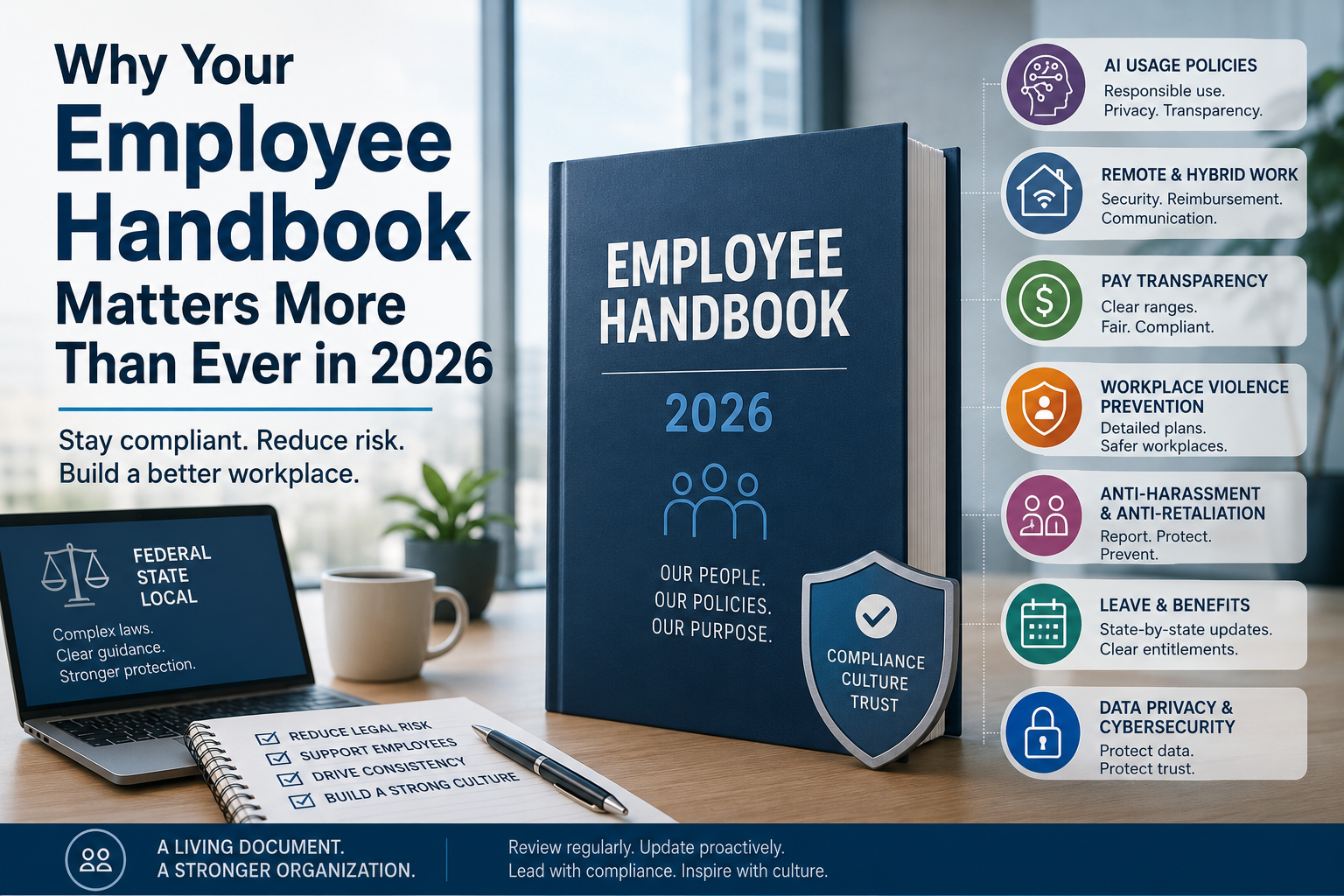
For decades, the employee handbook has been dismissed as a dusty formality — something HR hands over on day one and nobody reads again. Yet the employee handbook has quietly survived every wave of workplace change, from the rise of remote work to the explosion of state-level employment law. In 2026, it has become one of the most powerful tools an organization has for managing legal risk and setting the tone for how work actually gets done.
The reason is simple: federal, state, and local employment laws rarely align perfectly, and it's the employee handbook — supported by carefully drafted stand-alone policies — that translates that patchwork of regulation into something employees and managers can actually follow day to day.
The Widening Gap Between Federal, State, and Local Rules
Employers today are navigating far more than a single federal standard. States and municipalities are increasingly stepping in with their own, often stricter, requirements around leave, pay transparency, and workplace safety. A well-built employee handbook has to reflect this layered reality — flagging where state or local law supersedes federal minimums, and where stand-alone policies or state-specific addenda are needed to fill the gaps a general handbook can't cover on its own.
Leave law is a clear example of how fast this landscape is shifting. A growing number of states have rolled out or expanded paid sick leave and paid family and medical leave programs, and several states now require paid leave for any reason at all, not just qualifying events. An employee handbook that hasn't been updated to reflect these changes can leave an organization exposed — and leave employees confused about benefits they're actually entitled to.
What 2026 Handbook Updates Need to Cover
Several themes are shaping how employee handbooks are being rewritten this year:
AI usage policies. As generative AI tools become common in daily work, handbooks need clear language on acceptable use, data privacy, and transparency around AI-assisted decisions in hiring or performance reviews — both to guide employees and to guard against discrimination claims.
Remote and hybrid work. Handbooks now need real detail on cybersecurity protocols for remote employees, home-office expense reimbursement, and communication expectations — not just a paragraph acknowledging that remote work exists.
Pay transparency. With more states passing pay transparency laws, employee handbooks increasingly need to spell out compensation philosophy, how salary ranges are determined and posted, and the process for employees who have questions about their pay.
Workplace violence prevention. General "zero tolerance" statements aren't enough anymore. Many states now require detailed, specific violence prevention plans as part of employer policy.
Anti-harassment and anti-retaliation. Reporting procedures need to extend beyond the physical office to cover electronic communication, messaging platforms like Slack or Teams, and off-site interactions, with strong protections against retaliation.
Leave and benefits. As noted above, this is one of the fastest-moving areas, requiring localized addenda to keep pace with new state and local leave mandates.
Data privacy and cybersecurity. Handbooks must address how employee and customer data is protected, particularly for remote workers accessing company systems from outside the traditional office.
Handbook vs. Stand-Alone Policy: Why the Distinction Matters
One of the more overlooked questions employers face is when to fold a rule into the general employee handbook versus when to issue it as a stand-alone policy. The handbook sets the broad, organization-wide tone and culture; stand-alone policies allow for the granular, jurisdiction-specific, or fast-changing detail — like a state paid leave addendum — that would otherwise make the handbook unwieldy or quickly outdated. Understanding which regulations take precedence, and how to structure policies so they hold up under scrutiny, is central to building a handbook that actually protects the organization rather than just checking a box.
The Real Cost of Getting It Wrong
An outdated or poorly structured employee handbook isn't just a missed opportunity — it's a liability. Gaps between what a handbook says and what current law requires can expose employers to fines, penalties, and in some cases criminal sanctions. A strong risk management strategy starts with treating the handbook as a living document, one that's reviewed regularly against the shifting regulatory landscape at the federal, state, and local level.
A "Human-Centric" Shift
Beyond compliance, there's a broader trend toward handbooks that reflect genuine concern for employee well-being — not just rules for rules' sake, but policies that acknowledge the realities of hybrid work, mental health, and evolving expectations around transparency and fairness. This "human-centric" approach doesn't replace the compliance function of a handbook; it strengthens it, because policies employees actually understand and trust are easier to enforce consistently.
Final Thoughts
The employee handbook has survived this long precisely because it adapts. In 2026, that adaptability is being tested harder than ever, as AI, remote work, pay transparency, and expanding state leave laws all converge at once. Employers who treat their employee handbook and stand-alone policies as static documents risk falling behind the law — and their employees. Those who treat it as an evolving compliance and culture tool will be far better positioned to manage risk, avoid costly penalties, and build a workplace people trust.
FAQs
Q.1: How often should we update our employee handbook?
At minimum, review your employee handbook once a year — but any time federal, state, or local employment law changes (new leave mandates, pay transparency rules, etc.), you should update the relevant sections right away rather than waiting for the annual cycle.
Q.2: What's the difference between an employee handbook and a stand-alone policy?
The employee handbook lays out your organization's broad, company-wide rules and culture. Stand-alone policies cover narrower, fast-changing, or jurisdiction-specific issues — like a state-specific paid leave rule — that would make the handbook too cluttered or quickly outdated if built directly into it.
Q.3: Does our employee handbook need state-specific addenda?
In most cases, yes. Because states and cities increasingly set their own requirements around leave, pay transparency, and workplace safety, a single national employee handbook often can't capture every local nuance — addenda let you stay compliant without rewriting the whole document.
Q.4: What happens if our employee handbook doesn't reflect current law?
An outdated employee handbook can expose your organization to real risk, including fines, penalties, and legal liability, while also creating confusion for employees about their actual rights and benefits.
Comments
Log in or sign up to join the conversation.