
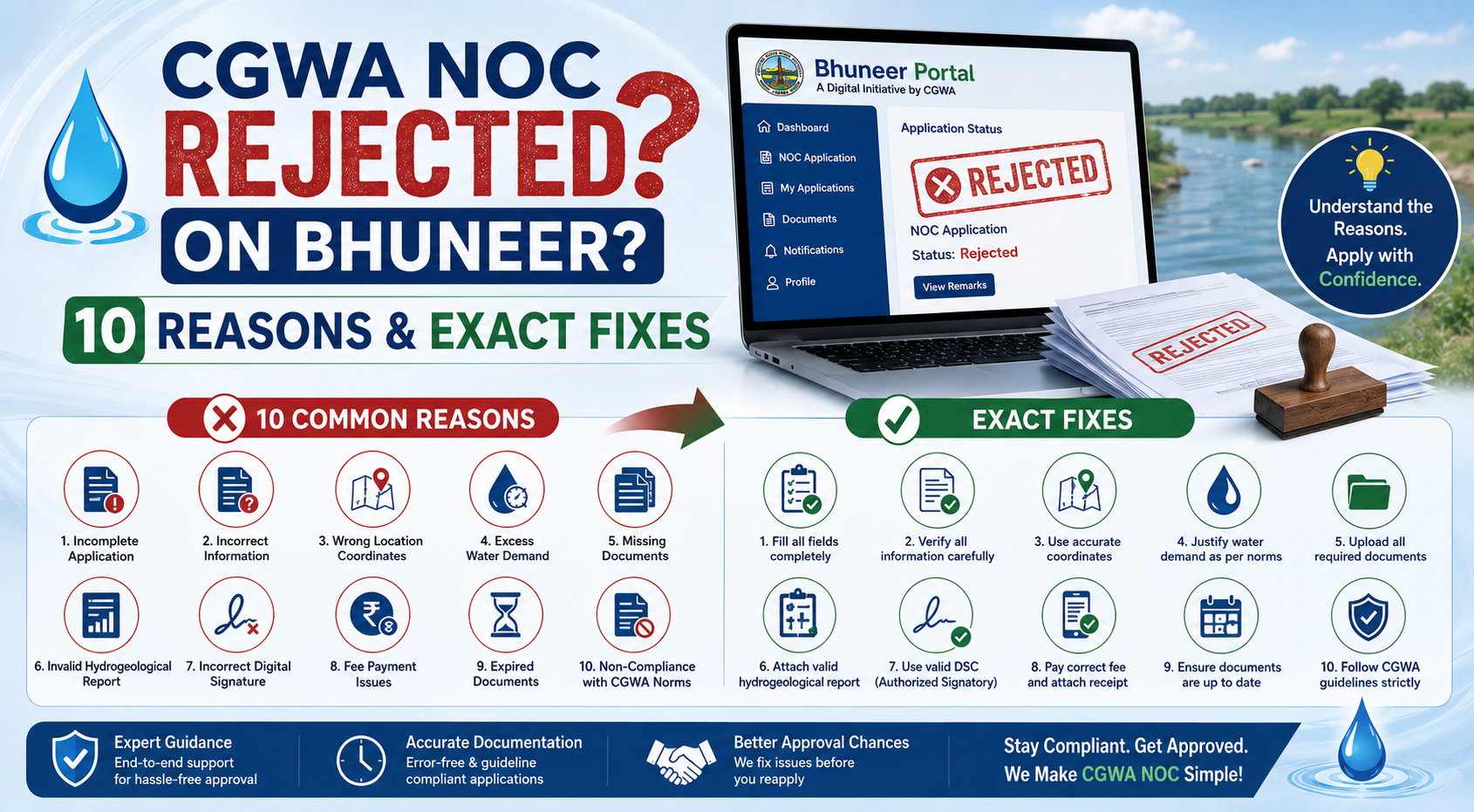
Obtaining a CGWA NOC is a mandatory requirement for industries, infrastructure projects, commercial establishments, educational institutions, and other organizations that rely on groundwater extraction.
However, many applications submitted through the Bhuneer Portal face delays or rejection because of documentation errors, technical inconsistencies, and non-compliance with regulatory requirements.
Understanding the common reasons behind rejection can help applicants avoid costly delays and ensure a smoother approval process. Proper planning, accurate documentation, and technical assessments significantly improve the chances of obtaining approval.
A professional hydrogeological survey is one of the most important steps in preparing a technically sound application, as it provides the scientific data required to support groundwater extraction proposals.
Understanding the Importance of a CGWA NOC
Groundwater is one of India's most valuable natural resources and is regulated to ensure sustainable usage. Organizations planning to extract groundwater beyond prescribed limits must obtain regulatory approval before commencing operations.
The approval process evaluates groundwater availability, recharge potential, environmental impact, and water conservation measures. Authorities carefully review each application to ensure groundwater extraction will not negatively affect surrounding areas.
Failure to comply with these regulations may lead to project delays, legal complications, penalties, or restrictions on groundwater extraction.
Common Reasons Why CGWA NOC Applications Get Rejected
Incomplete Documentation
One of the most common reasons for rejection is submitting incomplete documents. Missing ownership records, project details, water requirement calculations, site plans, or supporting reports can immediately delay the review process.
Applicants should carefully verify every required document before submission.
Incorrect Technical Information
Technical information must accurately represent the project and groundwater requirements. Incorrect extraction quantities, inconsistent coordinates, inaccurate borewell details, or mismatched project information often result in objections from authorities.
Every technical detail should be verified before submission.
Poor Hydrogeological Assessment
A weak or inaccurate hydrogeological assessment significantly affects application approval. Authorities rely on scientific groundwater data to determine whether extraction is environmentally sustainable.
An incomplete groundwater investigation may raise concerns regarding aquifer conditions, recharge potential, and groundwater availability.
A professionally conducted hydrogeological survey helps generate reliable technical information that strengthens the application.
Errors While Using the Bhuneer Portal
Many applications are delayed because applicants upload incorrect files, select the wrong project category, enter inaccurate location information, or leave mandatory fields incomplete.
Even minor portal errors may require resubmission or additional clarification.
Lack of Rainwater Harvesting Planning
Many groundwater users are expected to implement rainwater harvesting systems as part of sustainable groundwater management practices.
Failure to include appropriate recharge measures may reduce the likelihood of approval.
Inconsistent Water Requirement Calculations
Authorities carefully evaluate projected groundwater demand against actual operational requirements.
Excessive or poorly justified water demand often raises objections during technical review.
Water consumption estimates should be realistic, properly documented, and supported by project requirements.
Non-Compliance With Regulatory Guidelines
Every application must comply with applicable groundwater management guidelines.
Projects that fail to satisfy environmental conditions, groundwater extraction limits, monitoring requirements, or recharge obligations may receive rejection notices until deficiencies are corrected.
How to Improve the Chances of Approval
Successful applications are generally prepared with complete documentation, accurate technical studies, and proper regulatory compliance.
Applicants should verify project information multiple times before submission. Technical reports should be prepared carefully, ensuring all groundwater-related information is scientifically supported.
Professional consultants familiar with groundwater regulations can identify potential issues before submission and reduce the risk of rejection.
Importance of Professional Groundwater Assessment
Groundwater investigations involve scientific evaluation rather than assumptions.
Professional assessments include groundwater availability analysis, aquifer characteristics, recharge conditions, geological interpretation, water demand evaluation, and sustainability recommendations.
Accurate technical reports help regulatory authorities confidently evaluate the environmental impact of groundwater extraction.
Reliable assessments also reduce unnecessary revisions during the approval process.
What to Do After Receiving a Rejection
Receiving a rejection does not necessarily mean the project cannot obtain approval.
Applicants should first review the observations issued by the authority and identify every deficiency mentioned.
The next step involves correcting documentation, updating technical reports, resolving compliance issues, and submitting revised information wherever required.
A systematic approach generally leads to faster reconsideration.
Benefits of Working With Experienced Consultants
Groundwater regulations involve technical documentation, environmental compliance, scientific assessments, and procedural accuracy.
Working with experienced professionals helps applicants avoid common mistakes, prepare complete documentation, interpret regulatory requirements correctly, and improve application quality.
Professional guidance minimizes delays while increasing confidence throughout the approval process.
How Bhoojal Survey Supports CGWA NOC Applications
Bhoojal Survey provides comprehensive groundwater consultancy services for organizations requiring regulatory approvals. From groundwater investigation and technical documentation to compliance support and application assistance, the team helps applicants prepare accurate submissions that meet regulatory expectations.
With extensive experience in groundwater exploration and environmental assessments, Bhoojal Survey assists industries, commercial establishments, infrastructure projects, institutions, and developers throughout the approval process.
Obtaining a CGWA NOC becomes significantly easier when applications are supported by reliable technical studies, complete documentation, and regulatory compliance.
Conclusion
Rejection of a groundwater approval application is often the result of avoidable errors rather than project ineligibility. Incomplete documents, inaccurate technical information, weak groundwater assessments, calculation mistakes, and regulatory non-compliance remain the leading causes of rejection.
Preparing a scientifically accurate application supported by a professional hydrogeological survey greatly improves approval chances while reducing delays. Careful planning, proper documentation, and expert guidance ensure that groundwater extraction proposals satisfy regulatory requirements and contribute to sustainable groundwater management.
Organizations seeking dependable support throughout the approval process can rely on Bhoojal Survey for technically sound consultancy and end-to-end assistance.
FAQs
1. Why is a CGWA NOC application commonly rejected?
Applications are usually rejected due to incomplete documents, incorrect technical information, weak groundwater assessments, calculation errors, or non-compliance with regulatory guidelines.
2. How does a hydrogeological survey help in obtaining approval?
A hydrogeological survey provides scientific groundwater data, aquifer analysis, and sustainability assessments that strengthen the technical validity of the application.
3. Can a rejected CGWA NOC application be submitted again?
Yes. After addressing the deficiencies mentioned by the authorities and updating the required documents, applicants can submit a revised application.
4. Why should businesses seek professional assistance for groundwater approvals?
Professional consultants help prepare accurate documentation, technical reports, regulatory compliance, and groundwater assessments, improving approval chances while minimizing delays.
Comments
Log in or sign up to join the conversation.