

Since hostilities began in the Middle East three weeks ago, I’ve urged investors to stay calm and resist the temptation to panic-sell.
While I still stand by that advice, it’s important to point out that this conflict isn’t resolving as quickly as initially expected.
The situation has escalated, and the economic consequences are becoming clearer. We’re witnessing what I’d call a two-speed oil crisis, and understanding that split might be helpful in positioning your portfolio in the coming weeks and potentially months.
The “Real” Oil Price Could Be Much Higher
West Texas Intermediate (WTI) crude, the U.S. benchmark, topped $100 per barrel on Thursday of last week. To be sure, that’s elevated, but the spike was much worse in 2022 after Russia invaded Ukraine.
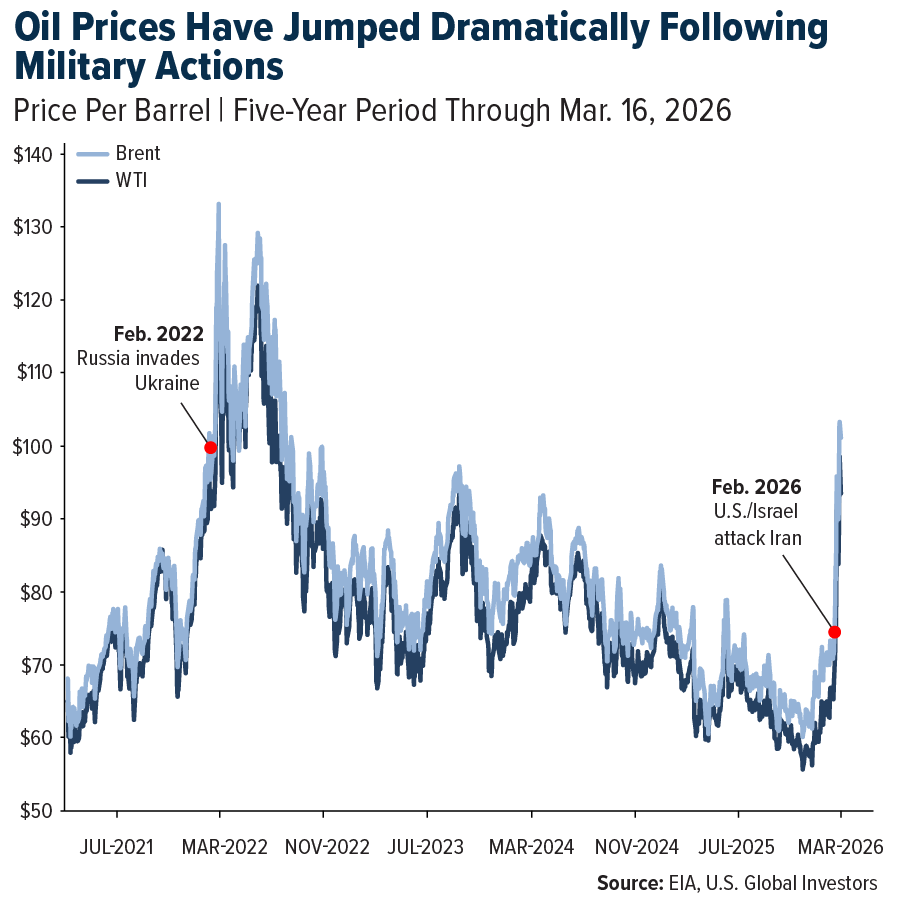
The real story is what’s happening in markets that fly under many investors’ radars. In Oman, for instance, crude reportedly hit a record $173 per barrel last week, surpassing even the 2008 financial crisis spike. The gap between Oman and U.S. prices now stands at more than $70 per barrel, according to the Kobeissi Letter.
That’s one of the largest divergences on record, and it’s a reminder that the commonly quoted benchmarks—WTI and Brent—reflect U.S. and North Sea supply conditions, not the crisis that’s unfolding in the Middle East.
What this tells me is that Western oil prices are understating the severity of the global shortage. If the Strait of Hormuz does not reopen soon, prices here in the U.S. will inevitably catch up as inventories are drawn down.
Why the U.S. Is Better Positioned Than You Might Think
Having said that, the good news for American investors is that the U.S. has never been better insulated from a Middle Eastern energy shock.
Domestic production is strong, with output nearing 14 million barrels every day, and the International Energy Agency (IEA) has already begun releasing 400 million barrels from member countries’ emergency reserves.
BBVA (BBVA)’s latest analysis projects the U.S. can maintain growth of around 2.5% this year, cushioned by high domestic production and strong internal demand.
Meanwhile, a Morgan Stanley (MS) study of the past 75 years found that the S&P 500 has risen an average of 8.4% in the 12 months following sudden external shocks like wars and energy crises.
The Pain Americans May Feel
Gas prices have already climbed nearly $1 per gallon in a single month. According to an analysis by a group of economists, including a former member of the White House Council of Economic Advisors, the typical household will pay an extra $740 in gas costs this year. This would effectively wipe out the tax refunds under the One Big Beautiful Bill Act.
Meanwhile, the conflict’s price tag keeps growing. The Pentagon is seeking more than $200 billion from Congress to fund the war, layered on top of the nearly $39 trillion in national debt I flagged in my last post. Every dollar spent is a dollar borrowed, and the fiscal pressure is building.
Europe Is the Canary in the Coal Mine
European natural gas storage is currently below 30%, a five-year low, heading into the critical refill season before winter.
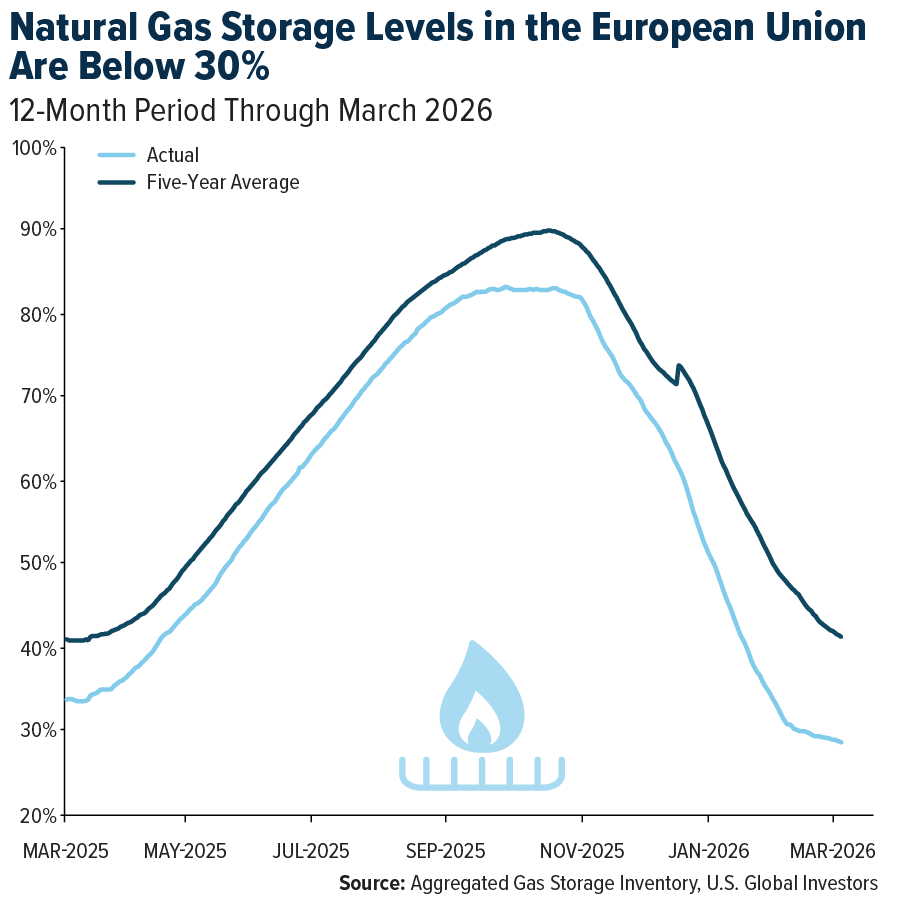
After severing dependence on Russian pipeline gas in 2022, Europe became heavily reliant on LNG imports. Much of it is made in Qatar and transits through the Strait of Hormuz. There’s no viable alternative route.
The damage may be lasting. Iran’s retaliatory strikes on Qatari infrastructure have knocked out 17% of Qatar’s LNG export capacity, and QatarEnergy’s CEO told Reuters last week that repairs could take three to five years. As I see it, that’s a structural loss for the global LNG market.
The consequences are severe. Capital Economics estimates that oil at $125 or higher could be enough to tip Europe into recession. Markets are now pricing in two interest rate hikes in the eurozone this year, a dramatic reversal from the rate cuts everyone expected just weeks ago.
Where I See the Opportunities
Right now, two themes stand out to me.
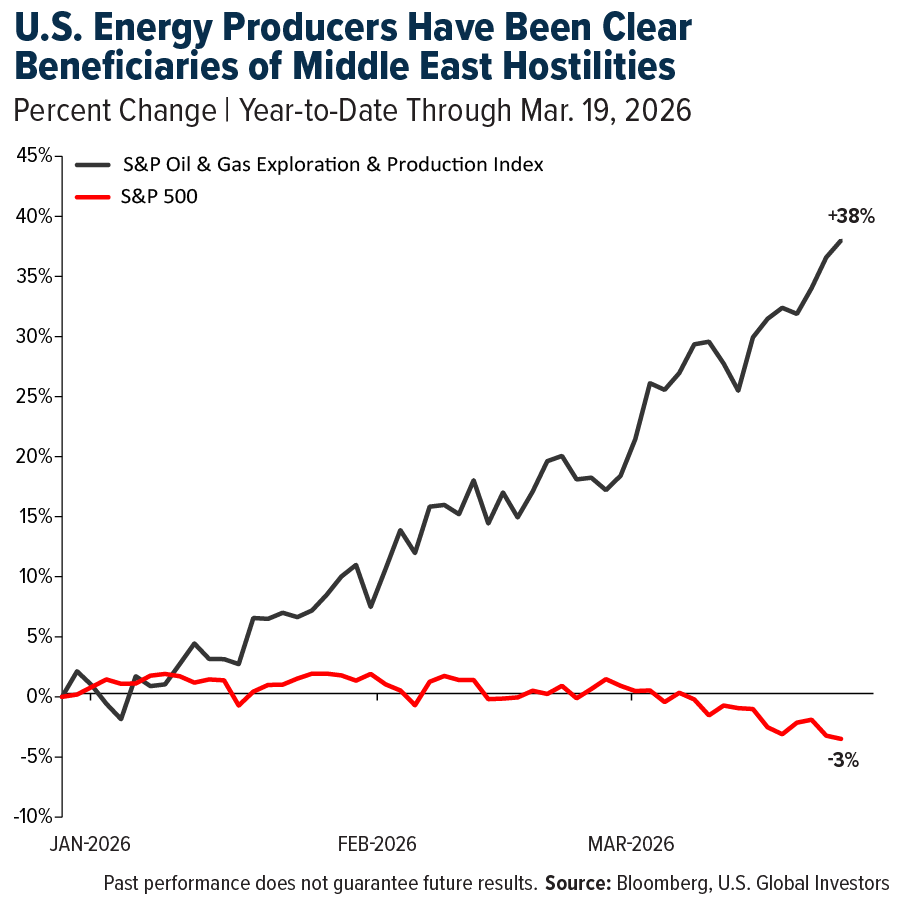
One, U.S. energy producers are the clear beneficiaries. The sector hit a new all-time high on Friday, and at $130 oil, domestic producers capture roughly $400 billion in additional revenue, according to a recent CG).com/global-insights/a-crude-awakening">Carlyle report. Goldman Sachs (GS) has identified five top oil pricks with favorable risk-reward profiles, including ConocoPhillips (COP), Chevron (CVX), Cenovus Energy (CVE), Suncor Energy (SU) and Canadian Natural Resources (CNQ).
And two, gold’s sell-off looks like an opportunity to me. The metal dropped nearly 5% last Thursday, falling below $4,600 per ounce, as rising yields and a stronger dollar continued to create short-term headwinds.
But the long-term case is only getting stronger. A $200 billion war spending request on top of record national debt, growing stagflation risks and a global energy crisis that could persist for years. These are precisely the conditions that have historically supported gold.
Again, the U.S. appears to be better positioned for this crisis than almost any other major economy on earth. Domestic energy production, strategic reserves and lower import dependence provide genuine protection. The investors who maintain discipline—who own energy, hold gold and resist the urge to flee to cash—are the ones I believe will be best positioned when this chapter closes.


Comments
Log in or sign up to join the conversation.