
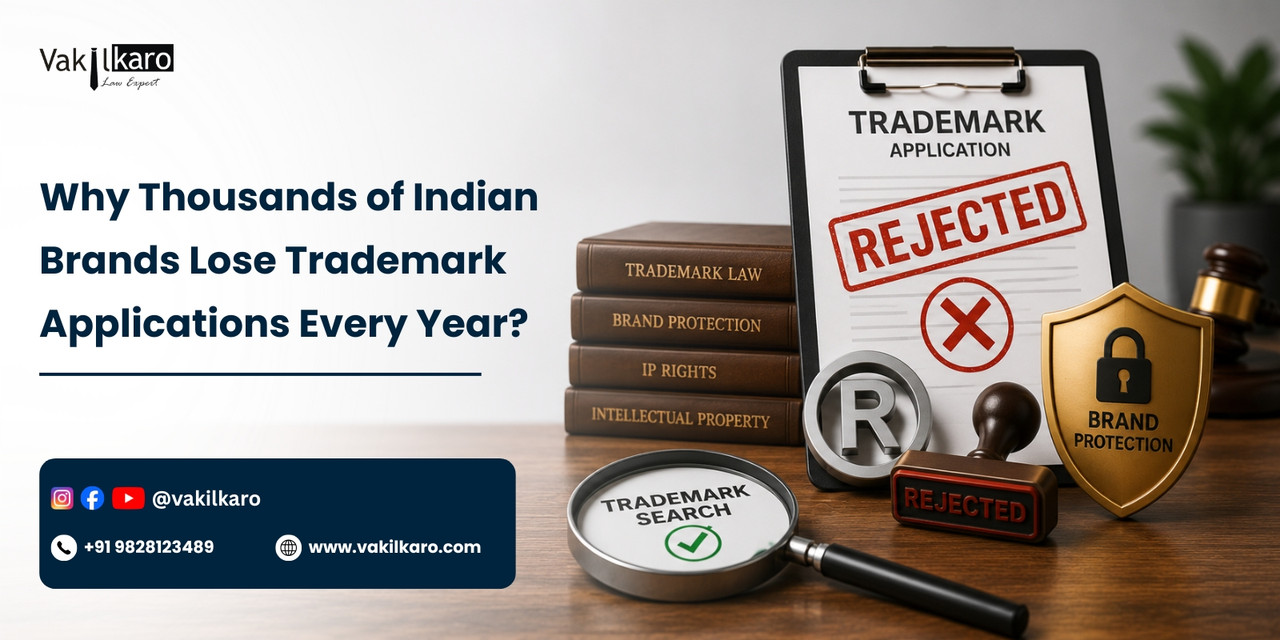
In India's booming economy, developing a brand is an exciting milestone for entrepreneurs, startup founders, and corporate leaders. To gain market share, you create an eye-catching logo, cultivate an engaged audience, and make significant marketing campaign investments. However, each year, thousands of firms receive an official registry objection or abandonment notice, which puts an end to their operations and is a heart-breaking reality check. Without strong legal protection, establishing a market presence would be like to erecting a skyscraper on a shifting sand dune. This short explains how to protect your company's assets against disastrous IP rejection as well as the typical structural mistakes entrepreneurs make during the filing process.
Thousands of Indian Brands Lose Trademark Applications Every Year: Explain
In India, the process of obtaining an intellectual property monopoly is often underestimated. Instead of seeing the application procedure as a complicated legal process, many business owners see it as a straightforward, automated administrative task. A startling proportion of applications encounter strong objections under Sections 9 that is the absolute grounds for refusal and 11 that is the relative grounds for refusal of the Trade Marks Act, 1999, according to registration statistics. A thorough comprehension of statutory content, procedural discipline, and proactive approach are necessary to overcome these challenges.
The Problem: Due to avoidable classification and similarity errors, more than 40% of trademark applications in India are postponed, rejected, or abandoned.
The Root Cause: Ignoring a thorough, multi-layered vetting process and depending on the availability of generic web domains prior to filing.
The Solution: By completing a perfect submissions within the stringent legal deadlines that to by choosing a legally sound brand name, and upholding the complete procedural uniformity.
The Illusion of Availability: Why a Basic Web Search Fails
The belief that a brand name is safe to claim if domain name is available or if an Instagram handle is available is a common point of failure for early-stage businesses. This is a harmful false belief. A typical search engine query can totally overlook phonetic, visual, or conceptual similarities buried deep within the official government database when starting brand registration in India.
Failing to do a full, expert trademark Search India before filing means you risk falling directly into relative grounds for refusal. In addition to searching for precise matches, the Trade Marks Registry actively highlights marks that are confusingly similar to one another. For example, a senior mark registered as “Clear” within the same class will instantly cause a structural blockade if you try to file a mark named “Klear,” making your application extremely susceptible to rejection. .
The Descriptive Trap: Choosing Marketing Appeal Over Legal Strength
Descriptive brand names are naturally preferred by corporate marketing teams since they effectively convey the functions of the product or service (for example, naming an organic juice company “Pure Cold Press”). However, under trademark law, something that works flawlessly for instant customer awareness can be utterly disastrous.
Your name strategy should focus on the top bounds of the Trademark Strength Spectrum and steer clear of common terms that examiners frequently reject in order to create an impenetrable corporate moat:
Invented Marks: Words that are entirely invented and have no native dictionary definition (e.g., Kodak, Rolex). These encounter the least amount of difficulty as they move through the registry.
Arbitrary Marks: Actual words used entirely outside of their typical industrial or physical context (e.g., Apple for computers).
Suggestive Marks: Words that are just a mere hint for a product's value or quality without explicitly declaring it e.g., Airbus for airplanes.
Descriptive Marks: Phrases that are clearly explaining the characteristics, features, or purpose of the product.
The digital portal will readily take your filing fee when you try to Register a Trademark Online, but if your mark falls into the descriptive trap, an examiner will promptly raise an objection under Section 9. The monopolisation of terms that other traders ought to be allowed to use to describe their own commodities is absolutely forbidden under absolute grounds for refusal. .
Classification Errors: The Danger of Mismapping Your Business Pipeline
Goods and services are categorised into 45 different legal classes using the Nice Classification system. A expensive mistake that leaves your company vulnerable to competitor poaching is misclassifying your operations or failing to predict where your firm will grow over the next years.
For instance, a contemporary fintech company may mistakenly believe that they simply require protection under Class 36 (financial services). However, they also need protection under Class 9 (downloadable software) and Class 42 because their product is supplied through an app or web platform (SaaS utilities). You must thoroughly plan out your physical and digital distribution networks before registering your brand. If you ignore comparable classes, a rival may file a similar name in a nearby industry, preventing you from expanding your business naturally.
The One-Month Clock: Navigating Rigid Statutory Timelines
The structural simplicity of online trademark registration has greatly reduced the barrier that withholds the entry for Indian brands. However, this ease of early submission frequently encourages operational complacency. Once the application status is changed to “Objected,” the legal clock begins to run and administrative delays are no longer an option but a necessity that to be catered at the earliest.
The register follows a stringent statutory deadline: you have precisely one month from the date the Examination Report was issued to provide a thorough, legally sound written response.
To dispel the examiner's worries, this response must include solid case law precedents, proof of user dates, and well-organized arguments. If you miss even one day of this deadline, the system will automatically classify your application as “Abandoned.” You will have to reapply from scratch and forfeit your chronological priority date after the application has been abandoned.
Conclusion and What Should You Do Now?
Losing a trademark application can result in a costly, identity-shattering business rebranding that destroys years of hard-won customer trust, making it more than simply a small bureaucratic setback. If intellectual property is regarded as a fundamental corporate asset from the start, these operational problems can be completely avoided. You may make sure that your marketing budgets create long-term, safeguarded enterprise value by carrying out thorough preparatory clearing procedures and upholding perfect compliance.
Take rapid control of the legal pipeline for your brand. Before you decide to properly register your trademark, don't wait for a rival to steal your design or send a forceful cease-and-desist letter.
Unplanned compliance disruptions can be avoided by protecting your operating structure. For insightful, forward-thinking information on business compliance and intellectual property strategy, stay tuned to the Vakilkaro Brief. Vakilkaro offers complete portfolio engineering, sophisticated asset search technologies, and specialist corporate counsel to transform your everyday inventions into an impenetrable commercial moat.
Comments
Log in or sign up to join the conversation.