

What Catalysts Will Drive Stock Prices Even Higher From Here?
Aside from continued irrational exuberance, there don't appear to be many viable alternatives. The S&P 500/SPX (SP500) and stocks, in general, have struggled to climb the wall of worry in recent sessions, and possibly for good reason. The upcoming Fed taper, increasing coronavirus cases, worsening economic data, overextended valuations, a deteriorating technical image, and other detrimental elements could cause the current pullback to get a lot worse. I've been discussing the upcoming correction and the need to get more defensive for several days now. I want to discuss the current market predicament in more detail and talk about some strategies that should continue to work in the current downturn.
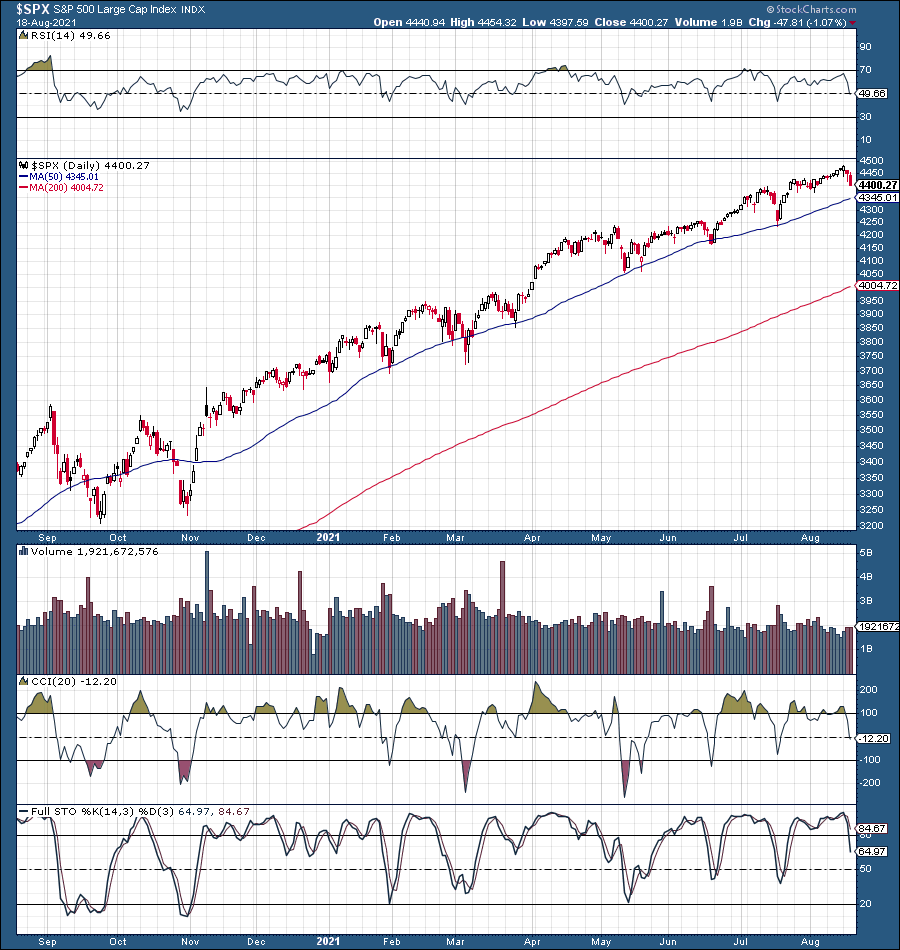
SPX 1-Year
Source: stockcharts.com
The SPX has been struggling to move notably higher in recent weeks. We see that the all-time high/ATH from a few days ago is just 2% above the ATH before the prior pullback. We also see a continued decline in trading volume, especially on up days. Strictly from a technical standpoint, it looks like the S&P 500 may be running out of steam. Now, in recent pullbacks, SPX has bounced off the 50-day moving average. However, this time it's likely going to be different, and here is why:
Fundamental Issues are Abundant
In prior declines, we primarily dealt with overheated technical conditions. At the same time, fundamental factors remained largely favorable (i.e., strong earnings, robust economic growth/data readings, improving trend in coronavirus cases, ultra-easy monetary conditions, etc.). However, now everything seems to be moving in the wrong direction.
Fed Taper Whispers
First, it's a reduction in asset purchases, and then it's higher interest rates next. If there is one thing the market hates, it's talk of tightening policy. The market has grown so accustomed to the ultra-easy monetary regime at hand that simple whispers of marginally tighter monetary conditions send waves of panic throughout the marketplace. Judging by the Fed minutes delivered this week, QE will be scaled back this year, and it looks highly likely that interest rates will begin to rise next year. Now, whether we actually see substantially tighter monetary conditions in the future is less important than what the market perceives will materialize. Right now, the market is factoring in tighter conditions, which is negative for stocks, particularly if we combine the tighter conditions with other developing factors.
Worsening Economic Readings
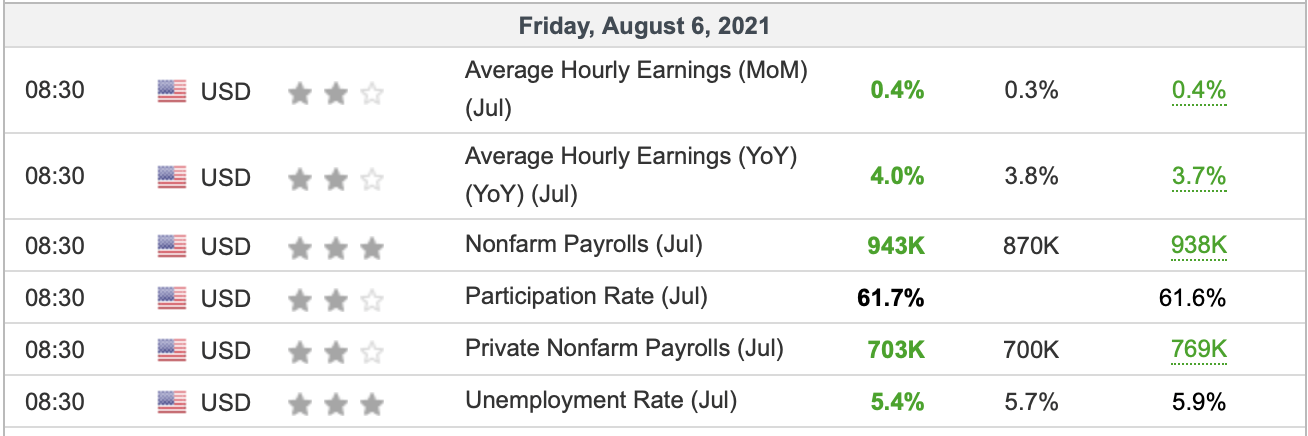
If we look past the slightly better than anticipated nonfarm payroll report for July, August has been full of disappointing economic data points.
Source: investing.com
Also, private nonfarm payrolls beat by only 3K, so all the better than anticipated job growth came from government employment. However, much of the recent economic data have missed estimates. For instance, ADP nonfarm payrolls missed by more than 50%, and Michigan consumer sentiment and expectations numbers missed by a wide margin. More recently, retail sales numbers declined by much more than anticipated, and oil inventories have continuously disappointed in recent weeks.
The takeaway from the recent economic data is that the recovery may be faltering. The consumer is responsible for about 70% of the U.S. GDP, and worsening consumer and retail sales data is discouraging. Furthermore, higher oil inventories imply that oil demand is not as robust as imagined, and people are not traveling as much as anticipated.
Increasing Coronavirus Cases
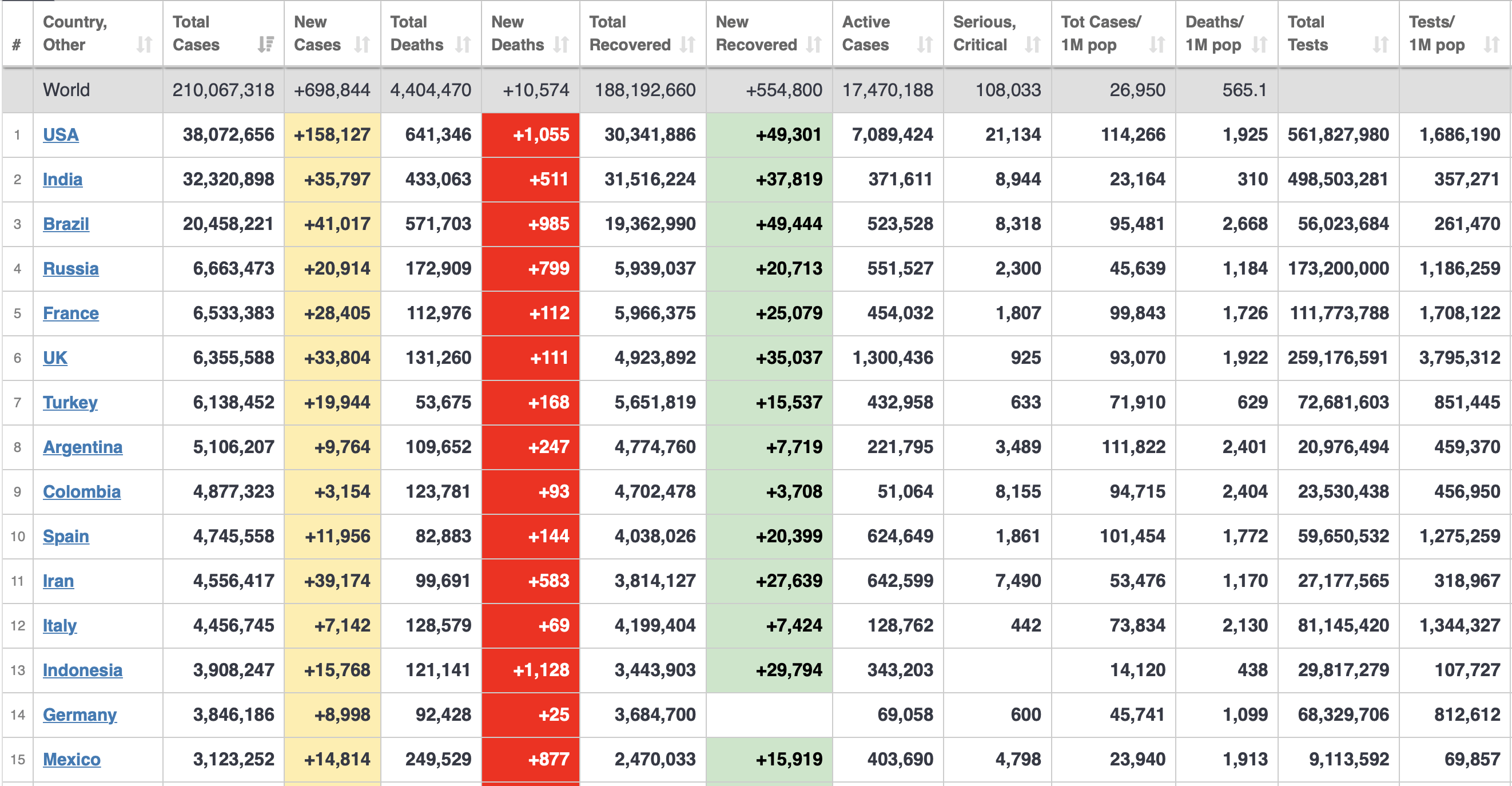
The worse than expected consumer and travel readings very likely have a link to the coronavirus. With the Delta Variant circulating the globe, coronavirus cases have exploded lately.
Source: worldometers.info
One hundred fifty-eight thousand new cases and over 1,000 deaths in one day are significant figures. Let's not forget that this is still summertime, and things could get much worse in the Fall and Winter months. Some experts even believe we could see a repeat of last year's disaster. This year's coronavirus season will likely be terrible, and it will probably further exacerbate the already weakening economic landscape.
Valuation Issues
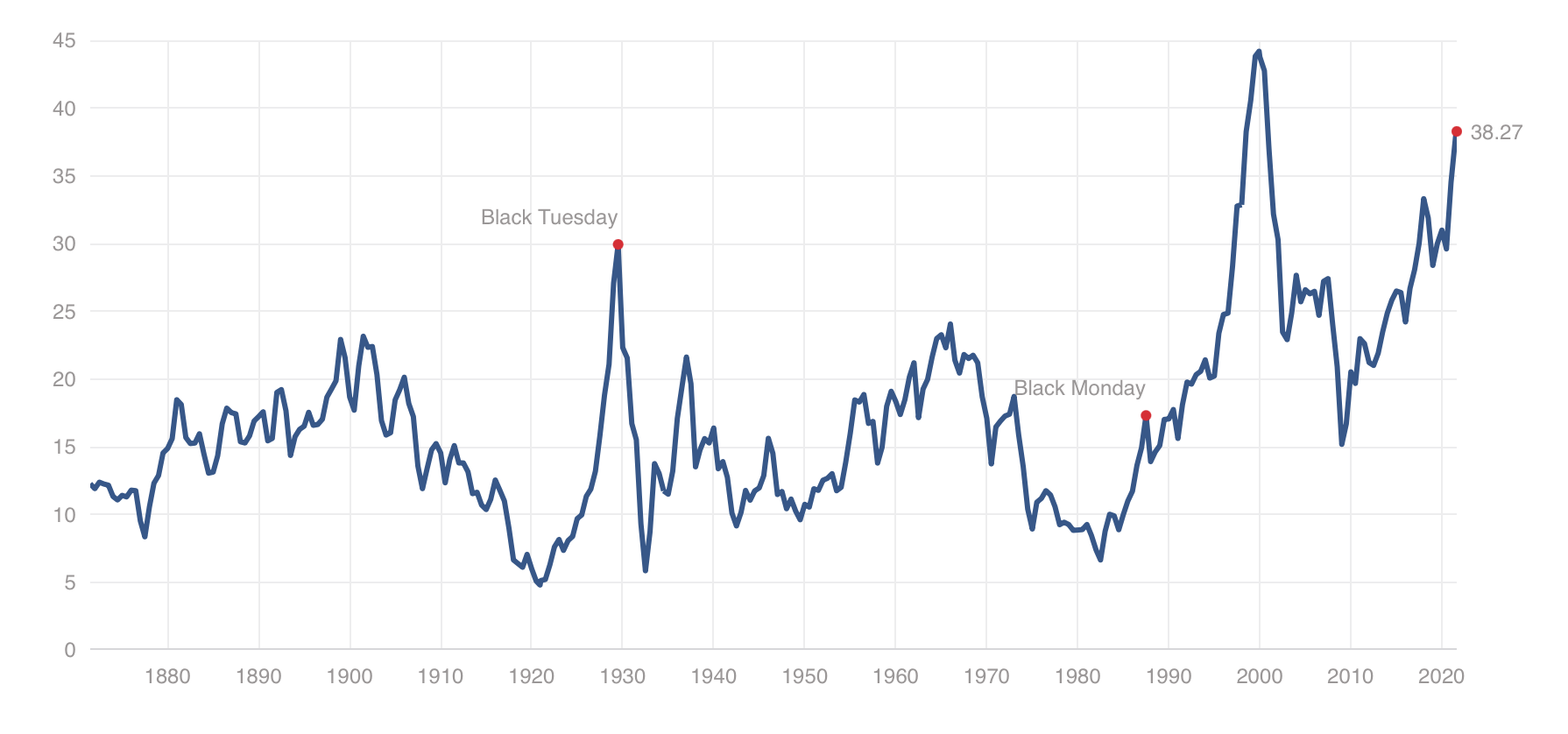
Shiller P/E Ratio
Source: multpl.com
As stocks continue to appreciate more rapidly than their earnings, the Shiller P/E ratio is approaching 2000 levels. The SPX's price to sales ratio is at 3.16, an all-time high right now. A crucial question to ask is, how long can this bubble continue to expand? While the answer to this question is difficult to attain, we know that sentiment can change quickly when positive catalysts run out, and a grizzly correction could materialize.
The Bottom Line: We May Be Running Out Of Catalysts
Earnings season is coming to an end, and most big-cap bellwether names have already reported. While most large-caps provided better than anticipated results, the next earnings season may not be as rosy. Also, we're seeing worsening economic readings in many crucial areas like the consumer, oil demand, and other areas. The coronavirus is making a resurgence in cases across the U.S., and the technical image surrounding equities is deteriorating. On top of all this, the Fed is preparing to introduce tapering before the end of the year. Valuations are sky-high already, so what catalysts will propel stocks even higher from here?
At current, there don't appear to be any catalysts capable of sending stocks notably higher from here. Instead, there is likely going to be a correction in the coming weeks. While the S&P 500 would need to shed about 50% for valuations to get back in line with their historical means, we may see a 10-20% decline. We are still in the easiest monetary environment in history. Once a severe correction is in motion, the Fed will likely backtrack on tapering, which should put in a floor beneath the market. Nevertheless, a 10-20% correction would bring the S&P 500 back down to the 4,000-3,600 area, which could cause a lot of damage to an unhedged portfolio.
How to Capitalize
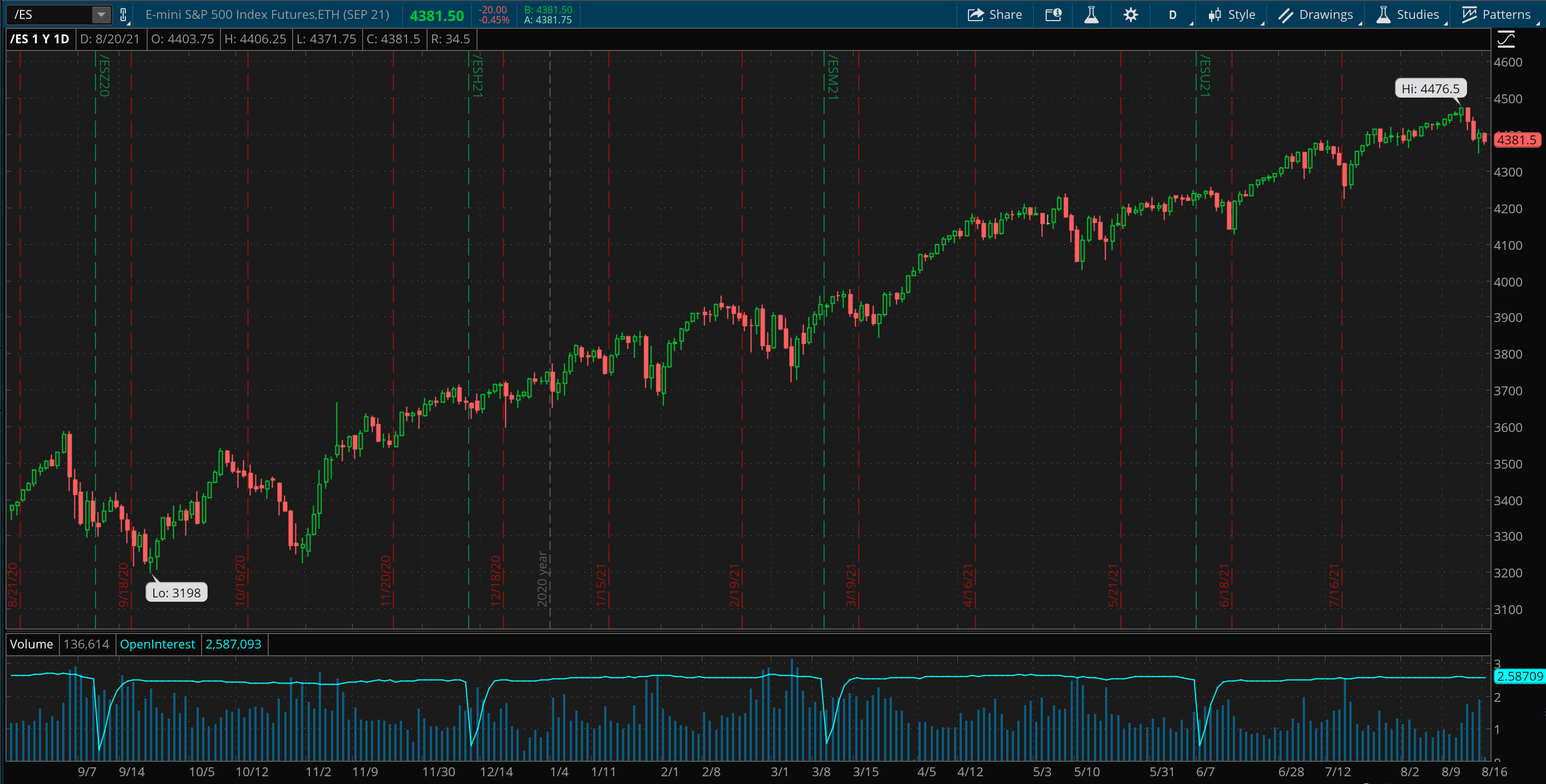
SPX Futures 1-Year
Source: thinkorswim
Right now, the SPX futures are still only about 2% below their ATH. However, the crucial support level is approaching. If the SPX futures break down below 4,350-4,300, support stocks could go notably lower. Therefore, I want to use this level to do several things. First, if price action continues to deteriorate, I want to raise my cash position. By increasing cash, I mean taking temporary profits in various stocks across the board. With stocks that I continue to hold, I want to add more protection. I already use a covered call strategy with multiple names to increase yield, but I want to improve my spread and put option positions. Furthermore, if SPX starts to head below 4,350-4,300, I will consider hedging positions via inverse ETFs and futures contracts.

Comments
Log in or sign up to join the conversation.