

Over at Econlog, I have a new post that I wrote last night, before the recent market crash. It occurred to me that it might be useful to present a graph explaining the argument I’m making.
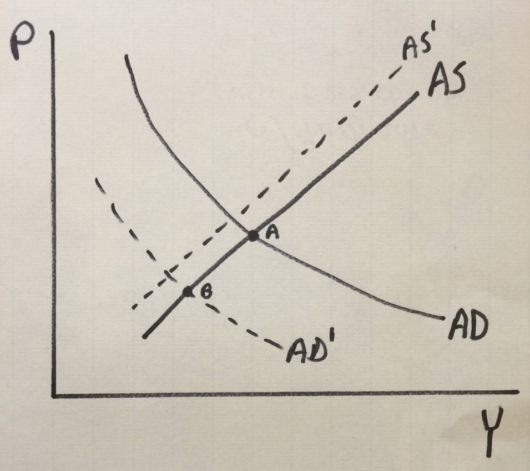
You’d expect a negative supply shock to be inflationary. But lots of recent supply shocks in the global economy have reduced the equilibrium interest rate, and central banks have inadvertently tightened policy by not cutting their policy rate fast enough. Markets clearly fear another example of this in response to the Covid-19 outbreak, especially as it spreads to other countries such as Italy and South Korea.
Adverse supply shocks are inflationary. But a bad monetary policy response can be even more deflationary. That’s what the markets currently fear.
To be sure, markets are often wrong, indeed in a sense they are always wrong—events are almost never exactly as they predicted. A few weeks ago, markets were too complacent about Covid-19 becoming a global pandemic. Who knows, perhaps today they are too fearful. But markets do provide the best guess as to what’s likely to happen, and today the best guess is that the odds of recession just increased, albeit still remain below 50%.
The Fed would prefer not to cut rates. But they also need to understand that the longer they wait, the deeper they will have to cut them. Don’t slowly wade into that cold lake—jump in!
PS. Americans are increasingly “risk averse” (i.e. scaredy cats). I worry that an outbreak in the US could lead to panic.
PPS. If I don’t respond to comments immediately, that’s because I’m at the store stocking up on toilet paper.
PPPS. I’m 28 days into one of those colds where you can’t stop from coughing. I developed it the day after returning on a long flight from the Eastern hemisphere.
PPPPS. Fortunately, it was a flight from New Zealand!

Comments
Log in or sign up to join the conversation.