
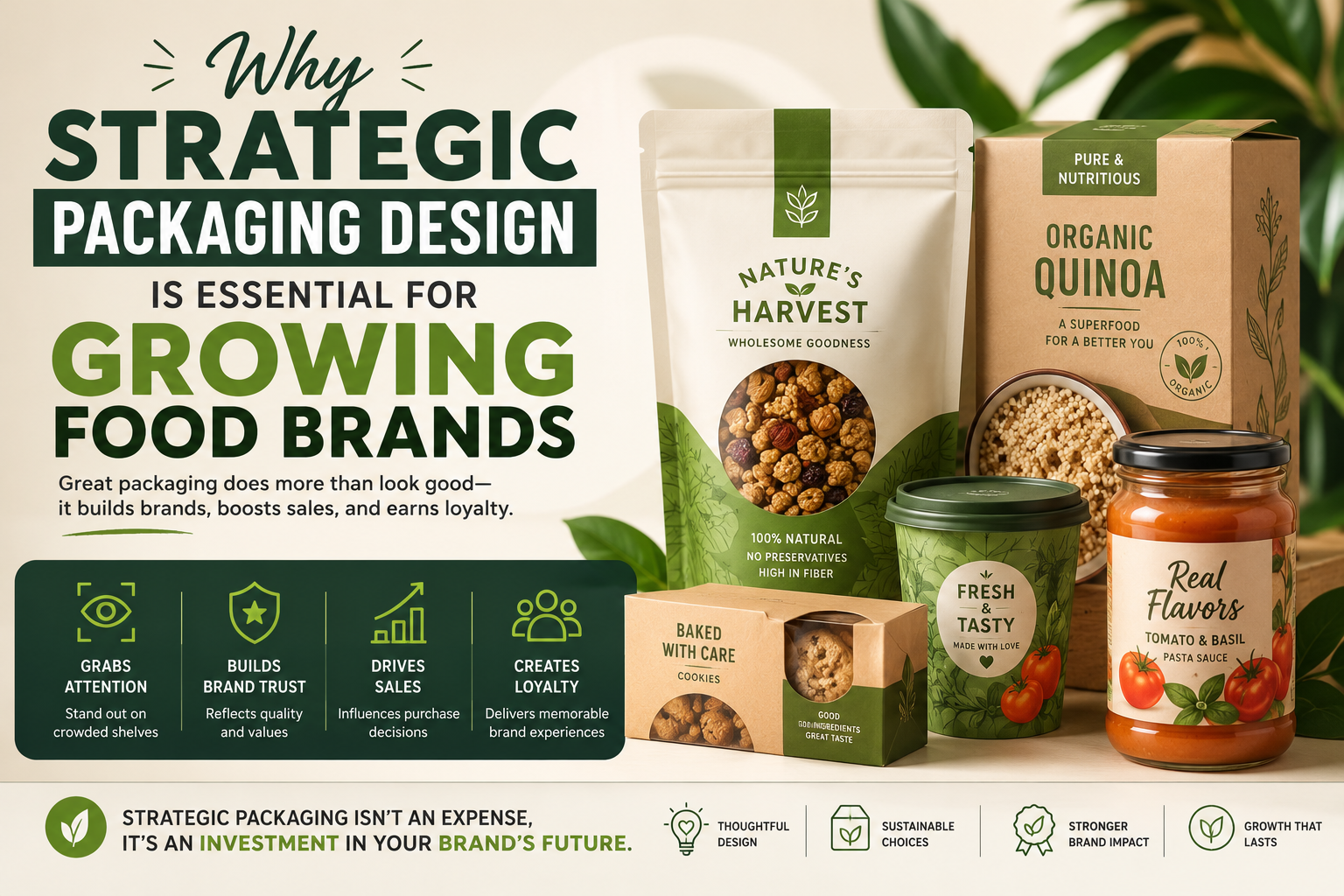
A growing food brand rarely loses customers because the product is bad. More often, it loses them because the product never gets picked up in the first place.
Walk through any supermarket today, and you'll see hundreds of products competing within a few square metres of shelf space. Most promise quality. Many claim to be healthier, tastier, or more sustainable. Yet shoppers rarely stop to compare every option. They scan, recognise, eliminate, and choose.
That process takes seconds.
For growing brands, this changes the role of packaging completely. It is no longer just about making a product look attractive. It is about making the right impression at exactly the right moment.
This shift is why businesses are increasingly investing in food packaging and design services that begin with strategy rather than aesthetics.
Good Packaging Doesn't Just Get Seen. It Gets Picked.
One of the biggest misconceptions around packaging is that its job is to attract attention.
Attention is only the first step. The real objective is conversion.
Retail experts often refer to this as shelf conversion - the moment when a shopper notices a product, picks it up, and considers buying it. Plenty of products succeed at the first step but fail at the second because the packaging doesn't communicate quickly enough.
A shopper shouldn't have to work to understand what they're looking at.
Within a few seconds, the pack should answer simple questions:
What is this?
Who is it for?
Why should I choose it?
Strategic packaging isn't limited to graphics or colour palettes. Structural choices can also influence perception. Distinctive formats- such as pyramid-shaped packs, triangular cartons, or uniquely contoured containers - can make otherwise ordinary products feel more premium and memorable. When used thoughtfully, these structural decisions help products attract attention without relying solely on louder branding or promotional claims.
When those answers are immediately clear, hesitation drops and purchase intent rises. That's where strategic packaging begins to influence business outcomes.
Strong Packaging Makes Premium Pricing Feel Natural
Price isn't determined only by ingredients or manufacturing costs. Perception plays a significant role. Consumers often use packaging as an indicator of product quality before they have any experience with the product itself.
When packaging feels organised, intentional, and well considered, people naturally assume the same level of care exists inside the pack.
This doesn't mean premium brands need expensive finishes or elaborate graphics. In fact, many premium food brands rely on simplicity. Clear information, thoughtful typography, balanced layouts, and high-quality materials often communicate confidence far more effectively than visual excess.
The result is something every growing business wants: greater pricing flexibility without constantly relying on discounts.
Packaging Should Make Expansion Easier
Growth creates an unexpected challenge. Many food brands launch with a single hero product. Over time they expand into new flavours, formats, or entirely new categories.
If every package looks unrelated, customers fail to connect those products with the parent brand. Trust doesn't transfer. Strong packaging systems solve this by creating a recognisable structure that works across an entire portfolio.
Whether the business launches a new snack, beverage, cereal, or ready-to-eat meal, customers immediately understand that the products belong to the same family.
This makes line extensions far smoother because the brand equity built by one product supports every product that follows.
Retailers Notice Good Packaging Too
Consumers aren't the only audience packaging needs to impress. Retail buyers evaluate packaging differently. They consider whether products are easy to merchandise, easy to identify, and visually consistent across shelves.
Packaging that creates confusion doesn't just affect shoppers. It can also affect retailer confidence.
Products with clear hierarchy, strong brand architecture, and cohesive visual systems are often easier to display and easier to manage within a category.
For growing brands seeking wider distribution, that consistency can quietly improve retail acceptance.
Packaging Now Has to Win in Two Places
Shopping habits have changed dramatically. A product no longer appears only on supermarket shelves. It also appears as a tiny thumbnail on Blinkit, Instamart, Zepto, Amazon, and countless ecommerce platforms.
This has led to what many designers describe as shelf-to-screen design. Packaging must now perform in two completely different environments. From two metres away in a supermarket. And from a few centimetres wide on a mobile phone screen. Fine details that look beautiful in person often disappear online.
Brands are responding by simplifying layouts, strengthening typography, improving colour contrast, and creating clearer visual hierarchies.
The strongest packaging systems are no longer designed exclusively for shelves. They're designed for every place a customer encounters the product.
Strategy Is Becoming the Real Competitive Advantage
Packaging trends change every year. Consumer psychology changes far more slowly. People still look for clarity before complexity. They still trust familiarity. They still make quick judgments based on visual cues.
This is why more founders are treating packaging as a strategic business decision rather than a creative exercise.
The discussion has moved beyond colours and logos toward questions like:
Will this reduce customer hesitation?
Will shoppers remember it next month?
Can it support future product launches?
Will it justify a higher price point?
Will retailers find it easy to merchandise?
These questions create stronger commercial outcomes than asking whether a package simply looks modern.
One interesting sign of this shift is how packaging work is increasingly being presented. Browse the portfolios of studios like Erth Co., and you'll notice that many projects are explained through the business problems they solve rather than the visual styles they use. The conversation is becoming less about decoration and more about recognition, scalability, and long-term brand growth - a reflection of where the industry itself is heading.
The Real Competitive Advantage
The conversation around packaging has traditionally focused on visibility - how to stand out, attract attention, or look different. But visibility is temporary. Recognition is cumulative. Every consistent interaction makes the next purchase slightly easier than the last. Over time, that advantage compounds quietly, until customers stop comparing alternatives altogether. At that point, packaging is no longer supporting the brand. It has become one of the reasons the brand continues to grow.
Comments
Log in or sign up to join the conversation.