
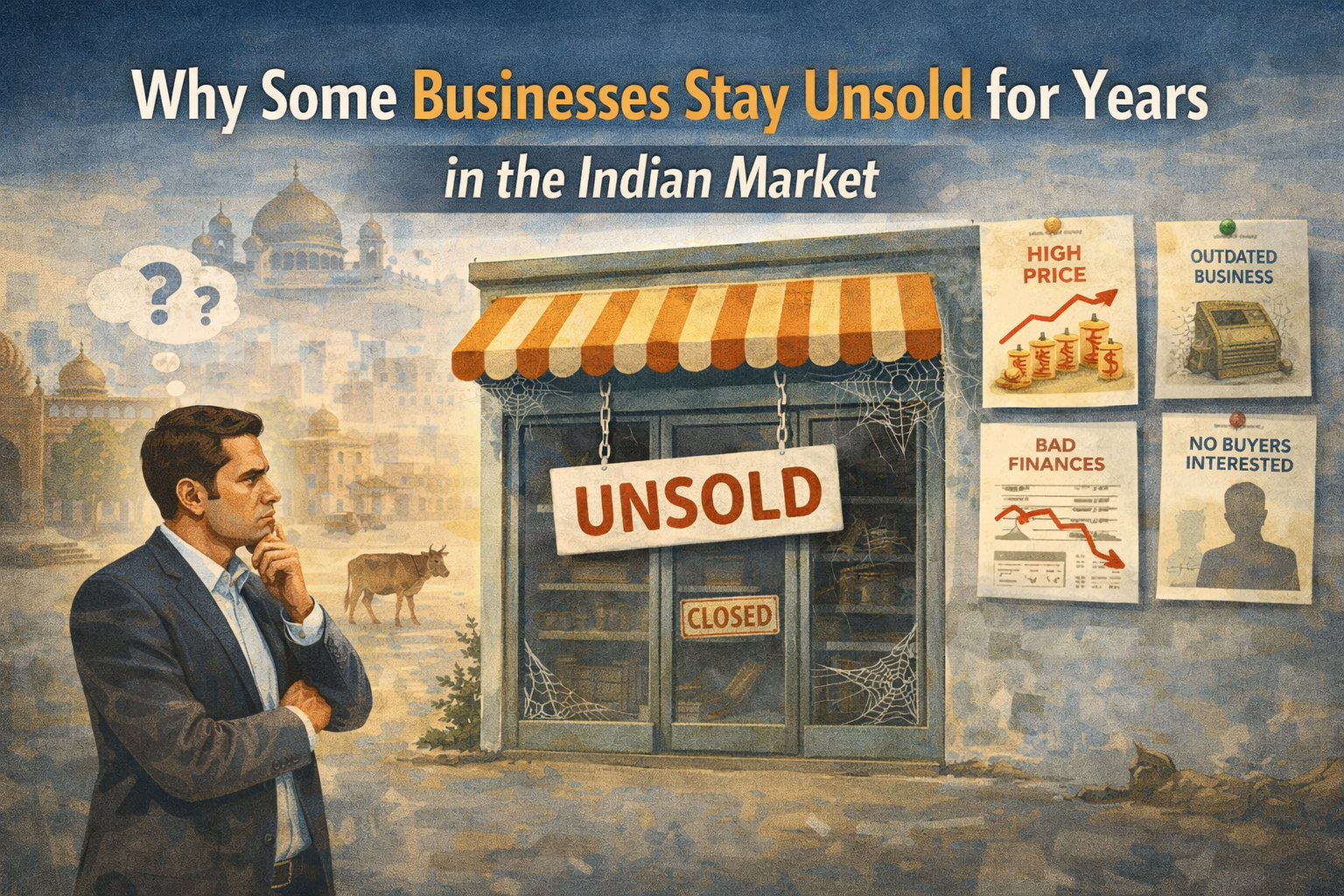
Selling a business in India sounds easy. The economy is expanding, the startup ecosystem is abuzz, and ambitious entrepreneurs would not be short of their next opportunity. But enter the office of any business broker in Mumbai to Coimbatore, and he or she will say that his or her lists are full of businesses that made no effort to get a serious buyer in two, three, or even five years.
And then how come that businesses remain unsold in a country of 1.4 billion and one of the fastest-growing economies in the world? The causes are entrenched, like the Indian business construction, family attitudes towards money, and the concept of trust within our culture.
The Gap in Valuation Is Larger Here
Business in India is hardly ever a business. It is the identity of one person, the sacrifice of a person and family, and at times the whole retirement of one person, bundled in it. When an owner is sitting opposite a prospective buyer, and he is hearing a price reduction that is half of what they had thought it should be, it does not simply seem like a bad offer, but it seems to be an insult to all they have worked so hard to create.
This effective pricing has been one of the largest causes of businesses being unsold throughout the Indian markets. A sweet store owner in Pune may be of the opinion that his 30-year-old shop is worth 2 crore due to the legacy and the regulars. A buyer looking at the actual footfall, margins, and documented revenue might offer ₹70 lakh. Neither party is entirely wrong - but neither is willing to meet in the middle.
Cash Transactions Create a Paper Trail Problem
Let us be honest about something that everyone in Indian business knows but rarely says out loud. A large number of small and mid-sized businesses in India run on a split system - some transactions on the books, some off. The actual profit might be significantly higher than what the ITR shows, but a buyer cannot pay a premium for income they cannot verify.
This creates a painful situation. The seller knows the real numbers. The buyer suspects the real numbers. But without documentation, no serious buyer, especially one seeking bank financing, can justify the higher valuation. Deals collapse not because the business is bad, but because the paperwork tells a different story from the owner's.
Family Dynamics Complicate Everything
Indian businesses are predominantly family-run, which brings a layer of complexity that most Western business sales models do not account for. Sometimes the decision to sell is not unanimous. One sibling wants out, another wants to hold on. The father started the business and emotionally cannot let it go, even though the sons are done running it.
In many cases, there are informal stakeholders - relatives who have lent money, family members who work in the business without formal agreements, or elders whose blessing is considered necessary before any major decision is made. A buyer who thought they were negotiating with one person slowly realises they are actually negotiating with an entire family tree.
The Business Lives and Dies With the Owner
This occurs particularly in the tier-2 and tier-3 Indian cities. The owner is the brand. Customers come because they trust him personally. Suppliers give credit because they have known him for decades. The staff listens because of his authority, not because of any system or process.
The moment a new face walks in, everything becomes uncertain. Regular customers start exploring alternatives. Key employees start updating their resumes. Long-standing vendor relationships become transactional overnight. A buyer sees this risk clearly and either walks away or makes an aggressively lowball offer, which can cause the deal to fall apart.
Broker Networks and Awareness Are Still Developing
In the United States and the United Kingdom, there is a mature ecosystem of M&A advisors, business brokers, and exit planners, even at the small-business level. That ecosystem can be found in India, which is still developing. In smaller cities, numerous business proprietors bother to establish the existence of professional business brokers. They make their attempts in the background using word of mouth, and so, the right purchase might never even hear that the business exists.
The Mindset Around Selling Has Stigma Attached
In Indian culture, selling your business can carry an unspoken stigma. People wonder - is he in financial trouble? Did the business fail? Is there something wrong that we do not know about? This social pressure pushes many owners to either delay listing their business or do so so secretly that they never find a genuine buyer.
What Needs to Change
Businesses that successfully sell in the Indian market - and there are many - tend to have owners who started thinking about their exit two to three years in advance. They worked on cleaning up their books, formalising vendor and customer agreements, building a management layer that could run independently, and working with advisors who understood both valuation and the emotional weight of letting go.
Understanding why businesses stay unsold is not just an academic exercise in the Indian context - it is genuinely the difference between retiring comfortably and being trapped in a business you no longer want to run. The Indian market has buyers. It has a capital. What it needs more of is truly prepared sellers.
Comments
Log in or sign up to join the conversation.