

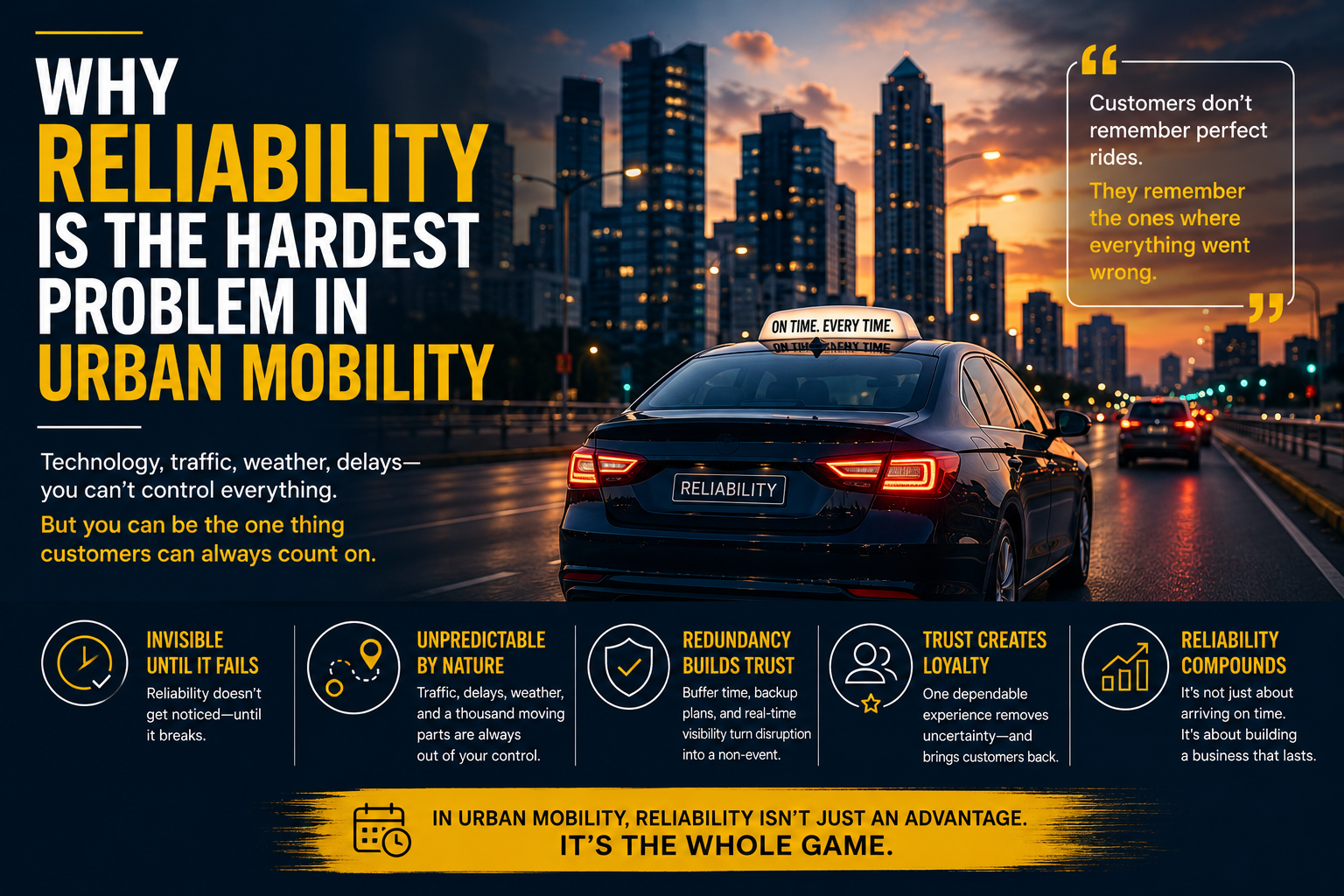
Ask most people what they want from urban transport and they'll say something about price, or speed, or a nice app. Ask them what actually makes them switch providers, and it's almost always the same answer: something went wrong once, unpredictably, and they didn't want to risk it happening again.
Reliability doesn't get talked about as much as it should in mobility, probably because it's boring to market. "We show up when we say we will" doesn't make for an exciting pitch deck slide. But it is, in my experience, the single hardest problem to actually solve at scale — harder than pricing, harder than growth, harder than most of the technology problems that get more attention.
Reliability is invisible until it fails
This is the strange thing about reliability as a product feature: when it works, nobody notices it. A car that arrives on time, exactly as booked, generates zero feedback. It's simply what was expected. The moment it fails, even once, it becomes the only thing that customer remembers about you.
That asymmetry makes reliability a terrible thing to under-invest in, because you get no credit for it going right and outsized damage when it goes wrong. Building the best airport cab service in a market isn't usually about having the newest app or the flashiest cars. It's about becoming the operator that people stop worrying about entirely.
Why it's structurally hard
Reliability in urban mobility is difficult for reasons that have nothing to do with effort or intention. Traffic is unpredictable. Flights are delayed. Drivers get sick. Vehicles break down. Weather happens. Every one of these variables sits outside your direct control, and yet the customer's expectation is that you absorb all of it invisibly and still deliver on time.
This means reliability isn't really about eliminating disruption — that's impossible — it's about building enough redundancy and buffer into the system that disruption doesn't reach the customer. Spare vehicles on standby during peak periods. Drivers briefed on contingency routes. Systems that flag a delayed flight before the passenger even lands. All of it costs money and looks inefficient on paper, right up until the day it's the only reason a customer's trip wasn't ruined.
The temptation to over-promise
Growth pressure creates a specific trap: the temptation to promise faster pickups, tighter windows, and guaranteed availability in order to win customers from competitors. It works, for a while. Then reality catches up, promises get broken, and the trust you spent years building erodes in a matter of weeks.
The operators who last tend to under-promise slightly and consistently deliver, rather than promising something impressive and delivering it inconsistently. It's a less exciting way to grow. It's also the only way to grow that compounds instead of resetting to zero every time expectations aren't met.
Reliability compounds into something bigger than transport
Here's what surprised me most: once a customer trusts that your service is reliable, the relationship changes shape entirely. People who book airport cab online for one trip, and have it go exactly as expected, stop comparison shopping the next time. They stop checking prices elsewhere. The decision becomes automatic, because you've removed the uncertainty that made them shop around in the first place.
That's the real economic value of reliability in urban mobility. It's not a nice-to-have sitting on top of the product. It's the mechanism by which a transactional customer becomes a habitual one. Everything else — pricing, marketing, app design — is easier to build than that kind of trust, and none of it matters much without it.
If urban mobility has a hardest problem, it isn't autonomous vehicles or route optimisation. It's the unglamorous, compounding discipline of simply doing what you said you'd do, every single time, for customers who will never thank you for it and will absolutely notice the one time you don't.
Comments
Log in or sign up to join the conversation.