

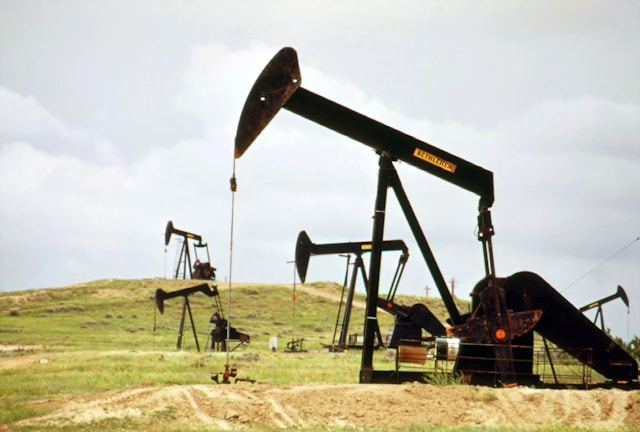
Exxon (XOM) warned this week that the oil situation is getting dire. The energy tape barely moved on it.
The oil futures structure makes that warning real. It tells you more than the headline does.
Oil sits in backwardation right now. Forward prices have to converge up toward spot, and that convergence lifts the whole complex over time.
You have probably been waiting for energy to confirm before acting. The institutions already started.
The Block Hunter Console pulled three energy prints this morning.
One of them is a straddle that does not care which way the headline breaks.
Here is where the structure sets up.
Why Exxon’s Warning Matters
Exxon warned that the oil situation is getting dire. That is not a throwaway line from an integrated major.
The United States imports more oil than it produces. We export refined energy products, but we do not pump enough crude for ourselves.
We rely on heavy crude to make the derivatives. Venezuela holds the heavy crude that feeds that need.
Now we are releasing the Strategic Petroleum Reserve. We are drawing it down into a conflict-driven shortage.
The reserve already ran low going into this administration. We never filled it back up.
The Oil Structure Says Up
Oil sits in backwardation. That falling forward structure leans heavily bullish.
The front contract trades near 87.50. The next one sits at 85.40.
That two-dollar gap reflects the net cost of carry. It stays wide all the way out before flattening near next year.
Backwardation pulls oil up as forward prices converge toward spot. That mechanic makes a move south of 85 difficult.
The structure ran even steeper on March 6th. It has flattened a little since. It remains very steep today.
One detail trips people up here. Oil term structure settles in physical, while the VIX term structure settles in cash. The two behave differently because of that.
The Straddle In The XLE Chain
The Console pulled three energy prints this morning. Institutional money started to wade into the energy waters.
XLE reads cleanest of the three. The print bought June 18 calls at the 56.50 strike, then bought puts at the same strike.
The size matched on both sides. Roughly 5,300 contracts each, same strike, same expiration.
That is a straddle. It pays a move in either direction.
An institution sizing a straddle is not calling direction. It is positioning for volatility around the energy complex.
Where CVX And Clean Energy Line Up
CVX showed call buying today. The name runs as an integrated company. It earns on refined products as well as crude.
ICLN carried the third print. Roughly 10,000 contracts hit, mostly bought at the 25 strike for July 17.
ICLN has been on a tear. The flow lines up with renewed interest on the solar side.
Devon (DVN) also saw bullish trade last week. That print crossed on Wednesday.
Why This Read Is A Framework
No specific trade with strikes and a cost belongs here. Treat this as a framework.
Near-term trepidation hangs over Exxon, XLE, and CVX. The structure leans bullish. The read still needs the tape to confirm.
The institutional positioning and the oil structure point the same way:
XLE: roughly 5,300 calls and 5,300 puts at the 56.50 strike, June 18, a straddle
CVX: call buying with integrated refiner exposure
ICLN: roughly 10,000 contracts mostly bought at the 25 strike, July 17
Structure: oil in backwardation, front near 87.50 against 85.40 on the next contract
Edge: forward prices converging up toward spot, lifting the complex
These are the inputs. The specific strike and cost belong to the trader who confirms the break.
What The Console Reads That The Tape Misses
The tape barely reacted to Exxon’s warning. The chart shows energy drifting and gives no reason for the institutional interest.
The prints explain it. The Console reads which side each print hit and the volume-to-open-interest math that separates opening trades from closing ones.
A straddle, a block of calls, and a clean-energy print all crossed in a single session. That alignment gives the signal a flow scanner cannot separate.
By the time the chart confirms a move in energy, the contracts deciding it have already sat on the books.


Comments
Log in or sign up to join the conversation.