
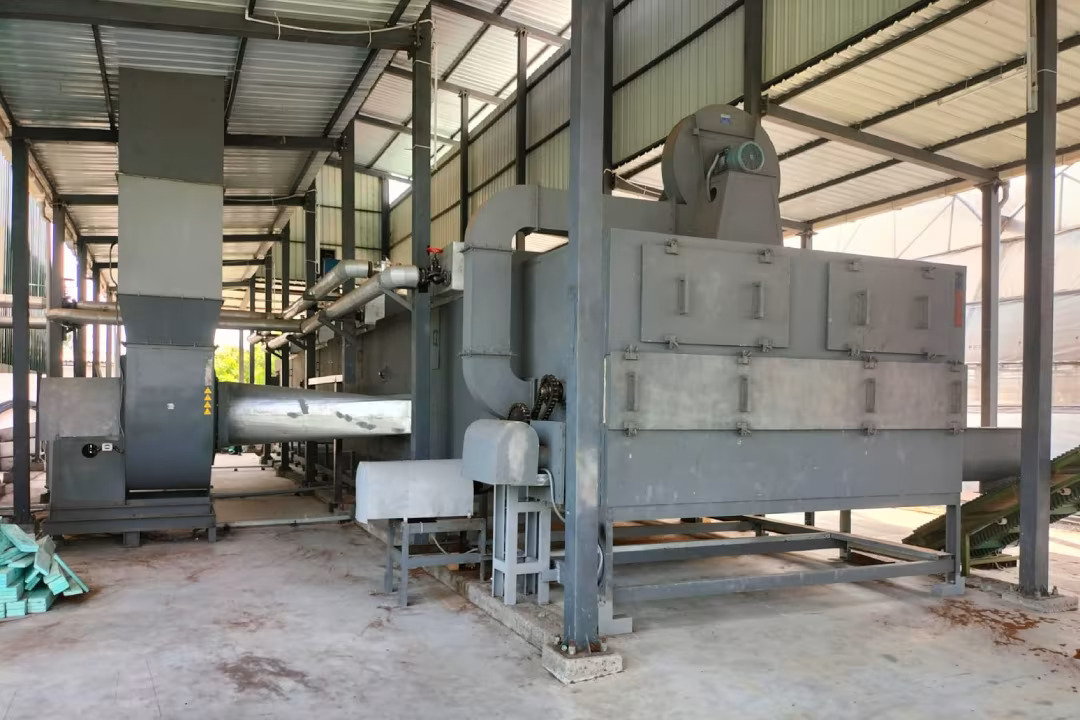
Up to 35% of retted coir fiber shipments fail moisture specification at port inspection each year. Elevated fiber moisture above 15% triggers thermophilic bacterial activity inside bales, generating heat that degrades cellulose bonds from the core outward. Export rejections, demurrage charges, and reprocessing costs eliminate margin before a single product reaches the buyer. Purpose-engineered coconut coir fiber drying systems eliminate this failure point at source, converting wet retted fiber into export-ready, bale-stable product within a single continuous process pass.
Why Fiber Moisture Above 15% Destroys Processing Economics
Freshly retted coir fiber enters the drying stage carrying between 30% and 60% moisture by wet weight, depending on whether water retting or dry retting was employed. Removing this moisture is not simply an evaporation task, the tangled, low-density fiber mass creates significant airflow resistance that causes uneven drying zones within static-bed equipment. A coir fiber dryer engineered without fiber-specific airflow modeling will consistently over-dry surface fiber while leaving core moisture above the critical 15% threshold.
Bale heating is the direct consequence of residual core moisture. Thermophilic organisms activate above 40°C internal bale temperature and degrade fiber length and tensile strength within 72 hours of packing. A mattress fiber producer in Tamil Nadu, India, operating a conventional static-bed system at 120°C inlet temperature and 800 kg/hr throughput recorded 28% batch rejection over a six-month export cycle before switching to a purpose-built industrial coir fiber dryer with modeled airflow distribution. Rejection fell to under 4% within the first quarter of operation.
Benchmark comparison confirms the scale of the problem: industry surveys of coir mills using unengineered drying equipment report average throughput efficiency of 61%, compared to 89% for mills using dedicated coconut coir fiber drying systems with monitored moisture exit sensors. That 28-percentage-point gap translates directly into labor, fuel, and capital waste per processed tonne.
How Rotary Drum Dryers Achieve Uniform Moisture Extraction at Scale
Rotary drum dryers solve the airflow resistance problem through continuous tumbling. As the inclined cylinder rotates, fiber masses break apart and re-form in a cascading pattern, exposing fresh fiber surface area to the heated airstream during every rotation cycle. Thermal contact is continuous rather than static, and co-current or counter-current airflow configurations allow precise thermal profiling matched to fiber grade and inlet moisture content.
Operating temperatures in rotary drum configurations typically range from 80°C to 220°C at the inlet zone, stepping down to 50°C to 70°C at the discharge end to prevent over-drying surface fiber. A geotextile coir mat manufacturer in Kerala, India, installed a rotary drum coconut fiber drying machine rated at 2,500 kg/hr with a 45 kW burner system and achieved consistent exit moisture of 8.5% across all fiber grades within three weeks of commissioning. Pre-installation exit moisture had varied between 11% and 19% on the same raw material input.
The operational trade-off with rotary drums is relevant to specify honestly: fiber tumbling at high throughput rates causes measurable shortening of long-staple fiber grades above 20 cm. Mills producing premium long-fiber products for automotive composite reinforcement must evaluate this against throughput gains. Belt dryer configurations address this specific limitation.
How Belt Dryers Protect Long-Fiber Grade Quality for Automotive Applications
Belt dryers eliminate tumbling entirely. Fiber loads spread across perforated stainless steel belts, and temperature-controlled air passes upward or downward through the fiber layer at controlled velocity, achieving moisture extraction without mechanical fiber-to-fiber abrasion. For automotive composite manufacturers sourcing long-staple coir fiber as natural reinforcement in door panels and trunk liners, fiber length preservation above 25 cm is a specified supply condition, not a preference.
A coconut coir fiber drying system configured as a multi-pass belt dryer, operating at 60°C to 130°C across three belt zones, delivers exit moisture below 10% while maintaining fiber length integrity to within 3% of inlet length measurement. An automotive composite supplier in Pune, India, sourcing coir for natural fiber-reinforced polypropylene panels specified a 5-zone belt dryer at 1,200 kg/hr capacity and recorded a fiber length retention rate of 96% against a 78% benchmark from prior rotary drum processing. Tensile strength measured at 32 MPa post-drying against a pre-installation baseline of 27 MPa.
Belt dryers carry a higher capital cost per unit throughput than rotary drum equipment — typically 20% to 35% more per installed kilowatt of thermal capacity. Mills must evaluate fiber quality premium pricing against this capital differential before specifying configuration.
How Energy Efficiency Engineering Reduces Fuel Cost Per Tonne Dried
Fuel is the dominant variable cost in coir fiber drying, accounting for between 40% and 65% of per-tonne processing cost in biomass-fired or LPG-fired installations. Heat recovery systems that recirculate exhaust air back through the drying chamber reduce fresh air heating demand by 25% to 40%, directly cutting fuel consumption per tonne processed. An industrial coir fiber dryer equipped with exhaust air recirculation achieves measurable payback on the added capital cost within 14 to 22 months at continuous two-shift operation.
Heat pump dryer configurations extend these savings further. Operating at drying temperatures between 40°C and 75°C, heat pump coconut fiber drying machines consume up to 60% less energy per kilogram of moisture removed compared to direct-fired systems at equivalent throughput. A copra and coir co-processing facility in Sulawesi, Indonesia, installed a 500 kg/hr heat pump coir fiber dryer with 18 kW compressor power and cut drying energy cost from USD 12.40 per tonne to USD 5.10 per tonne within the first operating year. The system paid back its capital premium in 18 months.
Power consumption ranges from 1.5 kW for small-batch pilot systems to 75 kW for high-volume continuous installations, giving procurement engineers a wide specification range matched to mill output scale and available power infrastructure.
How System Integration and Automation Sustain Consistent Output Quality
Manual moisture monitoring introduces a critical single point of failure. An operator checking exit fiber moisture at two-hour intervals allows 120 minutes of out-of-specification product to accumulate before corrective action begins. Inline near-infrared moisture sensors, integrated with variable-speed airflow controls and burner modulation, hold exit moisture within ±0.5% of target continuously, eliminating accumulation of off-specification fiber in the output stream.
A coir fiber export company in Sri Lanka processing 3,000 kg/hr across two production shifts installed a fully automated coconut coir fiber drying system with PLC-based moisture control and recorded a reduction in moisture non-conformance events from 23 per month to fewer than 2 per month within 90 days of commissioning. Bale rejection at destination ports dropped from 17% to 2.1% over the same period. Automation also generated a 9% reduction in fuel consumption by eliminating operator-driven over-drying as a precautionary practice.
Comments
Log in or sign up to join the conversation.